tool_score: 4.2
Funraise pitches itself as the modern alternative to clunky legacy fundraising software, and on first impression it looks the part. The real question for a nonprofit is whether the modern polish translates into raised dollars and whether the setup effort pays off. This review digs into both.
Faz’s First Take
What I like about Funraise is that it actually feels modern, which sounds trivial until you have used the dated interfaces that dominate this sector. The donation forms are clean, the campaign tools are contemporary, and the peer-to-peer experience is built for how people actually fundraise online today. The company also reports that P2P fundraisers on the platform raise meaningfully more than industry averages, which is the kind of outcome claim that matters.
The honest tension is setup. More than one reviewer notes that getting Funraise configured can be more involved than expected, and there are occasional glitches. And while it is affordable next to enterprise tools, the smallest orgs may still feel the price. Funraise is a strong modern platform that rewards organizations willing to invest in proper setup.
Last updated: June 1, 2026.
Related: See also: Best AI tools for nonprofits 2026 | Best AI fundraising tools for nonprofits
What Funraise Does
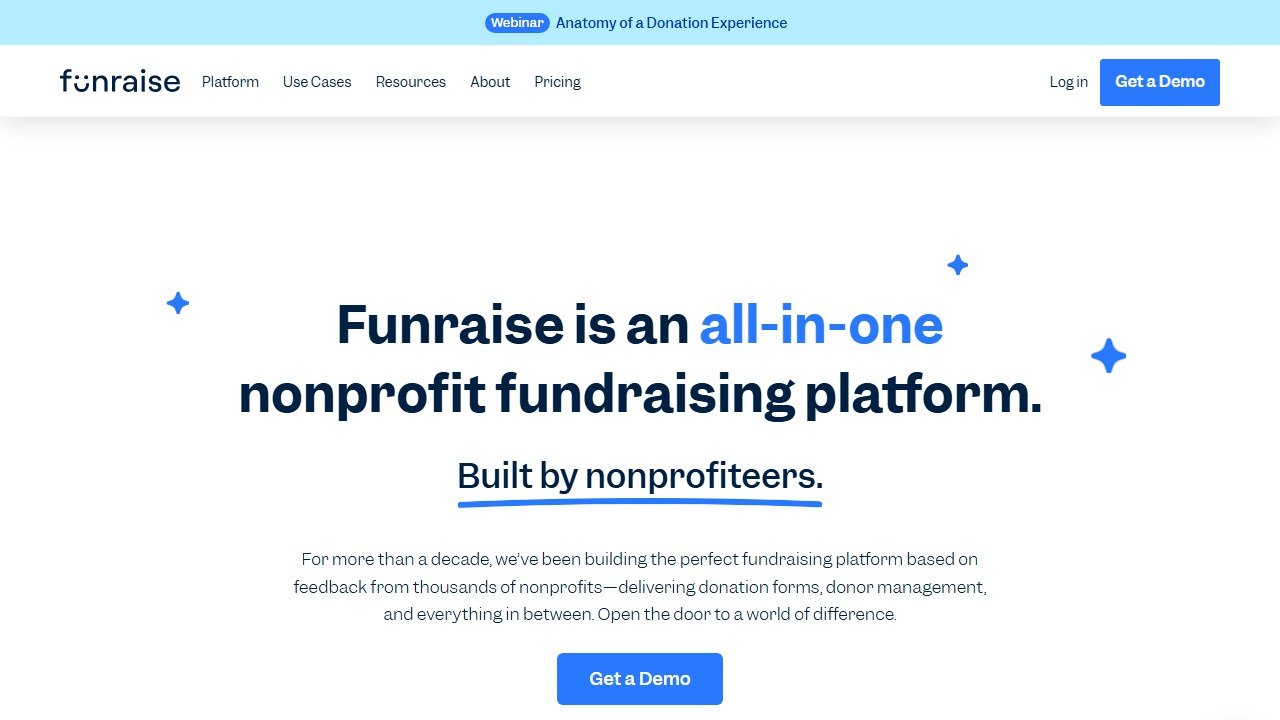
Website: Funraise
Funraise is a cloud-based, all-in-one fundraising platform built for nonprofits that want modern tools without enterprise complexity. It brings together customizable donation forms, campaign websites, peer-to-peer fundraising, recurring giving, event registration and ticketing, donor management, and reporting in one connected system.
The platform’s positioning is contemporary fundraising done well. Where legacy tools feel dated, Funraise emphasizes clean, conversion-minded donation experiences and modern campaign tools. It enables nonprofits to create branded forms, automate donor communications, and track contributions in real time, with the goal of improving both fundraising efficiency and donor retention.
Peer-to-peer is a particular strength. Funraise reports that peer-to-peer fundraisers using the platform raise about twice the industry average, a claim that reflects its focus on engaging, modern P2P experiences. Combined with recurring giving tools, the platform leans into the two channels that drive sustainable nonprofit revenue.
Funraise has also layered in AI features intended to boost fundraising impact, positioning itself as a modern platform that adds helpful intelligence on top of strong fundamentals rather than as an AI-first product. For organizations that want a forward-looking tool without betting everything on AI, that balance is sensible.
Key Features
Donation Forms and Campaign Websites
Funraise’s donation forms are a highlight: clean, customizable, and designed to convert, with support for suggested amounts, recurring options, and branding. The platform also lets organizations build campaign websites and landing pages, so a campaign can have a cohesive, professional presence without separate web development.
Peer-to-Peer Fundraising
Peer-to-peer is where Funraise differentiates. The tools support individual and team fundraiser pages with a modern, engaging experience, and the platform’s reported results (P2P fundraisers raising about twice the industry average) point to genuine effectiveness. For organizations whose supporters fundraise on their behalf, this is a core reason to choose Funraise.
Recurring Giving
Sustainable revenue comes from recurring donors, and Funraise builds recurring giving into the core experience, making it easy for donors to set up and manage ongoing gifts. Strong recurring tools, paired with donor management, help organizations grow the predictable revenue base that underpins long-term stability.
Events and Ticketing
Funraise includes event and ticketing tools so organizations can run fundraising events within the same platform, with registration and attendee data tied to donor records. This rounds out the all-in-one proposition, letting events feed the same donor database as online giving and P2P.
Reporting and AI
The platform provides comprehensive reporting with insight into campaign performance, donor behavior, and overall progress, which reviewers cite as a strength. Funraise’s AI features add automation and intelligence intended to lift fundraising results, and the company is noted for continuous updates and feature enhancements that keep the platform evolving.
Pricing Breakdown
| Aspect | Detail | Notes |
|---|---|---|
| Model | Subscription | Tailored to organization size and needs |
| Payment processing | Standard rates | On top of subscription |
| Positioning | Affordable vs enterprise | Reviewers note no high base prices like some rivals |
| Smallest orgs | Cost a consideration | May stretch the tightest budgets |
Funraise uses a tailored subscription model rather than a single public price, with payment processing on top. Reviewers generally find it affordable relative to enterprise platforms, while noting the smallest organizations should weigh the cost carefully. Get a quote matched to your size and channels.
Saru’s Pricing Analysis
Funraise positions between free or pay-as-you-go tools and full enterprise platforms. For context:
• Givebutter: free platform, the budget floor
• Donorbox: pay-as-you-go fees
• Funraise: tailored subscription, mid-market modern platform
• Classy (GoFundMe Pro): no published price, an annual subscription plus a per-donation fee, enterprise
Funraise’s value case is modern, effective tooling, especially for P2P and recurring giving, at a price below enterprise. If those channels drive your revenue, the reported P2P outperformance can more than cover the cost. The honest test: if peer-to-peer and recurring giving are central to your strategy, Funraise earns its subscription. If you only need a basic donation form, a free or pay-as-you-go tool is more proportionate.
Who This Is For
Funraise is well-suited for:
Small to mid-sized nonprofits wanting a modern platform. If dated software frustrates your team and donors, Funraise’s contemporary experience is a real upgrade.
Organizations focused on peer-to-peer and recurring giving. These are Funraise’s strengths, and the reported P2P outperformance makes it especially attractive for supporter-driven fundraising.
Teams without dedicated IT. Once set up, the platform is designed to be usable by non-technical staff, with support reviewers praise.
Growth-minded orgs that value continuous improvement. Funraise’s steady feature updates and AI additions suit organizations that want a platform that keeps evolving.
Funraise is not well-suited for:
The smallest, most budget-constrained organizations. If a free tool covers your needs, the subscription may be more than necessary. Givebutter (reviewed here) is the budget alternative.
Teams needing instant, no-setup launch. Reviewers note configuration can take real time, so it is not the fastest tool to go live on.
Organizations needing a deep, dedicated CRM. Funraise includes donor management, but CRM-first organizations may prefer a platform like Neon CRM or Virtuous (reviewed here).
Teams with zero tolerance for occasional bugs. Some reviewers report intermittent glitches, so mission-critical reliability seekers should test thoroughly first.
Pros
- Genuinely modern experience: clean, contemporary donation forms and campaign tools that stand out in a dated sector.
- Strong peer-to-peer fundraising: reported P2P outperformance of roughly twice the industry average.
- Solid recurring giving: built-in tools to grow the sustainable revenue base.
- Comprehensive reporting: useful insight into campaigns, donor behavior, and progress.
- Growing AI features: automation and intelligence layered on strong fundamentals, with continuous updates.
- Praised usability and support: approachable for non-technical teams once configured.
Cons
- Setup can be complicated: initial configuration may take more time and effort than expected.
- Occasional bugs: some reviewers report intermittent technical glitches.
- Cost for the smallest orgs: affordable versus enterprise, but still a consideration for the tightest budgets.
- Not the deepest CRM: donor management is included but secondary to fundraising tools.
- AI is additive, not central: helpful, but not an AI-first engine if that is your priority.
- Tailored pricing: no single public price means you need a quote to compare.
Faz’s Honest Verdict
My litmus test for Funraise: are peer-to-peer and recurring giving central to your fundraising, and do you want a modern platform that does not feel like it was built a decade ago? If yes, Funraise is a strong choice, and the reported P2P outperformance is the kind of result that pays for the subscription.
Go in prepared to invest in setup, because the polish on the front end is matched by real configuration work behind it, and test thoroughly for the occasional glitch. If you are tiny and a free tool covers you, Funraise may be more than you need. But for a growth-minded small or mid-sized org leaning into modern fundraising channels, it is a smart, contemporary pick that keeps getting better.
Final Verdict
Funraise earns a 4.2/5. It is a modern, user-friendly, all-in-one fundraising platform whose strengths in peer-to-peer, recurring giving, and reporting, plus a growing AI layer, make it a compelling choice for small and mid-sized nonprofits leaning into contemporary fundraising.
The score reflects honest trade-offs: setup can be more involved than expected, some reviewers report occasional bugs, and the smallest organizations should weigh the cost. Donor management is present but secondary to the fundraising tools.
But for an organization whose revenue depends on peer-to-peer and recurring giving and that wants a platform built for how fundraising actually works today, Funraise delivers modern tools and real results. Matched to that profile, it is a strong pick in 2026.
For the broader nonprofit fundraising landscape, see the best AI fundraising tools for nonprofits guide and the best AI tools for nonprofits pillar.
Rating: 4.2/5
Saru’s Data Verdict
Funraise’s review data is positive and consistent: praise for the modern interface, usability, support, and especially peer-to-peer results, balanced by criticism of setup complexity and occasional glitches. That is the profile of a strong, evolving platform that prioritizes a great front-end experience and is still smoothing operational edges.
The verdict follows the data. Funraise is a buy when modern P2P and recurring giving are central and you will invest in setup, and a pass when you need a free tool or a deep dedicated CRM. The reported P2P outperformance is the differentiator a feature list does not capture.
Rating: 4.2/5
References & further reading
For deeper data and primary sources on nonprofit fundraising:
- Candid (Foundation Center + GuideStar). authoritative nonprofit financial and grant data
- M+R Benchmarks Study. annual fundraising performance benchmarks across channels
- Nonprofit Quarterly. reporting on nonprofit operations, governance, and fundraising
Tools mentioned in this review
How event and auction platforms price, and the lines that get missed
Event software is priced unlike the rest of nonprofit technology, because the value arrives on one night a year. That shapes both the contract and the risk, and Funraise is no exception.
Annual licence against pay as you go
The two shapes in this market are an annual subscription with transaction fees folded in, or a lower entry with a percentage taken per transaction. GiveSmart publishes both models, which is unusually transparent: an annual plan with no per-transaction fees, or a pay as you go option that is “$0 to get started” and charges only as you raise. OneCause publishes figures too, though they sit inside collapsed FAQ panels rather than on the cards, which is why several comparison articles report it as quote only.
The hardware nobody budgets
Card readers, kiosks, tablets and printers are usually separate from the software and often rented per event. Ask for the full equipment list for an event your size, ask whether it is rental or purchase, and ask what shipping costs and when it must be returned. This line routinely adds a four figure sum to an event budget and it appears in no pricing comparison we have seen.
Staffing on the night, which is the real differentiator
On-site support is where these vendors genuinely differ and where the money quietly goes. Ask exactly what is included: how many people, for how many hours, whether setup and teardown count, and what happens if the event overruns. Then ask what the same support costs if you add it later, because adding it in the week of the event is not a negotiation you will win.
What the platform costs the other eleven months
An annual licence bought for one gala is being paid for during a lot of quiet months. That is fine if the platform also runs your year-round giving, and poor value if it does not. Look at whether the tool is genuinely your donation platform or a seasonal rental, and price it against a general giving platform if the answer is the latter. Verified 4 September 2026: Givebutter charges the organisation 0% with donor tips enabled and a flat 3% without, and Donorbox runs a free plan at 2.95% to 3.95%.
Get the renewal capped before the event, not after
Your leverage is highest before you have run an event on the platform and lowest immediately after, when the data, the guest records and the institutional habit all live inside it. Agree the renewal uplift in the first contract. It is the cheapest thing you will ever negotiate and it is invisible until the year it matters.
Payment processing, the line that usually costs more than the software
Almost every comparison of Funraise against its rivals stops at the subscription. For most nonprofits the larger number is what comes off each donation, and it is metered on the one thing you are trying to grow.
The arithmetic that decides this
A single percentage point on $500,000 raised online is $5,000 a year. That is more than the entire annual subscription to several nonprofit CRMs. So a platform that is $600 a year cheaper but takes half a point more of your online giving is not cheaper at any organisation raising more than $120,000 online, and the crossover point moves against you every year you grow.
Two different models, and they are not comparable
Some platforms charge a subscription and take nothing from donations, leaving you to hold a processor relationship directly. Little Green Light states plainly that it takes nothing from your donations. Others bundle processing into the platform, which is simpler to run and structurally more expensive at volume. GoFundMe Pro, formerly Classy, publishes that its model is an annual subscription plus a transaction fee per donation, and that second half is the part that scales.
Ask for the effective rate, not the headline rate
Processing quotes are usually given as a percentage plus a fixed amount per transaction, and the fixed component dominates at small gift sizes. On a $20 donation, 30 cents is another 1.5% on top of whatever percentage was quoted. If your median online gift is small, and for most community organisations it is, your effective rate is materially higher than the number on the page. Work it out on your own median gift before comparing anything.
Covered fees change the picture and are worth asking about
Where a platform offers donors the option to cover processing fees, take-up is the variable that decides your real cost, and it varies enormously by audience and by how the prompt is worded. Ask any vendor quoting you a bundled rate what their observed cover rate is across comparable organisations, and treat a refusal to answer as information. A model that looks expensive at 0% cover can be the cheapest option at 60%.
Get processing out of the subscription line in every quote
Insist that every vendor states processing separately from the platform fee, with the percentage, the fixed per-transaction amount, and whether ACH and card are priced differently. A blended annual figure hides exactly the line that grows with your success, and it is the single most common reason a nonprofit software budget is wrong in year two.
Where the figures on this page come from
Every price quoted here was read from the vendor’s own pricing page on 4 September 2026, not from an aggregator or a review site. That distinction matters more in this category than in most, because nonprofit software pricing changed materially over the past year and a great deal of what circulates online describes packaging that no longer exists.
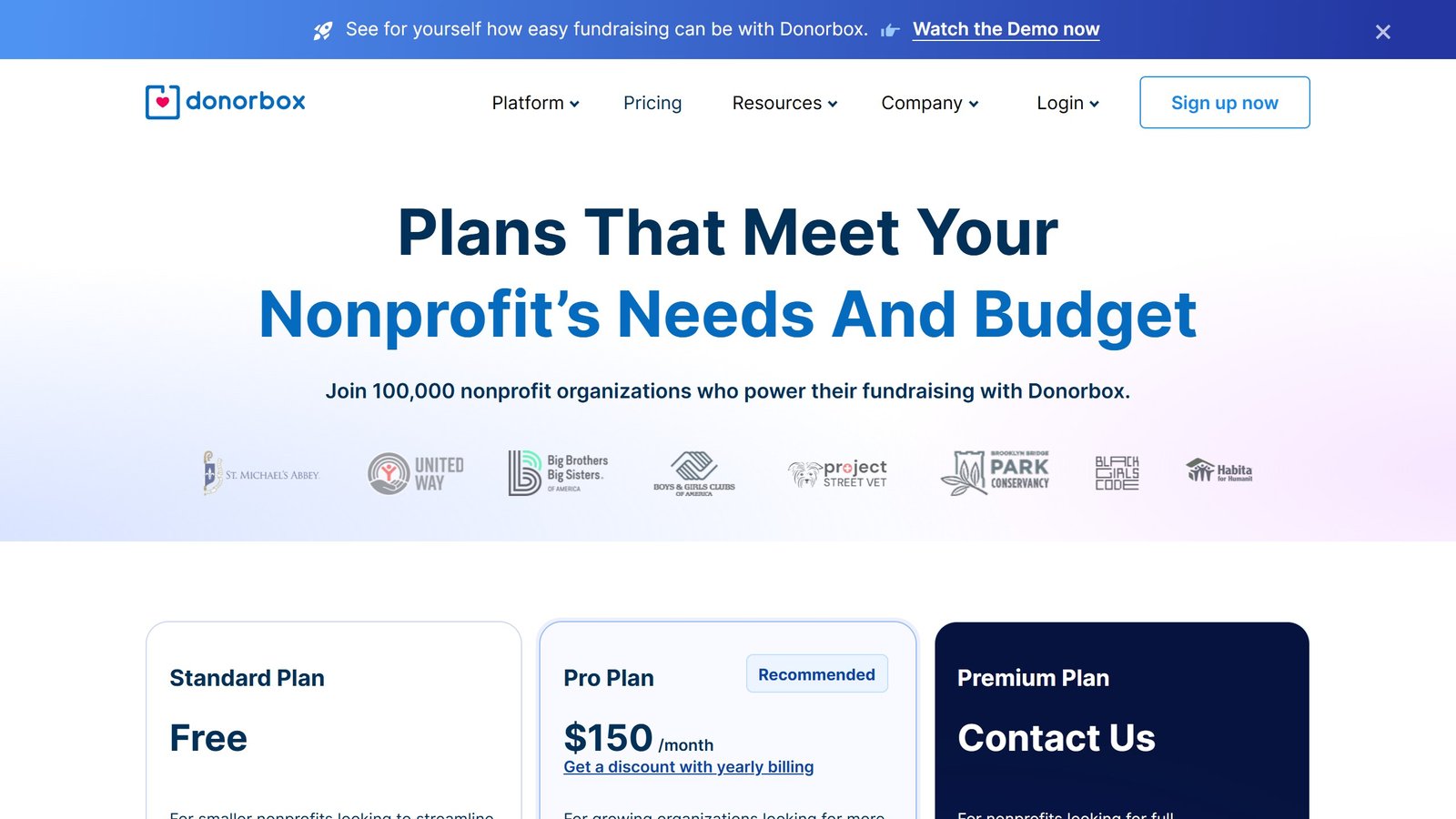
The pages we read
Little Green Light publishes every constituent band from $45 a month. Salesforce Nonprofit Cloud publishes $70 per user per month (as of 4 October 2026) with ten licences free under Power of Us. Bloomerang publishes $125 a month for the CRM with other products priced separately. Keela publishes every contact band from $164 a month. Dataro publishes $15,000 a year plus ten cents per active donor on a page that is not linked from its own navigation. Blackbaud and Virtuous publish no figures at all.
What we do not do
We do not carry a figure we cannot source to the vendor. Where a number circulates widely and cannot be traced to a vendor page, we say so and withdraw it rather than repeating it with a hedge, and we have withdrawn our own published figures on that basis more than once. Where a vendor confirms an unpublished price directly to us, it is attributed as confirmed by the company rather than presented as a public rate.
Why every figure carries a date
Keela raised every band by roughly 15 to 22% in under two weeks in late August 2026. Neon retired an entire tier structure. A pricing claim without a verification date is not checkable, and in this market it is usually wrong within a year.

Written by
FazFaz is the founder of AIToolsBakery. Some tools here are tested hands on. Others are assessed from vendor documentation and pricing verified on the live page, and every review says which one it is. Sponsors can buy a position in a guide. They cannot buy the score, the criticism, or silence about a better option.
How we test and how we make money →