tool_score: 4.2
Classy has long been the platform serious, large nonprofits reach for when their fundraising gets complicated. Now that GoFundMe owns it and has rebranded it GoFundMe Pro, the question is sharper than ever: who is this powerful, pricey platform actually right for? This review answers that honestly.
Faz’s First Take
Classy is a genuinely powerful platform, and the GoFundMe acquisition gives it something no competitor has: the scale and reach of the worlds largest fundraising network behind it. For a large nonprofit running complex campaigns across donation pages, peer-to-peer, events, and recurring giving, that combination of power and reach is compelling.
The honest tension is that all that power comes with enterprise cost and enterprise complexity. With a subscription paid annually up front, a fee on every donation, and onboarding measured in weeks, Classy is emphatically not a small-org tool. The skill in evaluating it is being honest about whether your fundraising is complex enough to need it. For the right organization, it is excellent. For the wrong one, it is an expensive, over-engineered choice.
Last updated: June 1, 2026.
Related: See also: Best AI tools for nonprofits 2026 | Best AI fundraising tools for nonprofits
What Classy Does
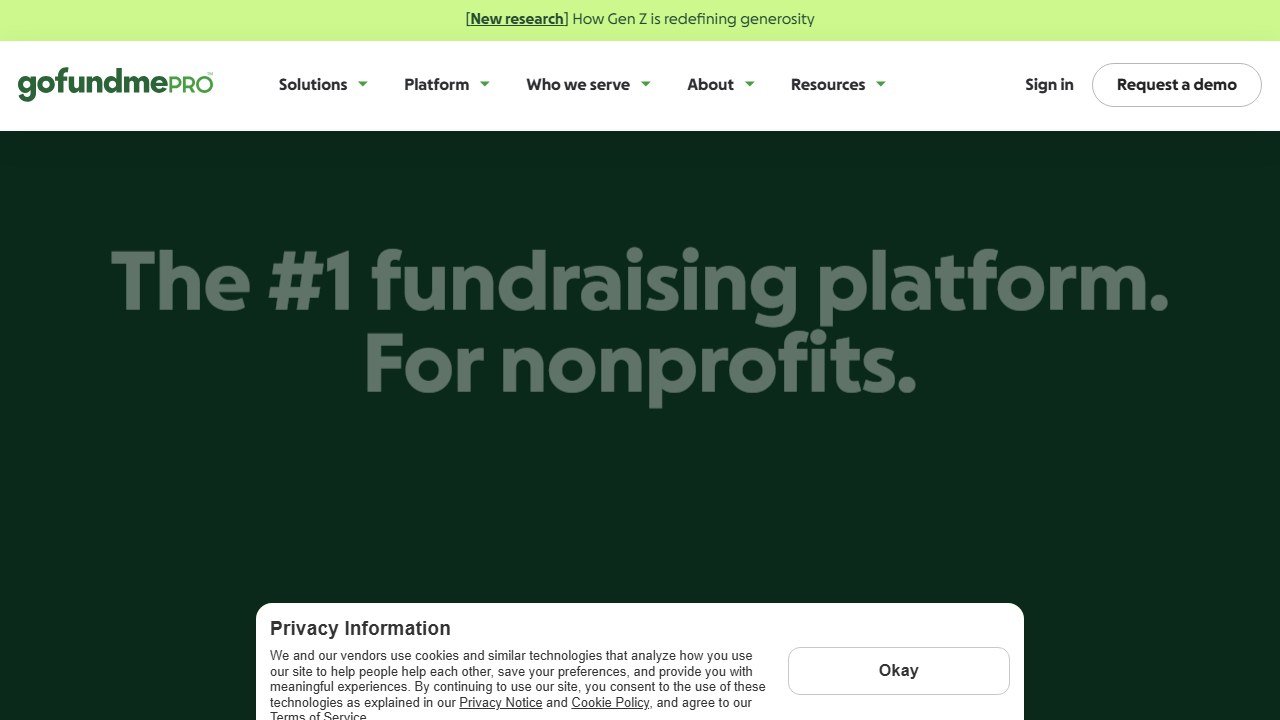
Website: Classy (GoFundMe Pro)
Classy, now operating as GoFundMe Pro, is an enterprise-grade fundraising platform for nonprofits. It brings together the full range of digital fundraising channels: customizable online donation pages, peer-to-peer fundraising, crowdfunding campaigns, recurring giving programs, and event registration and ticketing, all in one connected system.
The platform is built for complexity. Where simpler tools handle a donation form and a basic campaign, Classy is designed for organizations running many concurrent campaigns across multiple channels, with branded experiences, sophisticated peer-to-peer team hierarchies, and large-scale events. The reporting and data tools are correspondingly deep, aimed at development teams that need to analyze performance across a broad fundraising program.
The GoFundMe acquisition is the defining recent development. Rebranded GoFundMe Pro, the platform now sits inside the ecosystem of the worlds largest fundraising network. For nonprofits, the pitch is flexible professional software backed by the scale, brand recognition, and donor reach of GoFundMe, a combination no standalone competitor can match.
Reviewers consistently praise two things: the breadth of what the platform can do, and the quality of customer support, with help often arriving almost instantly through chat. The recurring criticism is equally consistent: it is expensive, and it is complex to set up. Both are the natural consequences of an enterprise tool built for sophisticated organizations.
Key Features
Multi-Channel Campaigns
Classy’s core strength is running many fundraising channels in one place. Online donation pages, peer-to-peer campaigns, crowdfunding, and recurring giving all live in the same system, with shared donor data and unified reporting. For an organization running a year-round program with overlapping campaigns, this consolidation is the main reason to choose Classy.
Peer-to-Peer Fundraising
Classy’s peer-to-peer tools are built for scale, supporting team hierarchies, individual fundraiser pages, and large coordinated campaigns. This is where the platform’s enterprise orientation shows: setting up sophisticated P2P structures is powerful but takes configuration effort, which pays off for large, recurring campaigns and is overkill for a one-off.
Events and Registration
Event registration and ticketing are integrated, supporting galas, runs, walks, and hybrid events with attendee management tied to donor records. Combined with peer-to-peer, Classy is well-suited to the large event-plus-fundraising campaigns that big nonprofits run, the kind that combine ticket sales, sponsorships, and participant fundraising.
Branded Donation Experiences
The platform lets organizations build highly branded, customizable campaign and donation experiences. This control over look and feel matters for established brands that need fundraising pages to match their identity, and it is a step beyond the simpler, more templated forms of entry-level tools. The trade-off is that building these experiences takes time and skill.
Reporting and Integrations
Classy provides deep reporting across campaigns and channels, and integrates with major CRMs (including Salesforce) and marketing tools so it can serve as the fundraising engine within a larger tech stack. For enterprise organizations, the ability to connect Classy to an existing CRM is often essential.
Pricing Breakdown
| Aspect | Detail | Notes |
|---|---|---|
| Published price | None | No currency figure appears anywhere on the pricing page |
| Subscription | Annual, paid up front | A fixed cost that does not fall if you raise less than forecast |
| Platform fees | Per donation | Rate not published, applied on top of the subscription |
| Paid add-ons | Live Events, Salesforce integration | Both marked on the pricing page as costing extra, neither priced |
Classy’s pricing does not just require a sales conversation, it requires your tax identification before the conversation starts. The pricing page is a two-step form asking for your country and then your nonprofit’s legal name or EIN, which lets the vendor look up your revenue before quoting you.
The structure is the part worth planning around. An annual subscription paid up front is a fixed cost that does not fall if your campaigns underperform, which is a materially different risk profile from a pure percentage-of-donations platform. The comparison the same company makes easy: consumer GoFundMe publishes its fee openly as 2.9% plus $0.30 per donation with no cost to create a fundraiser, while the paid nonprofit product asks for an EIN. Full breakdown on the Classy pricing page.
Saru’s Pricing Analysis
With an undisclosed annual subscription plus a fee on every donation, Classy is among the most expensive options in nonprofit fundraising, and the least transparent about it. For context:
• Givebutter: free platform, optional tips, the opposite end of the spectrum
• Donorbox: pay-as-you-go fees, no enterprise base
• Funraise: subscription, mid-market, more affordable
• Fundraise Up: conversion-focused, premium but transaction-based
Classy’s price is justified only by scale and complexity. If you run sophisticated, high-volume, multi-channel campaigns and large events, the platform’s power and the GoFundMe network reach can return the investment. If your fundraising is simpler, you are paying enterprise prices for capacity you will not use. The honest test: count your concurrent campaigns and channels. Many, across multiple types, Classy makes sense. A handful, look at a mid-market or free tool.
Who This Is For
Classy (GoFundMe Pro) is well-suited for:
Larger nonprofits with complex, multi-channel fundraising. If you run concurrent campaigns across donation pages, peer-to-peer, crowdfunding, and events, Classy’s consolidation and depth are a real advantage.
Organizations running large-scale events. The combination of event registration and peer-to-peer suits galas, runs, walks, and hybrid events at scale.
Established brands that need control. Highly branded, customizable donation experiences matter for organizations with strong identities and marketing standards.
Teams that want GoFundMe network reach. The acquisition adds the scale and donor reach of the worlds largest fundraising network behind a professional platform.
Classy is not well-suited for:
Small and midsize nonprofits. An annual subscription paid up front, platform fees on every donation, and onboarding complexity are disproportionate. Givebutter (reviewed here) or Donorbox (reviewed here) fit far better.
Organizations needing to launch fast. Building branded campaigns, P2P hierarchies, and integrations takes weeks, not hours.
Teams primarily needing a CRM. Classy is a fundraising platform, not a full donor CRM. Pair it with a CRM, or choose a CRM-first tool if records and relationships are the priority.
Budget-sensitive orgs wary of fees. The per-transaction platform fees on top of subscription can add up, which matters for cost-conscious organizations.
Pros
- Powerful multi-channel platform: donation pages, peer-to-peer, crowdfunding, recurring, and events in one connected system.
- Enterprise-grade peer-to-peer and events: built for large, sophisticated campaigns and big event fundraising.
- Excellent customer support: consistently praised, with fast, helpful chat support.
- GoFundMe network reach: the acquisition pairs professional software with the scale of the worlds largest fundraising network.
- Highly branded experiences: deep customization for organizations with strong brand requirements.
- Strong integrations: connects to major CRMs like Salesforce to serve as the fundraising engine in a larger stack.
Cons
- No published price: an annual subscription paid up front plus a fee on every donation, with no figure available until you have handed over your EIN.
- Per-transaction platform fees: added on top of subscription, raising the effective cost.
- Complex onboarding: branded campaigns, P2P hierarchies, and integrations take weeks to configure and train on.
- Overkill for simple fundraising: the power is wasted on organizations with straightforward needs.
- Rebrand transition: the shift from Classy to GoFundMe Pro can create short-term naming and positioning confusion.
- Not a full CRM: a fundraising platform that you typically pair with a separate donor CRM.
Faz’s Honest Verdict
My litmus test for Classy is blunt: are you a large nonprofit running genuinely complex, multi-channel campaigns and big events? If yes, Classy (now GoFundMe Pro) is one of the strongest platforms you can choose, and the GoFundMe network reach is a real bonus no competitor matches. The power and support justify the price at that scale.
If you are small or midsize, or your fundraising is straightforward, this is the wrong tool, full stop. You would pay enterprise prices and onboarding pain for capacity you will not touch. There is no shame in being too small for Classy. Most nonprofits are, and they have better-fitting, cheaper options. Buy Classy when your complexity has outgrown everything else, not before.
Final Verdict
Classy, now GoFundMe Pro, earns a 4.2/5. It is a powerful, enterprise-grade fundraising platform whose breadth, peer-to-peer depth, event tools, and newly added GoFundMe network reach make it a leading choice for large nonprofits with complex, multi-channel programs.
The score reflects real constraints: high pricing, per-transaction platform fees, and onboarding complexity that put it out of reach for small and midsize organizations, plus the short-term friction of a rebrand. It is also a fundraising platform rather than a full CRM.
But for the large organization whose fundraising has genuinely outgrown simpler tools, Classy delivers power, polish, support, and reach that justify its cost. Matched to the right scale, it is an excellent platform in 2026.
For the broader nonprofit fundraising landscape, see the best AI fundraising tools for nonprofits guide and the best AI tools for nonprofits pillar.
Rating: 4.2/5
Saru’s Data Verdict
Classy’s review data is bimodal in a telling way: strong praise for power, breadth, and support from larger organizations, and pointed criticism of cost and complexity from smaller ones. That split is not a contradiction, it is the signature of an enterprise tool being evaluated by organizations of very different sizes.
The verdict follows the data. Classy is a buy for large, complex operations and a pass for small and midsize ones, almost regardless of feature preferences. The GoFundMe network reach is the new variable that strengthens the case at the top of the market.
Rating: 4.2/5
References & further reading
For deeper data and primary sources on nonprofit fundraising:
- Candid (Foundation Center + GuideStar). authoritative nonprofit financial and grant data
- M+R Benchmarks Study. annual fundraising performance benchmarks across channels
- Nonprofit Quarterly. reporting on nonprofit operations, governance, and fundraising
Tools mentioned in this review
What the rest of the giving platforms charge, and what they meter on
Every platform here takes a cut of donations, which means the bill grows with the thing you are trying to grow. What separates them is where the cut sits and who is asked to pay it. Here is each alternative to GoFundMe Pro, read from its own pricing page on 4 September 2026.
Donorbox, free to start, and the fee falls as you pay more
Donorbox publishes the clearest ladder in the category. Standard is free with a platform fee of 2.95% to 3.95%. Pro is $150 a month and drops the fee to 1.75% to 2%. Premium is quote only at 1.6% to 2%. Because the subscription buys a lower rate, there is a crossover volume below which paying is a loss: on $100,000 raised the fee saving is roughly $1,575 against an $1,800 subscription, so the free plan wins. On $200,000 the same shift is a clear gain. Work out your own crossover before upgrading, because the sales conversation will not.
Givebutter, 0% if your donors tip, 3% if they do not
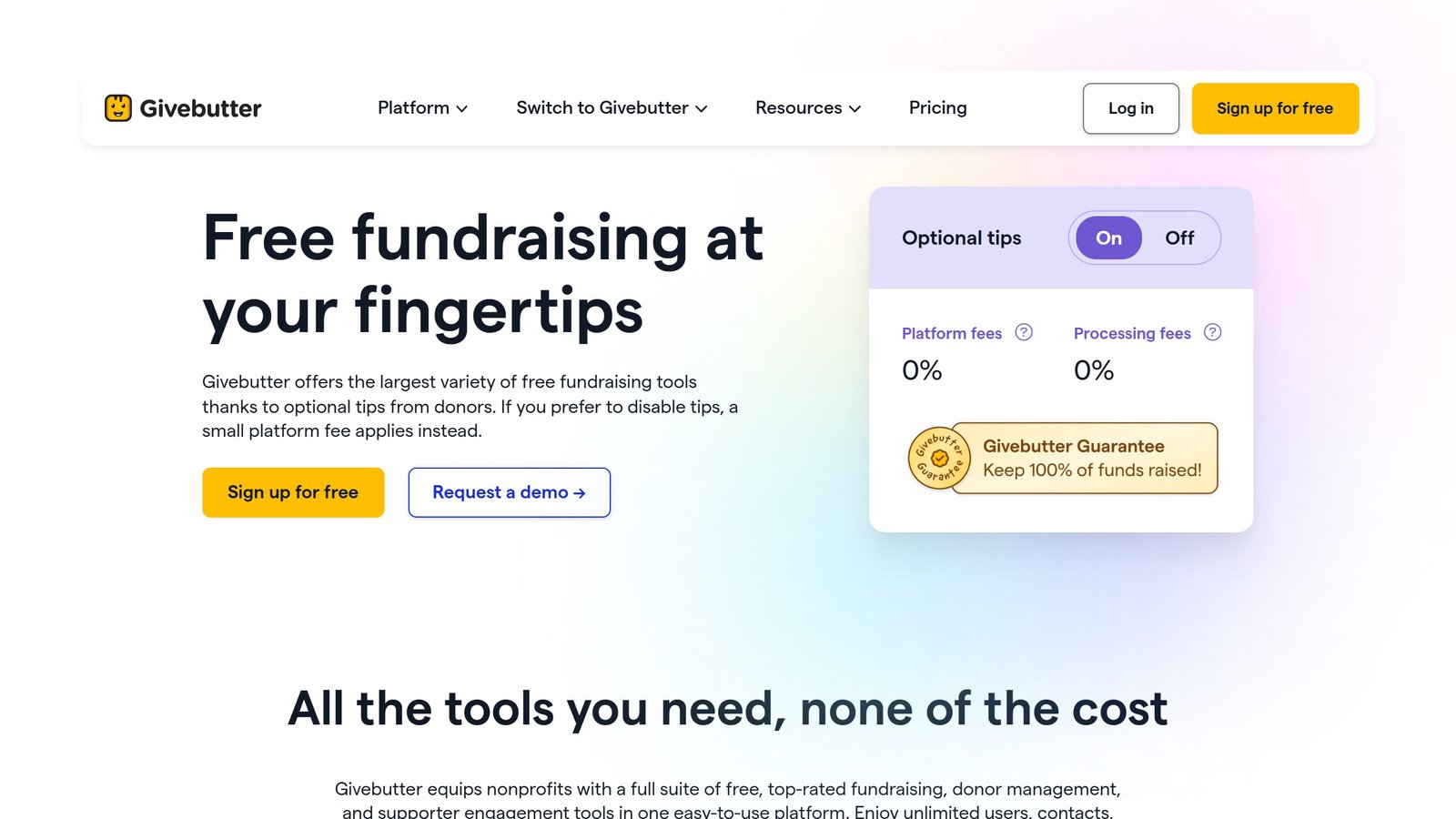
Givebutter charges no platform fee at all when donor tips are enabled, and a flat 3% when they are switched off. Its paid tier, Plus, starts at $29 a month or $348 a year. The model is genuinely free to the organisation, but it is not free in the room: the form suggests a tip by default, so a supporter giving $100 can be charged noticeably more than $100. Whether that is a fair trade is a decision about your donors rather than your budget, and it is worth making deliberately rather than by leaving a default alone.
Fundraise Up, which has stopped publishing a rate
Fundraise Up published a single flat 4% per transaction when we read it on 14 July 2026. On 4 September 2026 the percentage is gone. We loaded the page, waited for it to render, opened every accordion and read the source: nine percentages remain and every one is a conversion rate or a case study result. The page now says “performance-based pricing” and asks for a demo. Treat any 4% you see quoted elsewhere, including our own dated figure, as the number a current quote should be checked against.
The processors underneath, which nobody escapes
Whatever the platform charges, a card processor charges too, and Donorbox publishes the nonprofit rates plainly: Stripe at 2.2% plus 30 cents and PayPal at 1.99% plus 49 cents for eligible organisations. The fixed component is the part that hurts small gifts. On a $20 donation, 30 cents is another 1.5 percentage points on top of whatever rate was quoted, so a platform that looks competitive on a $250 gift can be expensive on your actual median.
The line that is missing from almost every comparison
International giving. Donorbox states that its currency conversion defaults to 2% above the optimal rate. On a $1,000 gift from overseas that is $20, on top of the platform band and the card processing, and it appears in no comparison table we have seen. If any meaningful share of your donors give from abroad, ask every platform on your shortlist for its FX markup in writing and add it to the model.
Donor fee coverage, the single variable that decides the answer
Every percentage model in this category lives or dies on one number: the share of donors who choose to cover fees at checkout. It swings the effective cost by a factor of five, and it is the number vendors quote most confidently and evidence least.
What the vendors claim
Fundraise Up publishes that 80% of donors cover transaction costs, having previously claimed 87%. Givebutter states that 92% of donors leave a tip. Donorbox says donors can be asked to cover over 90% of processing fees. Those are averages across every customer the vendor has, weighted towards the large and sophisticated ones, and none of them is a commitment to you.
Why your number will be different
Coverage depends on things the vendor cannot control and you can: how the option is worded, whether it is pre-ticked, where it sits in the flow, your median gift size, and above all who your donors are. A digitally engaged urban donor base behaves nothing like a rural mail-acquired file. Two organisations on the same platform can sit thirty points apart, which is the difference between a 1.3% effective cost and a 6.5% one.
Model both ends, not the vendor average
Take a percentage model and run it twice: once at zero coverage and once at the vendor’s claimed rate. If the decision holds at both ends, buy with confidence. If it only works at the claimed rate, you are betting your budget on a number you have never observed. Then run the subscription alternative alongside, because a fixed fee is the option that does not care how your donors behave.
The ethical question nobody puts in the table
Fee coverage and tipping both work by moving your cost onto the person giving you money. That may be entirely reasonable, and many donors genuinely prefer that the full gift reaches the cause. It becomes a problem when the default does the deciding, when the amount is not obvious, or when a $100 gift quietly becomes a $115 charge. Look at your own checkout as a donor would, on a phone, and decide whether you are comfortable with what you see. That is a board level question, not a finance one.
Where the figures on this page come from
Every price quoted here was read from the vendor’s own pricing page on 4 September 2026, not from an aggregator or a review site. That distinction matters more in this category than in most, because nonprofit software pricing changed materially over the past year and a great deal of what circulates online describes packaging that no longer exists.
The pages we read
Little Green Light publishes every constituent band from $45 a month. Salesforce Nonprofit Cloud publishes $70 per user per month (as of 4 October 2026) with ten licences free under Power of Us. Bloomerang publishes $125 a month for the CRM with other products priced separately. Keela publishes every contact band from $164 a month. Dataro publishes $15,000 a year plus ten cents per active donor on a page that is not linked from its own navigation. Blackbaud and Virtuous publish no figures at all.
What we do not do
We do not carry a figure we cannot source to the vendor. Where a number circulates widely and cannot be traced to a vendor page, we say so and withdraw it rather than repeating it with a hedge, and we have withdrawn our own published figures on that basis more than once. Where a vendor confirms an unpublished price directly to us, it is attributed as confirmed by the company rather than presented as a public rate.
Why every figure carries a date
Keela raised every band by roughly 15 to 22% in under two weeks in late August 2026. Neon retired an entire tier structure. A pricing claim without a verification date is not checkable, and in this market it is usually wrong within a year.

Written by
FazFaz is the founder of AIToolsBakery. Some tools here are tested hands on. Others are assessed from vendor documentation and pricing verified on the live page, and every review says which one it is. Sponsors can buy a position in a guide. They cannot buy the score, the criticism, or silence about a better option.
How we test and how we make money →