Most fundraising advice talks about the ask. Cultivation is everything that makes the ask reasonable: the visits, updates, invitations and conversations that turn someone who gave once, or has never given, into a person who understands your work and wants to back it. Done well, it is the difference between a first gift and a relationship. Done badly, it becomes a count of meetings logged in a CRM.
This guide defines each stage of the donor cultivation cycle in the words of the fundraising profession’s own dictionary, explains where moves management came from, shows how cultivation differs from stewardship, and walks through building a cultivation plan and choosing strategies for different donors. It also flags several statistics that circulate in cultivation guides and do not hold up. If the hard part for your team is knowing who to cultivate next and what to say, Gratefully drafts cultivation letters from each donor’s history and ranks who needs attention, with a free plan.
About the sources. Definitions come from the Association of Fundraising Professionals’ Fundraising Dictionary, whose copyright line dates it to 2003, and other published sources read on 18 September 2026. Retention figures come from the Fundraising Effectiveness Project. Where a widely repeated statistic could not be traced to a source we could read, we say so and leave it out.
What donor cultivation means
The AFP Fundraising Dictionary defines to cultivate as “to engage and maintain the interest and involvement of (a donor, prospective donor, or volunteer) with an organization’s people, programs, and plans.” Three words in that definition carry the weight. Engage means two-way contact, not a newsletter. Maintain means it continues, rather than stopping once the gift arrives. And people, programs and plans means the donor meets your staff, sees the work and understands where it is going.
Cultivation is therefore not a single activity. It is a sequence of deliberate contacts, each one chosen to deepen the donor’s connection, and each one planned with the next in mind. For a first-time donor it might be a thank-you call and a program update. For a major gift prospect it might be a year of site visits, conversations with program staff and an invitation to advise on a new initiative.
The donor cultivation cycle
The cycle most organisations use has five stages. Each has an AFP dictionary definition, which is useful when a team needs to agree what “qualified” or “cultivated” actually means before it starts tracking them.
| Stage | AFP Fundraising Dictionary definition | What it looks like in practice |
|---|---|---|
| Identify | “to ascertain, through investigation, research, and analysis (those candidates who appear to be the most promising as prospective leaders, workers, or donors)” | Reviewing giving history, engagement and research to build a prospect list |
| Qualify | “to confirm (the capacity of a prospect) to contribute” | A first conversation to confirm interest, capacity and connection |
| Cultivate | “to engage and maintain the interest and involvement of (a donor, prospective donor, or volunteer) with an organization’s people, programs, and plans” | Visits, updates, events and conversations that build involvement |
| Solicit | “to ask (a person or group) for a contribution of money, resources, a service, or opinion” | A specific ask, for a specific amount and purpose, when the donor is ready |
| Steward | Stewardship: “a process whereby an organization seeks to be worthy of continued philanthropic support” | Acknowledgment, recognition, honouring intent and reporting on results |
Identify and qualify
Identification starts with the people you already know: donors whose giving is growing, volunteers, event guests and board connections. The AFP separates a suspect from a prospect, defining a prospect as “any potential donor whose linkages, giving ability, and interests have been confirmed.” Qualification is where that confirmation happens, usually in a conversation rather than a database. It saves your team from cultivating people who have capacity but no interest, or interest but no capacity for the gift you have in mind.
Cultivate and solicit
Cultivation is the longest stage and the one most likely to stall. A useful discipline is that every contact should have a purpose and a next step, and that the purpose should move the donor closer to understanding a specific need. The ask comes when the donor has seen enough to judge it. Asking too early spends goodwill; waiting too long lets interest fade.
Steward, then begin again
The cycle is a loop, not a line. Stewardship after a gift is also the start of cultivation toward the next one, which is why the retention figures below matter so much. A donor who is thanked, informed and involved is already partway through the next cycle.
Where moves management came from
Moves management, the practice of planning and tracking each contact that moves a prospect toward a gift, is usually credited to G.T. “Buck” Smith and David Dunlop, who worked in development at Cornell University. In an interview with Jim Lord, Dunlop is described as co-creating the practice with Smith during a 38-year career at Cornell. The AFP dictionary has no entry for moves management, but it does define a moves chart: “a projection of actions or moves that are required to obtain a commitment from a prospect.”
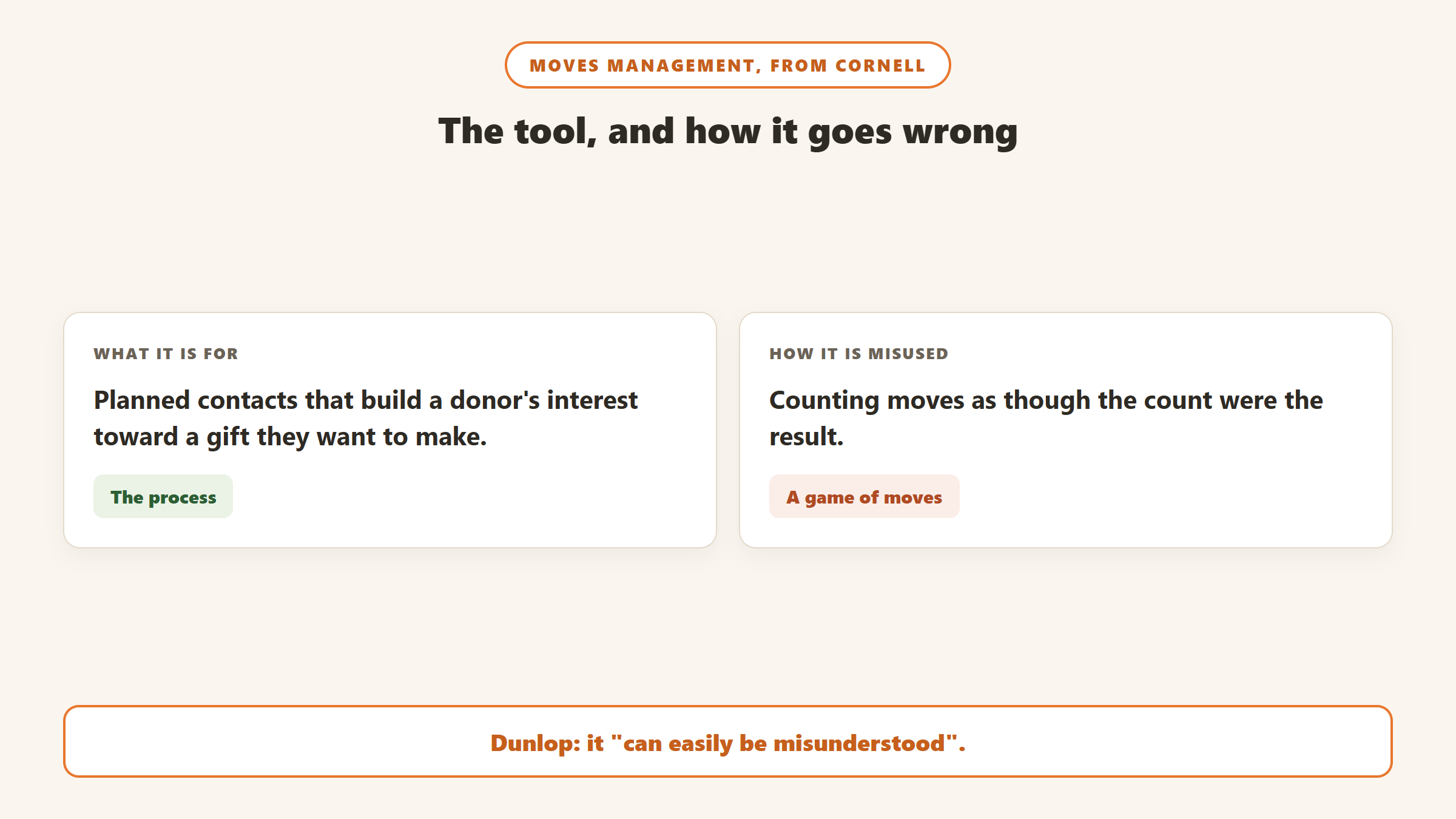
The same interview carries a warning worth repeating. Dunlop said the practice “can easily be misunderstood, so people start ‘making moves’ and making a game of moves, rather than really recognizing the process”. His point was that the process exists to help people do what they already want to do, in line with their values. Counting contacts is a tool for that, not a goal. Our guide to AI for moves management covers how software now tracks moves.
Donor cultivation vs stewardship
The two are easy to confuse because they use similar activities: calls, letters, visits and updates. The difference is timing and purpose.
| Cultivation | Stewardship | |
|---|---|---|
| When | Before an ask | After a gift |
| Purpose | Build interest and involvement so the donor is ready to give | Show the donor their gift was used as intended and that the organisation deserves continued support |
| AFP framing | Engage and maintain interest and involvement | Seek to be worthy of continued support, including acknowledgment, recognition, honouring intent and effective use of funds |
| Typical activities | Visits, tours, conversations with program staff, invitations | Thank-yous, gift receipts, impact updates, recognition, reports on results |
In practice they overlap. A good impact update stewards the last gift and cultivates the next. The useful test is to ask what the contact is for: if it reports on what a gift achieved, it is stewardship; if it builds toward a future gift, it is cultivation. Our donor stewardship guide covers the after-the-gift half in detail.
How to build a donor cultivation plan
- Choose who is in the plan. Start with a manageable portfolio: donors whose giving is rising, first-time donors above a threshold, lapsed major donors and qualified prospects. Our donor segmentation guide shows how to build these groups, and Gratefully’s ranked daily list, with the reason for each donor, is a quick way to seed it.
- Set an objective for each person. A specific gift, purpose and rough timing, even if it changes.
- Plan the next two or three moves. Each with a purpose, an owner and a date. A move is any meaningful contact: a call, a visit, a tailored update, an invitation.
- Record what you learn. Interests, family, concerns and questions. This is what makes the next contact personal rather than generic.
- Review monthly. Who moved, who stalled, and who is ready to be asked.
- Hand over cleanly. When a gift officer leaves, the plan and notes should transfer with the portfolio. Our guide to portfolio handover covers this.
A simple cultivation plan template
| Field | Example |
|---|---|
| Donor | A three-year donor whose gifts have grown each year |
| Stage | Cultivate |
| Objective | A gift to fund the new after-school program, within twelve months |
| Known interests | Education, grandchildren in the local school district |
| Next move | Invite to a program visit |
| Owner and date | Development director, within the next month |
| Move after that | A call with the program lead to discuss what expansion would need |
| Notes from last contact | Asked how the program measures results |
Donor cultivation strategies
For first-time donors
The first year is where most donors are lost. The Fundraising Effectiveness Project’s full-year 2025 figures put new donor retention at 18.9%, against 59.3% for repeat donors. Cultivation here is simple and personal: a prompt thank-you, a specific update on what the gift did, and a second, relevant ask. Our first-time donor retention guide covers the first-year plan.
For mid-level donors
Mid-level donors often receive mass appeals despite giving at a level that justifies more attention. A named contact, an invitation to see the work, and asks tied to specific projects are the usual steps up. Our guide to mid-level donor upgrades covers how to find them.
For major gift prospects
Major donor cultivation is longer and more personal: several visits, time with leadership and program staff, and involvement in shaping what the gift will do. The AFP defines a major gift as “a significant donation” whose threshold “is determined by the organization”, so set your own threshold and plan cultivation accordingly. Cultivation events, which the AFP defines as special events “to enhance interest in and enthusiasm for the work of an organization”, work best as a step in a plan, followed by a personal contact. Our major gift fundraising guide goes further.
Common cultivation mistakes
- Cultivating without an objective. Visits that are pleasant but lead nowhere. Every prospect in the plan needs a gift purpose, even a provisional one.
- Treating events as cultivation on their own. A gala or tour is only a move if someone follows up personally afterwards.
- Asking before qualifying. A capacity estimate is not interest. The qualification conversation is what tells you whether to keep going.
- Letting the plan live in one person’s head. If notes and next steps are not recorded, the relationship leaves with the staff member.
- Forgetting what the donor asked. A question left unanswered from the last visit is the easiest next move there is, and the most damaging one to miss.
Keeping cultivation donor-centred
The Donor Bill of Rights, created by the AFP with the Association for Healthcare Philanthropy, CASE and the Giving Institute, is a good check on cultivation practice. Its first right is for donors to be informed of the organization’s mission, of how it intends to use donated resources, and of its capacity to use donations effectively for their intended purposes. Good cultivation delivers exactly that before the ask, rather than after. If a donor reaches the solicitation stage without understanding how their gift would be used, the cultivation has not done its job, however many contacts it logged.
Statistics to be careful with
Cultivation guides are full of numbers, and several do not survive a check against their supposed source:
- “Only 8% of first-time donors make a repeat gift.” Blackbaud’s donor cultivation cycle glossary attributes this to the Fundraising Effectiveness Project. The FEP’s own full-year 2025 new donor retention figure is 18.9%. We could not find an FEP figure of 8%.
- “It costs five times more to acquire a donor than to keep one.” Widely repeated, and we found no primary source for it.
- “A major gift takes 18 months to cultivate on average.” Quoted without a source in the pages we read.
None of these is needed to make the case for cultivation. The FEP’s measured gap between new donor retention at 18.9% and repeat donor retention at 59.3% makes it on its own: moving a donor from their first gift to their second roughly triples the chance they stay.
Measuring cultivation
- Moves per prospect in the last 90 days, and how many prospects have no planned next move.
- Stage conversion: how many qualified prospects reached an ask, and how many asks succeeded.
- Time in stage, to spot prospects that have stalled.
- Retention of cultivated donors against the rest of the file, using the FEP definitions.
- Average gift size of cultivated donors this year against last year, to see whether the relationship is deepening as well as continuing.
- Recaptured donors: lapsed donors brought back through a cultivation plan, which the FEP counts separately from new and retained donors.
Dunlop’s warning applies to the first metric especially: a high count of moves means little if the moves are not building anything. Our fundraising metrics guide covers the programme-wide numbers.
Knowing who to cultivate next
Most of cultivation’s difficulty is not the visit itself but keeping track of who needs which contact, and remembering enough about each person to make it personal. Gratefully is a donor intelligence layer that helps with both. Its outreach letters page says it drafts “thank-yous, appeals, check-ins, and cultivation letters that reference real details from each donor’s history”, that every claim in a letter is cited so you can check what it used, and that you edit and approve before sending through your own email tools. Its stewardship page describes a ranked daily list with the reason attached, from a nightly portfolio review. It says of itself that it “sits on top of the CRM you already run”, so it is not a CRM.
Gratefully’s pricing page, read on 18 September 2026, has a Free plan, and every new account starts with a 14-day trial of its Advanced plan with no card required before moving to Free. Paid plans start at $79 a month billed yearly. See our Gratefully review.
Disclosure: Zilwaris, the consultancy run by AI Tools Bakery’s founder, does paid advisory work for Gratefully. Gratefully did not pay for this placement, and it is assessed on the same criteria as everything else on this site.
Where the facts on this page come from
- Association of Fundraising Professionals, AFP Fundraising Dictionary (copyright 1996 to 2003), definitions of cultivate, identify, qualify, solicit, stewardship, prospect, moves chart, cultivation event and major gift.
- Jim Lord, interview with David Dunlop on moves management, The Center for Leadership Philanthropy.
- Fundraising Effectiveness Project, Q4 2025 report (full-year 2025 retention).
- Blackbaud, donor cultivation cycle glossary, read 18 September 2026, for the 8% claim.
- Gratefully: outreach letters, donor stewardship and pricing pages, read 18 September 2026.
The bottom line
Donor cultivation is the deliberate work of building interest and involvement before an ask, inside a cycle of identify, qualify, cultivate, solicit and steward. Build a plan that names each prospect, their objective and the next move with an owner and a date, review it monthly, and remember Dunlop’s warning that moves are a means, not the measure. The case for doing it is in the FEP’s own numbers: 18.9% of new donors give again, against 59.3% of repeat donors, so every donor you carry to a second gift is far more likely to stay.

Written by
FazFaz is the founder of AIToolsBakery. Some tools here are tested hands on. Others are assessed from vendor documentation and pricing verified on the live page, and every review says which one it is. Sponsors can buy a position in a guide. They cannot buy the score, the criticism, or silence about a better option.
How we test and how we make money →