Every fundraising guide says stewardship matters, and most then list a dozen thank-you ideas. What they rarely do is look at the evidence for those ideas, or separate the things you are legally required to do from the things that build loyalty. Both matter. The Fundraising Effectiveness Project’s full-year 2025 figures put new donor retention at 18.9% and repeat donor retention at 59.3%, which means most first-time donors never give again, and what happens after the first gift is the biggest single lever most nonprofits have.
This guide defines donor stewardship in the profession’s own terms, sets out the IRS acknowledgment rules every receipt has to meet, reviews what the research actually says about thank-you calls, and walks through a stewardship plan, a stewardship cycle and best practices you can use. If your team knows what good stewardship looks like but cannot keep up with it, Gratefully ranks which donors need attention each day and drafts thank-you and stewardship notes from each donor’s history, with a free plan. For tools, see our companion guide to donor stewardship software.
About the sources. Definitions come from the AFP Fundraising Dictionary (copyright 2003) and the Donor Bill of Rights; legal rules from the IRS; research from a peer-reviewed study, vendor data and a consultancy survey, each labelled as what it is. All were read on 18 September 2026. This is general information, not tax advice.
What is donor stewardship?
The AFP Fundraising Dictionary defines stewardship as “a process whereby an organization seeks to be worthy of continued philanthropic support, including the acknowledgment of gifts, donor recognition, the honoring of donor intent, prudent investment of gifts, and the effective and efficient use of funds to further the mission of the organization.”
That definition is broader than thanking people. It has five parts: saying thank you, recognising the donor, doing what the donor asked with the gift, looking after the money, and using it well. The last three are organisational behaviour, not communications. A beautiful thank-you letter does not make up for a restricted gift spent on something else.
The Donor Bill of Rights, created by the AFP with the Association for Healthcare Philanthropy, CASE and the Giving Institute, puts the donor’s side plainly. Right IV is to be assured gifts “will be used for the purposes for which they were given”, and Right V is “To receive appropriate acknowledgement and recognition.”
The legal floor: what the IRS requires
Before the relationship work, there is a compliance baseline. The IRS says a written acknowledgment for a contribution of $250 or more must contain the organization’s name, the amount of a cash contribution, a description but not the value of a non-cash contribution, a statement that no goods or services were provided if that is the case, and a description and good faith estimate of any goods or services that were provided.
IRS Publication 1771 (revised November 2023) adds several details that shape a stewardship calendar:
- A donor cannot claim a deduction for a single contribution of $250 or more without a contemporaneous written acknowledgment. An organization that does not acknowledge “incurs no penalty”, but the donor loses the deduction.
- One acknowledgment, “such as an annual summary”, can cover several contributions of $250 or more, and it can be sent electronically, “such as via an email addressed to the donor”.
- Charities “typically send written acknowledgments to donors no later than January 31” of the following year.
- For a payment over $75 that is partly a contribution and partly for goods or services, such as a gala ticket, the organization must provide a written disclosure. The penalty for not doing so is “$10 per contribution, not to exceed $5,000 per fundraising event or mailing.”
A receipt that meets these rules is necessary, not sufficient. It protects the donor’s deduction. It does not, on its own, make them feel their gift mattered.
What the research says about thanking donors
The most repeated stewardship advice is to call new donors to say thank you. The evidence on it is more mixed than most guides admit, and worth understanding before you plan around it.
The randomised study: no effect on retention
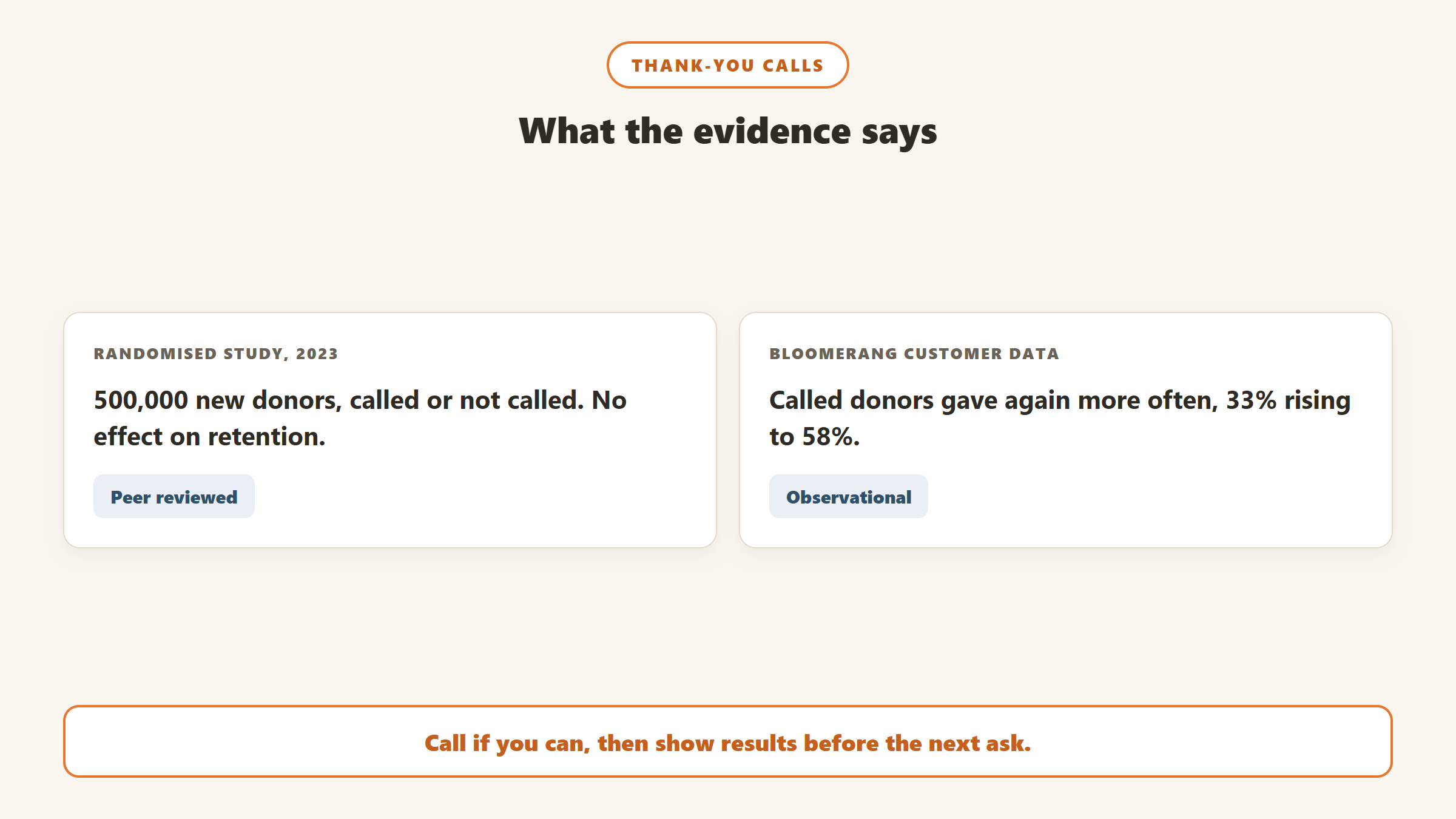
In the only large randomised test we found, Anya Samek and Chuck Longfield ran field experiments with public television stations and a national nonprofit in which 500,000 new donors were randomly assigned to receive a thank-you call or not. The study was published in the American Economic Journal: Applied Economics in April 2023. Fundraising professionals asked in advance predicted the calls would raise retention by 80%. The authors found “a precisely estimated null effect of calls on donor retention.”
The vendor data: called donors come back more
Bloomerang has published an analysis of 1,915,939 donors at 3,729 organisations in the US and Canada, covering first gifts made from 2012 to 2018. It reports that donors who received no call within 90 days were retained about 33% of the time, rising to 41.24% with one call and 58.21% with more than one. Two caveats, both from Bloomerang’s own page: its “retained” means a second gift at any time, not the FEP’s next-year definition, and the data is observational, so organisations that call may differ in other ways from those that do not. Bloomerang also argues the randomised study’s calls were outsourced and made months after the gift; that is Bloomerang’s reading, and we have not checked it against the paper.
What donors say they want
Penelope Burk’s Cygnus Applied Research has surveyed donors for years. Its donor-centred fundraising handout names three essentials: prompt, meaningful acknowledgment; designating each gift to something narrower than the whole mission; and “providing measurable results on the last gift before asking for another one”. In Burk’s original study, 95% of respondents said they would be very appreciative of a thank-you call from a board member within a few days, and 93% said they would definitely give again. These are stated intentions from a survey, not observed behaviour.
How to read the evidence together
A standard, scripted thank-you call, on its own, did not change retention in a well-run experiment. Donors still say they value personal thanks, and organisations that call more also see more repeat giving, for reasons that may include everything else those organisations do. The practical conclusion is that a thank-you call is not a magic lever, but prompt, personal acknowledgment followed by real results is what donors ask for. Plan stewardship as a sequence, not a single call.
How to build a donor stewardship plan
A stewardship plan decides, in advance, which donors receive which touches and when, so stewardship happens by default rather than when someone has time. Start with segments and a matrix.
A stewardship matrix you can adapt
| Segment | Acknowledgment | Recognition | Reporting | Involvement |
|---|---|---|---|---|
| All donors | Prompt receipt meeting IRS rules; a short, personal thank-you | Optional listing, with permission | Annual impact report | Invitations to open events |
| First-time donors | As above, plus a personal note or call | Welcome message | A specific update on what their gift did, within the first months | A low-key invitation to see the work |
| Monthly donors | Welcome series; year-end giving summary | Membership of a named programme | Quarterly results | Occasional behind-the-scenes updates |
| Mid-level donors | A named staff contact thanks them personally | Recognition level if you use them | Project-specific updates | Program visits, calls with staff |
| Major and legacy donors | Leadership thanks personally | As the donor prefers | Tailored reports on the funded work | Advisory roles, site visits, meetings with those served |
Then set the calendar: acknowledgment within days, a results update within the first quarter, the annual impact report, the year-end giving summary by January 31, and only then the next ask. Burk’s third essential, results before the next ask, is the one most plans break. Our guide to building a monthly giving program covers stewardship for recurring donors, and writing a nonprofit impact report covers the annual report.
A first-year calendar for new donors
New donors are where stewardship matters most, because the FEP’s 18.9% new donor retention leaves the most room to improve. A simple first-year sequence:
| When | Touch | Purpose |
|---|---|---|
| Within a few days | Receipt that meets IRS rules, plus a short personal thank-you | Acknowledge, accurately and warmly |
| Within a month | A welcome message: who you are, how to reach a person | Make the donor feel known, not processed |
| Around three months | A specific update on what gifts like theirs did | Report results before any new ask |
| Around six months | An invitation to see the work, in person or online | Involve |
| Before the anniversary | A second ask tied to something specific, then a giving summary at year end | Re-cultivate, and meet the January 31 convention |
Stewardship by gift type
- Restricted gifts. Report on the specific program the donor chose. Honouring intent is part of the AFP definition, and a restricted gift reported on generally reads as though it was not honoured.
- Event tickets and auction purchases. These are often partly a contribution and partly a purchase. For payments over $75, Publication 1771 requires a written disclosure with a good faith estimate of what the donor received, so build it into event receipts.
- Non-cash gifts. The IRS says describe the gift but do not value it in the acknowledgment. Thank the donor for what the item made possible.
- Tribute and memorial gifts. Acknowledge the donor and, with care, notify the family or honoree. These are among the most personal gifts you receive.
- Monthly gifts. One annual summary can cover the year for tax purposes; stewardship still needs regular results updates in between.
The donor stewardship cycle
- Acknowledge. The AFP defines acknowledge as “to express gratitude for (a gift or service) in written or oral form”. Fast, personal and accurate.
- Recognise. In the way the donor prefers. Burk’s handout reports that only 8% of donors said publishing names in newsletters and annual reports influenced them, down from 32% in her original research, so ask before you list.
- Honour intent. Use restricted gifts as restricted, and say so.
- Report results. The AFP’s definition of accountability is keeping “a donor informed about the use of the donor’s gift”. Specific beats general.
- Involve and re-cultivate. Stewardship of one gift becomes cultivation of the next. Our donor cultivation guide picks up from here.
Donor stewardship best practices
- Thank fast, then thank well. A prompt receipt, followed by a personal note from a real person.
- Keep thank-you letters short. Burk warns that letters “longer than one paragraph tend to revert to sales copy”. A thank-you is not an appeal.
- Tie each gift to something specific. Designation to a program or project, which Burk lists as an essential, makes results reportable.
- Show results before the next ask. Even a two-sentence update with one number counts.
- Keep records accurate. Misspelled names, wrong amounts and thank-yous sent to deceased donors undo years of work. Our duplicate donor records guide helps.
- Use the annual summary. The IRS accepts one summary for several gifts, which makes a year-end giving statement both compliant and a stewardship touch.
- Watch for silence. A donor who has not heard from you except to be asked is already drifting. Our LYBUNT and SYBUNT guide shows how to find them, and Gratefully flags donors drifting toward lapse with the reason attached.
Common stewardship mistakes
- Asking in the thank-you. A reply envelope tucked into a thank-you letter turns gratitude into an appeal.
- Thanking the gift, not the person. “Thank you for your gift of $100” is a receipt. Say what the gift will do and who it helps.
- Going silent until the next appeal. If the only contacts a donor receives are asks, the relationship is transactional by design.
- Stewarding only major donors. The largest retention gap is among first-time donors, most of whom give small amounts.
- Getting the details wrong. A wrong name, amount or salutation undermines every other touch.
- Listing donors without asking. Some donors want recognition and some want privacy. Record the preference once and respect it every time.
Measuring stewardship
- Retention by segment, using the FEP definitions: new, repeat and overall. Compare against the full-year 2025 figures of 18.9%, 59.3% and 43.3%.
- Time to thank: days from gift to personal acknowledgment.
- Results before the ask: the share of donors who received an impact update before their next solicitation.
- Second-gift rate for first-time donors within twelve months.
Our donor retention rate guide covers the calculation, and fundraising metrics covers the wider dashboard.
Keeping stewardship going when the team is small
Most stewardship plans fail on capacity, not intent. Gratefully is a donor intelligence layer that sits on top of your CRM and helps with the daily part. Its stewardship page describes a ranked daily list with the reason attached, from a nightly portfolio review, and says every claim cites the record it came from. Its outreach letters page says it drafts “thank-yous, appeals, check-ins, and cultivation letters” from each donor’s history, with “thank-you and stewardship notes” among the letter types, for you to edit and approve before sending through your own email tools. It is not a CRM and does not send receipts.
Gratefully’s pricing page, read on 18 September 2026, has a Free plan, and every new account starts with a 14-day trial of its Advanced plan with no card required before moving to Free. Paid plans start at $79 a month billed yearly. Our Gratefully review has more.

Disclosure: Zilwaris, the consultancy run by AI Tools Bakery’s founder, does paid advisory work for Gratefully. Gratefully did not pay for this placement, and it is assessed on the same criteria as everything else on this site.
Where the facts on this page come from
- AFP Fundraising Dictionary (copyright 1996 to 2003); AFP Donor Bill of Rights.
- IRS, Charitable contributions: written acknowledgments; Publication 1771 (Rev. 11-2023).
- Samek and Longfield, “Do Thank-You Calls Increase Charitable Giving?”, American Economic Journal: Applied Economics, April 2023 (peer-reviewed).
- Bloomerang, thank-you call analysis, updated 19 November 2025 (vendor data, observational).
- Penelope Burk, Cygnus Applied Research, donor-centred fundraising handout, 2021 (survey data).
- Fundraising Effectiveness Project, Q4 2025 report.
- Gratefully: donor stewardship, outreach letters and pricing pages, read 18 September 2026.
The bottom line
Donor stewardship is how an organisation shows it deserves the next gift: prompt acknowledgment, recognition the donor wants, honouring their intent and reporting real results. Meet the IRS rules on every receipt, then build a plan by segment with results delivered before the next ask. Be honest with yourself about the evidence: a scripted thank-you call alone did not move retention in the one randomised test, while prompt personal thanks and specific results are what donors consistently ask for. Steward as a sequence, and the next cycle of cultivation starts itself.

Written by
FazFaz is the founder of AIToolsBakery. Some tools here are tested hands on. Others are assessed from vendor documentation and pricing verified on the live page, and every review says which one it is. Sponsors can buy a position in a guide. They cannot buy the score, the criticism, or silence about a better option.
How we test and how we make money →