Bloomerang and Little Green Light are two of the most common donor databases in small and mid-sized nonprofits, and they come up in the same shortlist for a simple reason: both are built for fundraising teams rather than for general sales work, and both give every user a login at no extra cost. Past that, they are different products at very different prices. Little Green Light (LGL) is a lean, low-cost database with a published price for every list size. Bloomerang is a broader platform with fundraising forms, events, texting, a volunteer product and predictive tools, sold on annual terms with a published starting price only.
This page compares them on the things that decide the bill and the exit: what each costs at your list size, how each counts a record, what online gifts cost to process, what the contract says, and what you get for the difference. If you already run one of them and the real gap is knowing which donors to call this week, Gratefully connects live to both Bloomerang and Little Green Light and has a free plan, so you can test that before you think about switching.
How we put this together. Every price, fee and contract term below was read on the vendor’s own pricing page, terms of service or help centre on 18 September 2026, from India, and is shown as displayed. We have not run either system hands-on or migrated a database between them. Where a vendor does not publish something, we say so rather than estimate it.
Bloomerang vs Little Green Light at a glance
| Little Green Light | Bloomerang | |
|---|---|---|
| Starting price | $45 a month, up to 2,500 records | CRM from $125 a month, billed annually |
| Full price ladder published | Yes, up to 50,000 records and beyond | No, starting prices only |
| Users | Unlimited, no charge | Unlimited |
| Contract | “No contracts”, no cancellation fees | Default initial term of two years, then yearly |
| Online card gifts | Starting at 2.2% + $0.30 to the processor, no fee to LGL | 3.95% + $0.30 on Bloomerang Fundraising forms; 3.2% + $0.30 on CRM forms |
| Fundraising tools | Donation, event and membership forms | Forms, events, text fundraising and mobile apps; auctions and peer-to-peer as add-ons |
| Volunteers | Interests and hours by task, included | Separate Bloomerang Volunteer product from $119 a month |
| Data migration | Self-serve importer, or hire a consultant from LGL’s network | Training and onboarding included in proposals |
| Capterra rating (18 Sep 2026) | 4.8 from 317 reviews | 4.7 from 1,287 reviews |
What each costs at your list size
The honest comparison starts with an awkward fact: only one of these vendors lets you work out the price yourself.
Little Green Light publishes every tier
LGL’s pricing page sets the monthly rate by the number of constituent records in your database. On 18 September 2026 it showed:
| Constituent records | Per month | Per year, paid monthly | Per year, 12 months prepaid (10% off) |
|---|---|---|---|
| Up to 2,500 | $45 | $540 | $486 |
| Up to 5,000 | $60 | $720 | $648 |
| Up to 10,000 | $75 | $900 | $810 |
| Up to 20,000 | $90 | $1,080 | $972 |
| Up to 30,000 | $105 | $1,260 | $1,134 |
| Up to 50,000 | $135 | $1,620 | $1,458 |
Above 50,000 records, LGL adds $15 a month for each further 10,000, up to 200,000 records. Prepaying three months takes 2.5% off and six months takes 5%. The yearly totals are our arithmetic from the displayed monthly figures; LGL’s own billing article gives the same example, a $486 prepayment for the $45 tier. There are no setup or cancellation fees, users cost nothing (“Nothing. Nada. Zilch. Zero.” in LGL’s words), and every account starts with 30 days free. LGL’s help centre adds that your tier can go up or down month to month as your record count changes. Our Little Green Light pricing guide goes through the billing rules in more detail.
Bloomerang publishes starting prices only
Bloomerang’s pricing page lists four products, all billed annually:
- Bloomerang CRM: starting at $125 a month. Donor management, predictive giving insights, marketing and engagement, reporting, data management and a mobile app for fundraisers.
- Bloomerang Fundraising: starting at $40 a month, and only sold as part of a bundle with the CRM. Donation forms, event management, text fundraising and mobile apps for fundraisers and donors, with auctions and peer-to-peer as add-ons.
- The Giving Platform: starting at $242 a month. CRM and Fundraising together, with ongoing guidance and support.
- Bloomerang Volunteer: starting at $119 a month.
The page says pricing is “constituent-based” and every plan includes unlimited users, but it does not say how many constituents the $125 starting price covers, and it publishes no price above the starting figure. For a larger database you ask for a proposal. That is common in this market, but it means any site quoting a Bloomerang price at 10,000 or 25,000 records is quoting a proposal someone else received, not a published price. Our Bloomerang pricing guide tracks what the page has shown over time.
The same database on both
Here is what each vendor’s own pages let you calculate at four common sizes. The Bloomerang cells are marked as quotes because that is what they are.
| Records | Little Green Light, per year | Bloomerang CRM, per year |
|---|---|---|
| 2,500 | $540 ($486 prepaid) | From $1,500 at the entry band; band size not published |
| 5,000 | $720 ($648 prepaid) | Quote only |
| 10,000 | $900 ($810 prepaid) | Quote only |
| 30,000 | $1,260 ($1,134 prepaid) | Quote only |
Even at Bloomerang’s entry price, the CRM alone costs $1,500 a year against LGL’s $540 for up to 2,500 records, a gap of $960. Add Bloomerang Fundraising and the entry bundle is $165 a month bought as two products, or $242 a month as the Giving Platform, which is $2,904 a year. Those sums are ours; Bloomerang’s page shows only the individual starting prices. Bloomerang’s case is not that it is cheaper. It is that the higher price buys more product and more help, which the sections below weigh up.
How each one counts a record
The two vendors count differently, and the difference matters most for household-heavy files.
- Little Green Light defines a constituent record as “any individual or organization for which you’ve created a record”. Households are built by linking people with a constituent relationship, so a married couple entered as two people is two records.
- Bloomerang describes its pricing as constituent-based. An older Bloomerang article, from 2014, says records joined in a household count once against your licence level. We could not find that rule on the current pricing page, so ask for it in writing if your file has many households.
Before you compare quotes, clean the file. Duplicates inflate the count on both systems; our guide to duplicate donor records covers how each CRM merges them and which merges can be undone.
What online gifts cost to process
Subscription price is only part of the bill. If you take gifts online, processing fees can outweigh the subscription difference within a year.
- Little Green Light lists online giving at “starting at 2.2% + $0.30 per transaction paid to the payment processor (no fee to LGL)”. Its forms run through Stripe or PayPal, and LGL’s giving page quotes PayPal at 1.99% + $0.49.
- Bloomerang publishes two rate cards in a help article dated 20 July 2026. Bloomerang Fundraising forms, text, events, auctions and peer-to-peer charge 3.95% + $0.30 on Visa, Mastercard and Discover, 4.95% + $0.30 on American Express, and 1.95% + $0.95 on ACH, with an extra 1% on peer-to-peer. The CRM’s own forms and tools charge 3.2% + $0.30 on cards and 1.8% + $0.30 on ACH. If you bring your own processor, Bloomerang adds a platform fee of 1.95% on Fundraising or 1% on the CRM.
A worked example, using those published card rates: a $100 gift costs $2.50 to process through LGL’s Stripe rate, $3.50 through Bloomerang CRM forms and $4.25 through Bloomerang Fundraising forms. A nonprofit taking 500 such gifts a year would pay about $1,250, $1,750 and $2,125 respectively. Stripe’s 2.2% is its discounted nonprofit rate, which you apply for, so check you qualify. Many donors also choose to cover fees on either platform, which shrinks the gap for you but not for them.
Contracts, renewal and leaving
This is the difference the comparison sites leave out.
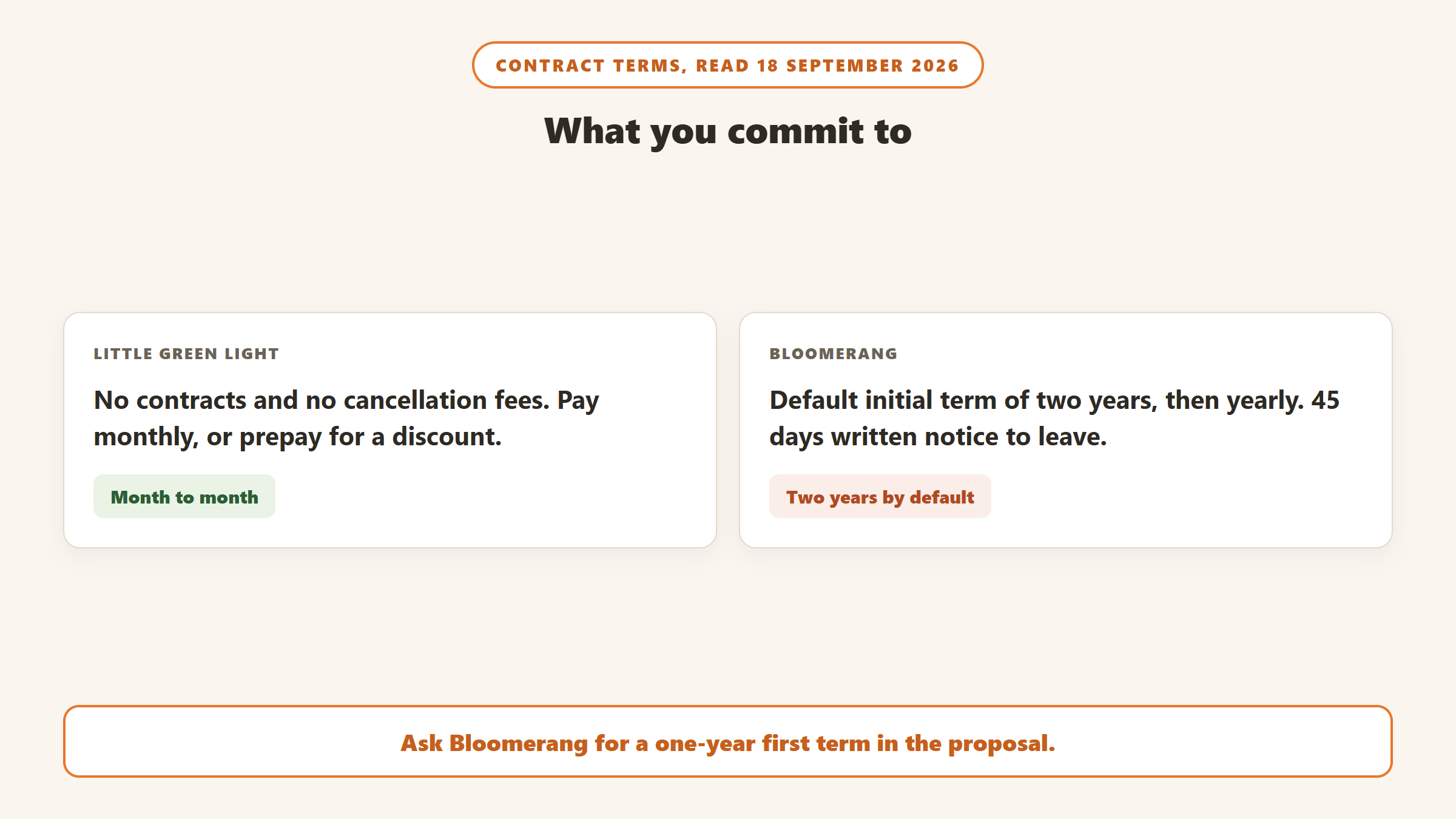
Bloomerang’s terms say: “Unless otherwise specified in your proposal, the initial term of this Agreement is two (2) years.” After that it renews for one-year terms unless either side gives written notice at least 45 days before the end of the term. Bloomerang reserves the right to change fees at the end of any contract period, and the terms allow extra fees for use above your subscription amounts, naming constituents, emails sent and attachment storage. On data, you can download it free at any time during the term, and Bloomerang says it is not responsible for keeping it more than 90 days after termination. The pricing page adds: “You own your data. We provide easy exports at any time.”
Little Green Light advertises “No setup fees”, “No cancellation fees”, “No contracts” and “No upsells”. You pay monthly or prepay for a discount, and cancel from the billing settings. We did not find a published rule on refunds of unused prepayment or on how long data stays available after you cancel, so export before you cancel and ask if you have prepaid.
Two practical points follow. First, if you sign with Bloomerang, diary the notice date: 45 days before your term ends is easy to miss. Second, a two-year term is not a reason to avoid Bloomerang, but it is a reason to negotiate the term, the record band and the price increase cap before you sign, because the proposal overrides the default.
Features: where the extra money goes
Donor management and insight
Both handle the core records you would expect: constituents, gifts, pledges, households and relationships, tasks and reporting. Bloomerang’s CRM plan lists “predictive giving insights”, and its pricing page offers intelligent prospect research as a paid upgrade. It also publishes a vendor claim that the top 20% of its customers see 47% first-time donor retention against an industry average of 19%. That average is in line with the Fundraising Effectiveness Project’s full-year 2025 figure of 18.9% for new donors, but the 47% is Bloomerang’s own number about its best customers, not an average result. Our first-time donor retention guide explains the benchmark.
LGL is more of a well-organised database than an insight tool. Its features page covers stewardship through a series of tasks for each prospect, giving summaries on every record, and flexible reports. It does not market predictive scoring.
Fundraising, events, memberships and volunteers
LGL includes forms for donations, event registrations and ticket sales, and new memberships, plus membership tracking with levels and renewal dates, event invitees and attendees, and volunteer interests and hours by task, all in the base price. Bloomerang splits this across products: fundraising forms, events, text giving and donor apps in Bloomerang Fundraising, auctions and peer-to-peer as add-ons, and volunteer management as a separate product with scheduling and screening. The Bloomerang tools are fuller, and they cost more.
Email and integrations
Both send email from inside the database. LGL’s help centre documents direct sending with published limits, and it integrates with Mailchimp and Constant Contact for campaign email, plus QuickBooks Online, Zapier, Stripe and PayPal. Bloomerang has built-in email and a QuickBooks Online integration, and publishes API documentation. LGL also has a REST API. Our guide to connecting Mailchimp to your donor CRM shows what each integration actually syncs.
Support and moving in
LGL answers support during office hours, Monday to Friday 9am to 7pm Eastern, and says it responds to most questions within one to two hours. It does not migrate data for you: it provides a free importer, documentation and webinars, and refers you to its consultant network if you want someone to do it. Bloomerang’s proposals include training and onboarding, and its Giving Platform includes ongoing guidance and support. If nobody on your team has time to map and import a file, that difference is worth real money. Our CRM migration guide lists what to ask any vendor before you move.
What reviewers say
On Capterra, read on 18 September 2026, Little Green Light scores 4.8 from 317 reviews and Bloomerang 4.7 from 1,287. LGL scores higher on value for money, 4.9 against 4.6, and on functionality, 4.5 against 4.3; the two tie on customer service at 4.8. On G2 the order reverses: Bloomerang CRM scores 4.6 from 922 reviews, LGL 4.4 from 63. The review counts tell you something too. Bloomerang has far more reviewers, so its score is the steadier of the two, while LGL’s G2 score rests on a small sample.
Which one should you choose?
- Choose Little Green Light if budget is the main constraint, you want to know the price at every size before you talk to anyone, you cannot commit to a multi-year term, or your team is comfortable importing its own data. For a small shop with a few thousand records, it does the job for a few hundred dollars a year.
- Choose Bloomerang if you want donation forms, events, texting and donor apps from one vendor, value guided onboarding and ongoing support, and can commit to an annual or multi-year agreement. Negotiate the term and ask how households are counted.
- Look at both and neither if your giving is mostly online and fees matter more than features. On a large online programme, the gap between 2.2% and 3.95% is bigger than the subscription gap. Our nonprofit CRM pricing comparison covers the wider field.
For deeper single-vendor reads, see our Bloomerang review, Little Green Light review, Bloomerang alternatives and Little Green Light alternatives.
Add donor intelligence to either one
Switching CRMs is expensive in time, so it is worth checking what problem you are trying to solve. If the data is fine and the gap is deciding who to contact and why, Gratefully works on top of both. Its product page says its live connectors cover Salesforce, Bloomerang and Little Green Light, “each syncing donor records, gift history and interactions automatically”. It then ranks which donors need attention with the reason for each, flags people drifting toward lapse, and drafts outreach from each donor’s history for you to review. Gratefully is not a CRM and does not replace either system.
Its pricing page, read on 18 September 2026, has a Free plan and says all integrations are included on every plan, including Free. New accounts start with a 14-day trial of its Advanced plan with no card required, then drop to Free. Paid plans start at $79 a month billed yearly. For a team on LGL’s $45 tier, that is a way to add the kind of insight Bloomerang markets without changing databases. Our Gratefully vs Bloomerang page explains how the two fit together.
Disclosure: Zilwaris, the consultancy run by AI Tools Bakery’s founder, does paid advisory work for Gratefully. Gratefully did not pay for this placement, and it is assessed on the same criteria as everything else on this site.
Where the facts on this page come from
- Little Green Light: pricing page, online donations page, features page, and help centre articles on billing, households, constituents and cancellation, read 18 September 2026.
- Bloomerang: pricing page, terms and conditions, and the help centre article on payment processing pricing (dated 20 July 2026), read 18 September 2026. The household counting rule is from a Bloomerang article published in March 2014.
- Fundraising Effectiveness Project: full-year 2025 retention by donor type.
- Capterra and G2 ratings, read 18 September 2026.
- Gratefully: product and pricing pages, read 18 September 2026.
The bottom line
Little Green Light wins on price, transparency and flexibility: $45 to $135 a month for up to 50,000 records, no contract, and processing at the processor’s rate. Bloomerang wins on breadth and support, with fundraising tools, predictive insights and guided onboarding, at a starting price of $125 a month for the CRM on a default two-year agreement and higher card fees on its own forms. Price your own list size, ask Bloomerang for its band and term in writing, and if what you really need is to know which donors to call, test that on the system you already have first.

Written by
FazFaz is the founder of AIToolsBakery. Some tools here are tested hands on. Others are assessed from vendor documentation and pricing verified on the live page, and every review says which one it is. Sponsors can buy a position in a guide. They cannot buy the score, the criticism, or silence about a better option.
How we test and how we make money →Frequently Asked Questions