Bloomerang is one of the most popular donor CRMs for small and mid-sized nonprofits, and teams that look elsewhere tend to name specific reasons: cost as the database grows, the way products are bundled, or a need it does not meet. Knowing which one applies to you decides which alternative makes sense. If your reason is insight rather than cost or bundling, the answer may be Gratefully rather than a new CRM.
This page lists what Bloomerang publishes that commonly prompts a switch, compares seven alternatives on published price and fit, and covers the cost of moving your recurring donors, which most comparison pages skip. Our Bloomerang review and Bloomerang pricing guide go deeper on the product itself.
How we put this together. Prices and features come from each vendor’s own pages, read on 16 and 17 September 2026. We have not migrated a database off Bloomerang ourselves, so this compares what vendors publish rather than a hands-on test.
Why teams look for Bloomerang alternatives
Price grows with your records
Bloomerang’s pricing page lists the CRM from $125 a month billed annually and the full Giving Platform from $242 a month, and says pricing is based on the number of records you hold. Users are unlimited, which is a genuine strength, but a growing database moves you up the price ladder whether or not your team grows.
What Bloomerang does not publish is the ladder itself. Its pricing page, read on 17 September 2026, shows starting prices and a “Get Personalized Pricing” button, not the price at 5,000, 20,000 or 50,000 records. That makes growth hard to plan for from the outside. Little Green Light, by contrast, publishes every step: $45 a month up to 2,500 records, $135 a month at 50,000, and $15 more for each further 10,000, so a 70,000-record database costs $165 a month there. Before your renewal, ask Bloomerang for two written quotes: one at your current record count and one at double it. The gap between them is the number that tells you whether the price will push you out in two or three years.
Products are sold as a bundle
Bloomerang Fundraising, the donation forms and event tools, starts at $40 a month but must be purchased as part of a bundle with the CRM. Volunteer management is a separate product from $119 a month. If you want one simple price for everything, the modular structure takes more work to budget for, so price the exact bundle you would use.
Annual billing and conversion time
All of Bloomerang’s published prices are billed annually. Its FAQ gives a standard conversion timeline of 12 to 14 weeks for new customers, which matters in reverse too: whatever you move to will take a similar project to get right.
Former Kindful customers
Kindful is now a Bloomerang product. Its website funnels to Bloomerang, and Bloomerang’s help centre says the Kindful integration is not available for new activations. Some Kindful users searching for alternatives are really deciding whether to move to Bloomerang or somewhere else entirely.
What you would be giving up
It is worth being clear about what Bloomerang does well before you leave it, because some of it is harder to find elsewhere than the comparison tables suggest. Keeping Bloomerang and adding Gratefully keeps all of it.
- Unlimited users. Bloomerang’s pricing page says users are unlimited, so adding a board member or a part-time fundraiser costs nothing. Some alternatives charge per user.
- A retention-first design. Engagement scores that update from email clicks, volunteer hours and event attendance are built into the product rather than added on.
- Address updates included. Bloomerang lists NCOA updates as part of its CRM, where several alternatives either charge for them or leave you to arrange your own. Our NCOA guide explains why that matters for mailings.
- An AI writing assistant at no extra cost. Bloomerang’s AI Content Assistant is included in the subscription, though it only uses what you type into it rather than reading donor records.
If most of these matter to you, the question may be whether Bloomerang can be made to work better rather than whether to leave.
What the first year costs, at published prices
Starting prices are not the whole story, but they are a fair first filter. Here is what a year looks like at each vendor’s published entry point, for an organisation near the bottom of each vendor’s pricing ladder. Your figure will be higher if you hold more records or contacts.
- Zeffy: $0, funded by optional donor tips.
- Little Green Light: $540 a year at $45 a month for up to 2,500 records, less 10% if you prepay the year.
- Givebutter Plus: $948 a year for up to 1,000 contacts, with the free CRM underneath; card processing applies on donations.
- Bloomerang CRM: from $1,500 a year at $125 a month billed annually, depending on records.
- Keela: $1,968 a year at $164 a month billed annually for up to 1,000 contacts.
- DonorDock: $6,000 a year, plus an optional $3,800 onboarding programme in the first year.
DonorPerfect and Virtuous do not publish enough to calculate a comparable figure. Whatever you are comparing, add the one-off costs: migration, any fee to release recurring donor data, and a few months of running two systems side by side.
Bloomerang alternatives at a glance
| CRM | Published starting price | Priced by | Best for |
|---|---|---|---|
| Little Green Light | $45 a month | Records | Small teams that want the lowest transparent price |
| Givebutter | Free CRM; Plus from $29 a month | Contacts, for Plus | Organisations raising mostly online |
| Zeffy | Free | Funded by optional donor tips | Very small budgets |
| Keela | $164 a month billed annually | Contacts | Teams that want automation and scoring |
| DonorDock | $500 a month billed annually | Flat, with add-ons | Teams that want everything in one plan |
| DonorPerfect | From $99 or $119 a month, depending on the page | Plan, quote for details | Organisations needing breadth and phone support |
| Virtuous CRM+ | Not published | Fundraising revenue tier | Growing organisations focused on journeys |
The alternatives in detail
1. Little Green Light: the lowest transparent price
Little Green Light publishes every tier: $45 a month for up to 2,500 records, rising in steps to $135 a month for 50,000, with $15 added for each further 10,000. Every feature is included on every tier, users are unlimited, and its pricing page promises no setup fees, no cancellation fees and no contracts, with a 30-day free trial and up to 10% off for paying a year ahead.
Little Green Light also publishes an open REST API and lists built-in integrations with Constant Contact, Mailchimp, QuickBooks Online, Stripe, PayPal and DonorSearch, and says it adds no fees for them.
The trade-offs: no AI drafting, no Salesforce integration on its integrations list, no support for split gifts, and a do-it-yourself migration with consultants available if you want help. For a small team moving off Bloomerang mainly to save money, it is the obvious first look. See our Little Green Light review.
2. Givebutter: a free CRM for online fundraising
Givebutter’s CRM is free with unlimited contacts. On its pricing page, the platform charges 0% platform fees when donor tips are enabled, or 3% plus card processing of 2.9% plus 30 cents if you turn tips off. Automations, texting and custom reports need Givebutter Plus, which starts at $29 a month for up to 250 contacts and runs $79 for 1,000 and $129 for 2,500.
It is strongest for organisations whose giving happens mostly through online campaigns and events. It is lighter on major gift management than Bloomerang.
3. Zeffy: free, funded by tips
Zeffy says its price is $0, with no transaction fees and no platform fees, funded by optional tips from donors. Its donor management has no contact limit and no paid contact tier. For very small organisations where every dollar of fees matters, it is worth a serious look, with the understanding that a free tool funded by donor tips will not have the depth of a paid CRM.
4. Keela: automation and scoring in the middle
Keela prices by contact count, from $164 a month for up to 1,000 contacts when billed annually, which Keela says saves up to 23% against monthly billing. It documents automated acknowledgments and receipts, donor scoring and suggested ask amounts, and an Implementation Specialist who can migrate contacts, donation records and recurring gifts. Its page does not name a currency, so confirm the figure shown in your region. See our Keela review.
5. DonorDock: everything in one plan
DonorDock sells a single plan at $500 a month billed annually, with unlimited contacts, five users, 10,000 marketing emails a month and a 2% platform fee on its own giving pages. Extra users are $40 a month each, onboarding is an optional $3,800, and it offers a 90-day money-back guarantee with no long-term contract. It costs more than Bloomerang’s entry CRM price but includes more in the headline figure.
6. DonorPerfect: broad modules, quoted prices
DonorPerfect sells Core, Plus and Pro plans. Its own pages disagree on the entry price, with the pricing guide saying $99 a month and the homepage $119, and per-plan prices are on request. Its pricing guide shows custom API access on the Pro plan only and QuickBooks integration from Plus upwards. Its pricing guide advertises free data transfers from most CRMs, though its data transfer page says pricing varies. See our DonorPerfect review and our Bloomerang vs DonorPerfect comparison.
7. Virtuous CRM+: for growing, journey-led teams
Virtuous does not publish prices. Its CRM comes in two tiers split at $5 million in annual fundraising revenue, both with unlimited users, and it is built around automated donor journeys. It suits organisations that have outgrown a small-team CRM and are ready for a sales conversation. Its separate Momentum product, a prioritised inbox for gift officers, also lists an integration with Bloomerang, which means some teams can try part of the Virtuous approach before deciding whether to move their whole database. See our Virtuous review.
Also consider
Salesforce Nonprofit Cloud for organisations that need deep customisation and have implementation budget; our Salesforce alternatives page covers the trade-offs. Neon CRM is often compared with Bloomerang, but Neon One’s website was down for maintenance when we checked on 17 September 2026, so we have not assessed its current pricing.
Taking your recurring donors with you
This is the part most alternatives pages leave out. Your monthly donors’ card details sit with the payment processor, and moving them means your old platform has to release the data. Givebutter’s help article lists Bloomerang as charging a $250 migration fee for this, as of 30 May 2025. Confirm the current fee with Bloomerang before you plan around it, and remember that Stripe transfers card data but not the recurring schedules, which have to be rebuilt.
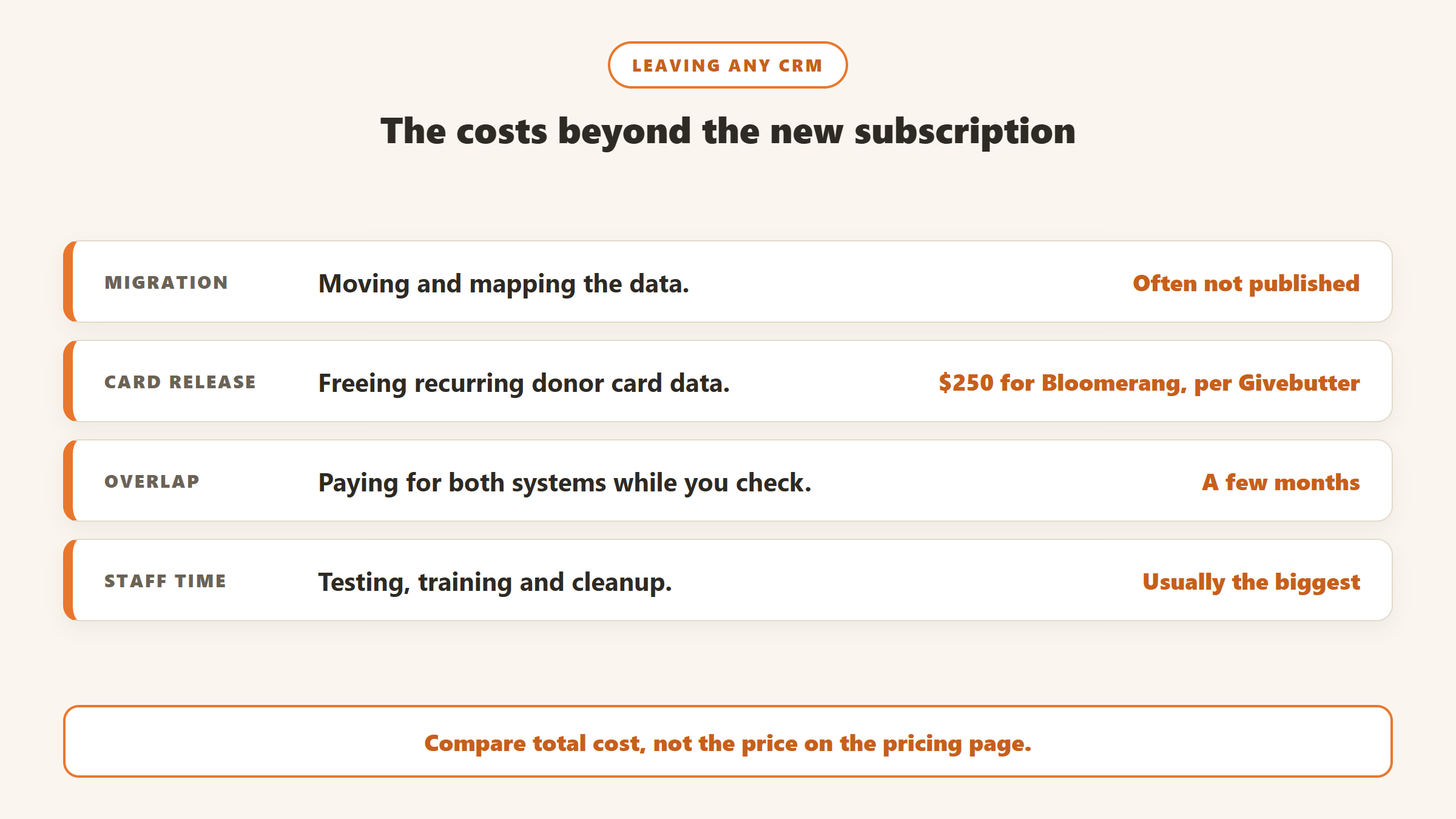
Our guide to nonprofit CRM migration covers the rest, including what Bloomerang’s own export leaves out.
How to choose
If cost is the reason
Start with Little Green Light, then Givebutter or Zeffy if most of your giving is online. Compare total cost including payment processing, not just the subscription.
If you want more automation
Look at DonorDock and Keela, and at Virtuous if you are larger. Ask each for a demo of the exact stewardship workflow you run today.
If you are growing fast
Look at Virtuous and Salesforce, and budget for implementation. The cheapest system to buy is often not the cheapest to run at scale.
Three common situations
A one-person development office raising under half a million dollars. The priority is a system you can run alone without it becoming a second job. Little Green Light’s flat, published pricing and unlimited users suit this well, and so does Givebutter if nearly all your giving is online. LGL publishes its own import guidance, and the recurring donor transfer is the one step to plan carefully.
A team of three to six fundraisers with regular events and a major gifts programme. You need stewardship tools, task assignment and reporting that more than one person trusts. Keela and DonorDock are both built for this size, and DonorDock’s single plan makes budgeting straightforward. Ask both to demonstrate your actual year-end process, not their standard script.
An organisation raising several million a year and adding staff. You are likely weighing Virtuous or Salesforce against staying on Bloomerang. At this size, the implementation partner, the data model and the reporting matter more than the subscription price, and the conversation should include how long the move will take and who will own the system afterwards.
You may not need to leave
If Bloomerang holds your records well and the real frustration is that nobody can tell who to call next, a migration moves that problem rather than fixing it. A donor intelligence layer that connects to Bloomerang is a cheaper test. Gratefully, for example, lists Bloomerang among the CRMs it connects to, needs no migration and has a free plan. Our CRM versus donor intelligence guide helps you tell the two problems apart.
Gratefully is the layer we recommend for Bloomerang users. Its own comparison page is clear that it is not a CRM and not a replacement for one: Bloomerang stays your system of record, and Gratefully syncs it overnight, reads the staff notes, emails and documents around each donor, ranks who needs attention every morning with a reason for each, and drafts outreach from each donor’s history. The free plan, read on its pricing page on 17 September 2026, includes every integration, and paid plans start at $79 a month billed yearly, a small fraction of a migration.
Disclosure: Zilwaris, the consultancy run by AI Tools Bakery’s founder, does paid advisory work for Gratefully. Gratefully did not pay for this placement, and it is assessed on the same criteria as everything else on this site.
Questions to ask every alternative
- What will this cost at our record count now, and at double it?
- Who migrates our data, what do you not move, and how long does it take?
- How do our recurring donors come across, and who pays the release fee?
- Which features in the demo are in the plan you quoted?
- Is the contract annual, and what happens if we leave?
A switching checklist
- Write down the problem you are solving and what a better system would do differently.
- Export a full Bloomerang database backup and note what its export does not include, such as email templates and engagement scores.
- Ask Bloomerang for the current fee and process to release recurring donor data.
- Shortlist no more than three alternatives and ask each the questions above in writing.
- Test an import of fifty real donors in your top choice before signing a long contract.
- Plan the move outside your busiest fundraising months, and keep Bloomerang readable until you have checked your year-end reports in the new system.
Where the facts on this page come from
- Bloomerang: pricing page, FAQ and the Kindful help article, read 16 and 17 September 2026.
- Little Green Light, Givebutter, Zeffy, Keela, DonorDock, DonorPerfect (pricing guide and homepage) and Virtuous pricing pages, read on the same dates.
- Givebutter’s help article on migrating recurring plans, for the Bloomerang release fee.
- Not assessed: Neon CRM, whose website was down for maintenance on 17 September 2026.
The bottom line
The usual reasons to leave Bloomerang are how its price grows with records and how its products are bundled. Little Green Light is the cheapest transparent alternative, Givebutter and Zeffy are free for online-first fundraising, Keela and DonorDock add automation, and Virtuous suits growing organisations. Budget for moving your recurring donors, and if your data is fine but your insight is not, test a layer on Bloomerang before you migrate. Gratefully is the one we would test first.

Written by
FazFaz is the founder of AIToolsBakery. Some tools here are tested hands on. Others are assessed from vendor documentation and pricing verified on the live page, and every review says which one it is. Sponsors can buy a position in a guide. They cannot buy the score, the criticism, or silence about a better option.
How we test and how we make money →Frequently Asked Questions