Gratefully is our top pick as a dedicated AI donor intelligence system: it unifies your data into a knowledge graph and hands you a ranked daily action list with the reason behind each name. But it is not the right tool for every situation, and “alternative” usually means one of a few specific things.
Before you shop alternatives, it helps to know exactly what you are comparing against. Our full Gratefully review breaks down every feature, the pricing model, and who it is right for.
Sometimes you do not need an intelligence layer at all, you need a CRM. Sometimes you need external wealth data Gratefully does not provide. Sometimes the budget is not there for a premium tool, or you need enterprise outreach at a scale Gratefully is not built for. The best alternative depends entirely on which of those is true for you.
This guide matches each alternative to the specific reason you might be looking past Gratefully. Where Gratefully is still the better fit, we say so honestly.
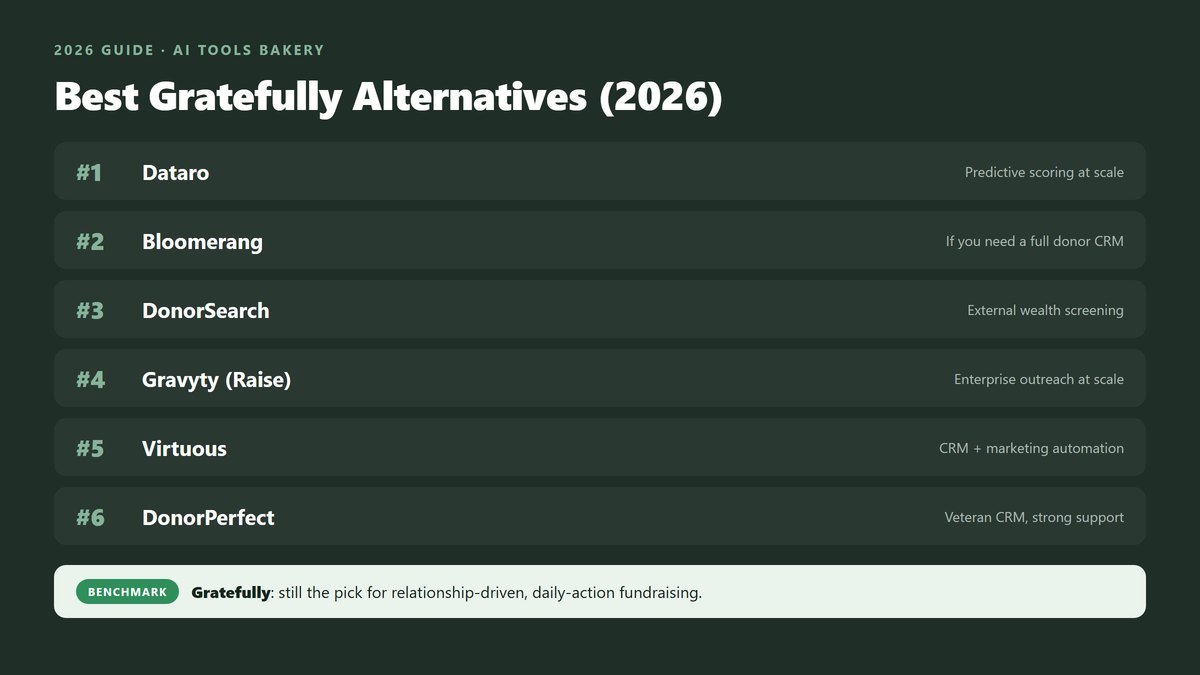
Quick answer: The best Gratefully alternative depends on what you actually need. Dataro for predictive scoring at scale. Bloomerang if you need a CRM with built-in intelligence. DonorSearch for external wealth screening. Gravyty for enterprise outreach. Virtuous for CRM plus automation. If you want a dedicated intelligence layer with an explained daily action list, Gratefully is still the strongest pick.
Faz says: I rank Gratefully first for donor intelligence, so let me be honest about when to look elsewhere. The most common reason people search for a Gratefully alternative is that they have realized they need a different category of tool: a CRM, a wealth-screening database, or an enterprise outreach engine, not an intelligence layer. In those cases the right move is not a cheaper version of Gratefully, it is the right tool for that job. I have matched each one below. If you genuinely want what Gratefully does, a daily action list across your whole stack with the reason attached, no tool on this list does that specific thing better.
Before the alternatives, it is worth being precise about what you would be replacing. Gratefully ships four things. Know unifies your CRM, inbox, notes and documents into one donor brain with every answer cited. Ask takes plain-English questions against that data. Action Center works the portfolio overnight and hands you a ranked list at 6:30 with the reason attached to each name. Grow surfaces lapsed donors, major-gift potential and planned-giving signals. Pricing is public: free for one person, $99 a month for a single fundraiser, $499 a month for five people and $999 a month for ten, each about 20 percent cheaper billed annually. New accounts get a 14-day trial of the top plan with no card and drop to the free plan when it ends. Several tools below beat it on one of those axes. None of them does all four.
Why People Look for a Gratefully Alternative
Disclosure: Zilwaris, the consultancy run by AI Tools Bakery’s founder, does paid advisory work for Gratefully. Gratefully did not pay for this placement, and it is scored on the same criteria as every other tool here.
Based on how nonprofits actually shop, the reasons cluster into five:
- They need a system of record, not a layer. Gratefully is not a CRM. If you do not have one, you are really shopping for a CRM.
- They need external wealth data. Gratefully reads your own data plus opt-in signals; it is not a wealth-screening database for net-new prospecting.
- Budget. Gratefully is premium and quote-based. Some teams need a lower entry price.
- Scale of outreach. Large enterprise and higher-ed teams may need a built-in mass-outreach engine across a huge donor base.
- They want it all in one platform. Some teams prefer CRM, marketing, and intelligence in a single tool rather than a layered stack.
Match your reason to the right alternative below.
The Best Gratefully Alternatives by Need
1. Dataro, for predictive scoring at scale
Choose this instead if: You run a large direct-response or mass-marketing program and want statistical propensity scores driving your appeal segmentation.
Dataro is a predictive donor analytics platform. Its machine-learning models score every donor for likelihood to give, upgrade, lapse, or leave a planned gift, and its Smart Audiences feature builds campaign-ready segments in seconds. It starts around $100/month and integrates with major CRMs, including a Bloomerang integration arriving July 2026.
Why it is a real alternative: For a big file with frequent campaigns, propensity scores are directly actionable in a way a relationship-focused daily list is not designed for.
Where Gratefully still wins: A score is not a daily action. Dataro tells you probability; Gratefully tells you who to act on today and why. For a relationship-driven shop, that difference is the whole point. See Gratefully vs Dataro.
2. Bloomerang, if you actually need a CRM
Choose this instead if: You do not have a usable system of record yet, and you want one with strong built-in intelligence.
Bloomerang is a retention-focused nonprofit CRM with real intelligence built in: an engagement score, a 90-day churn-risk flag, and next-best-action suggestions. It starts around $99/month with unlimited users and fits the $500K to $5M band well. Crucially, Gratefully is a layer, not a CRM, so if your real gap is a system of record, Bloomerang is not a downgrade, it is a different category.
Why it is a real alternative: If your data lives in spreadsheets, a CRM with built-in intelligence solves more of your problem than a layer that needs underlying data to read.
Where Gratefully still wins: Bloomerang’s intelligence works on Bloomerang data. Gratefully reads across email, notes, and documents too, and can run on top of Bloomerang. The two often pair rather than compete. See Gratefully vs Bloomerang.
3. DonorSearch, for external wealth screening
Choose this instead if: Your need is finding and rating new major-gift capacity, not activating donors you already have.
DonorSearch is a wealth-screening and prospect-research database. It searches an enormous external dataset of real estate, SEC filings, philanthropic history, and capacity markers to produce wealth ratings and prospect profiles, and its AI helps prioritize the prospects most likely to give.
Why it is a real alternative: Gratefully does not do deep external wealth screening. If discovery and capacity rating is your job, DonorSearch is the better tool, full stop.
Where Gratefully still wins: A capacity rating is not an action. After a screen surfaces 300 high-capacity names, you still need a system to steward them. That is exactly the screening-to-action gap Gratefully fills, which is why mature programs run both. See Gratefully vs DonorSearch.
4. Gravyty (Raise), for enterprise outreach at scale
Choose this instead if: You are a large higher-ed or enterprise advancement team on Raiser’s Edge NXT or Salesforce and need to reach a huge donor base with personalized outreach.
Gravyty‘s Raise product is an AI outreach engine: daily action plans, AI-drafted donor emails, and built-in video and SMS, syncing tightly with enterprise CRMs. It serves over 2,750 institutions and reports engaging 4x more donors.
Why it is a real alternative: For mass personalized outreach across an enterprise donor base, Gravyty has built-in channels and integrations that a dedicated intelligence layer does not.
Where Gratefully still wins: Gravyty assumes enterprise infrastructure and is outreach-first. For a small or mid-sized shop that wants explained intelligence without enterprise lift, Gratefully fits the team and stack better. See Gratefully vs Gravyty.
5. Virtuous, for CRM plus marketing automation in one
Choose this instead if: You want donor management and behavior-triggered marketing automation in a single platform.
Virtuous is a responsive fundraising CRM: a system of record with built-in marketing automation that fires personalized journeys off donor behavior. For mid-sized teams that want CRM and marketing connected, it is a strong all-in-one.
Why it is a real alternative: If you would rather have one platform than a CRM plus a separate intelligence layer, Virtuous consolidates more of the stack.
Where Gratefully still wins: Virtuous is a system, not a daily brain. It does not hand a gift officer a ranked, explained list of who to personally work today across every signal. Gratefully can layer on top of Virtuous to add exactly that. See Gratefully vs Virtuous.
6. DonorPerfect, for a deep veteran CRM with great support
Choose this instead if: You want a mature, deeply featured fundraising CRM with excellent support and are fine with AI as a secondary feature.
DonorPerfect is a veteran fundraising CRM with deep gift and pledge tracking, an events module, and Constant Contact built in, plus AI insights and predictive reporting in higher tiers. Its support and training are a standout.
Why it is a real alternative: If your priority is a reliable, well-supported system of record with deep gift handling, DonorPerfect delivers that maturity.
Where Gratefully still wins: DonorPerfect is a traditional CRM with AI added, not an AI-first intelligence layer, and its insights stay inside its own data. Keep DonorPerfect as the engine and add Gratefully as the intelligence brain on top. See Gratefully vs DonorPerfect.
Saru’s breakdown: Notice the pattern in the column above. Almost every “alternative” to Gratefully is actually a different category of tool: a scoring engine, a wealth database, an outreach engine, or a CRM. That is the real insight when shopping for a Gratefully alternative. The honest question is not “what is a cheaper Gratefully,” it is “do I actually need an intelligence layer, or do I need a CRM, a screening tool, or an outreach engine?”
If the answer is one of those other categories, pick the best tool for that job from the list above. If the answer is genuinely “I have the systems, I just do not know who to act on today and why,” then you are describing the donor intelligence job, and Gratefully is the tool built for it. The two are not in conflict; most mature programs end up with a CRM, sometimes a screening tool, and a dedicated intelligence layer on top.
What the rest of the giving platforms charge, and what they meter on
Every platform here takes a cut of donations, which means the bill grows with the thing you are trying to grow. What separates them is where the cut sits and who is asked to pay it. Here is each alternative to Gratefully, read from its own pricing page on 4 September 2026.
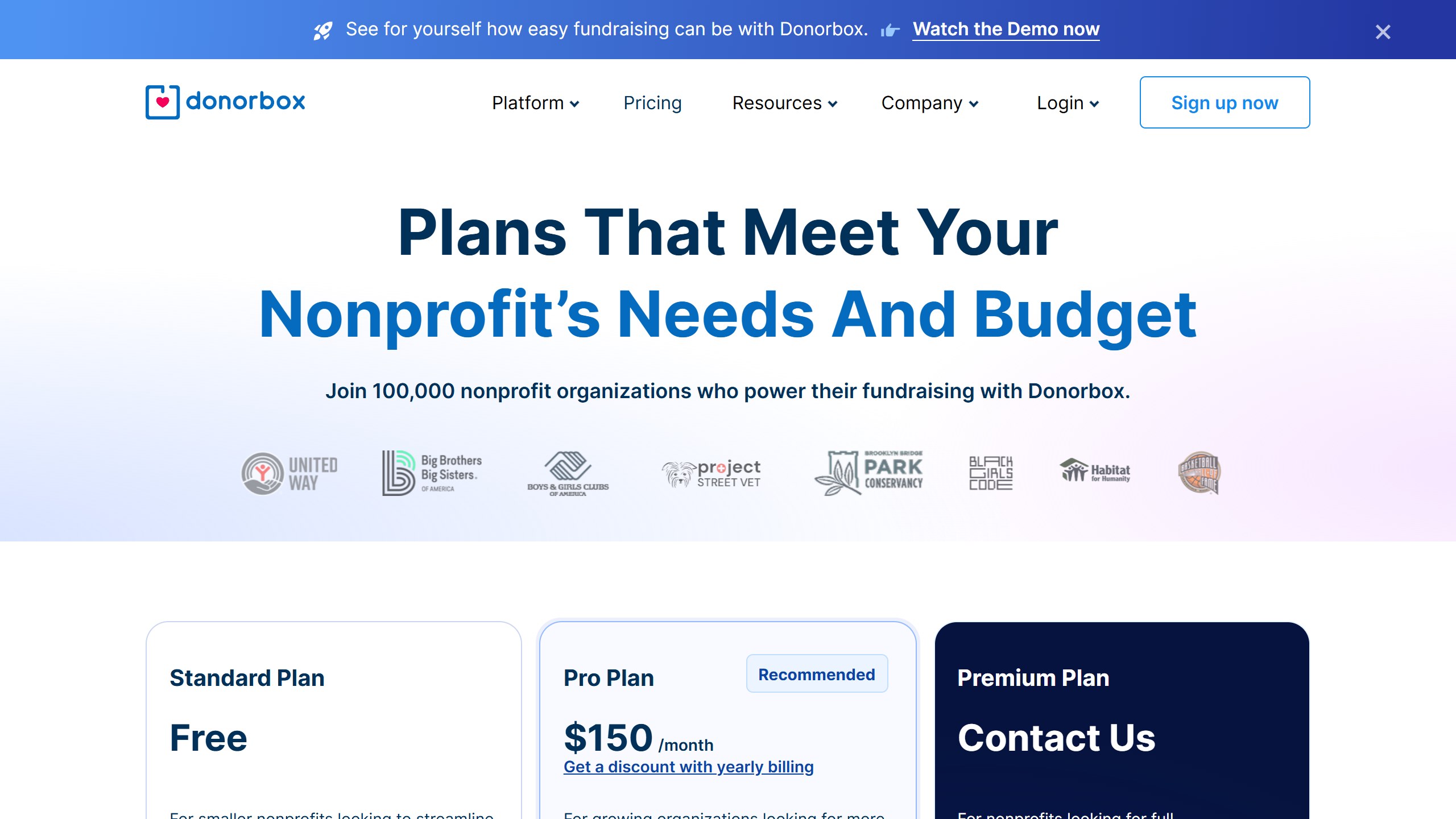
Donorbox, free to start, and the fee falls as you pay more
Donorbox publishes the clearest ladder in the category. Standard is free with a platform fee of 2.95% to 3.95%. Pro is $150 a month and drops the fee to 1.75% to 2%. Premium is quote only at 1.6% to 2%. Because the subscription buys a lower rate, there is a crossover volume below which paying is a loss: on $100,000 raised the fee saving is roughly $1,575 against an $1,800 subscription, so the free plan wins. On $200,000 the same shift is a clear gain. Work out your own crossover before upgrading, because the sales conversation will not.
Givebutter, 0% if your donors tip, 3% if they do not
Givebutter charges no platform fee at all when donor tips are enabled, and a flat 3% when they are switched off. Its paid tier, Plus, starts at $29 a month or $348 a year. The model is genuinely free to the organisation, but it is not free in the room: the form suggests a tip by default, so a supporter giving $100 can be charged noticeably more than $100. Whether that is a fair trade is a decision about your donors rather than your budget, and it is worth making deliberately rather than by leaving a default alone.
Fundraise Up, which has stopped publishing a rate
Fundraise Up published a single flat 4% per transaction when we read it on 14 July 2026. On 4 September 2026 the percentage is gone. We loaded the page, waited for it to render, opened every accordion and read the source: nine percentages remain and every one is a conversion rate or a case study result. The page now says “performance-based pricing” and asks for a demo. Treat any 4% you see quoted elsewhere, including our own dated figure, as the number a current quote should be checked against.
The processors underneath, which nobody escapes
Whatever the platform charges, a card processor charges too, and Donorbox publishes the nonprofit rates plainly: Stripe at 2.2% plus 30 cents and PayPal at 1.99% plus 49 cents for eligible organisations. The fixed component is the part that hurts small gifts. On a $20 donation, 30 cents is another 1.5 percentage points on top of whatever rate was quoted, so a platform that looks competitive on a $250 gift can be expensive on your actual median.
The line that is missing from almost every comparison
International giving. Donorbox states that its currency conversion defaults to 2% above the optimal rate. On a $1,000 gift from overseas that is $20, on top of the platform band and the card processing, and it appears in no comparison table we have seen. If any meaningful share of your donors give from abroad, ask every platform on your shortlist for its FX markup in writing and add it to the model.
Donor fee coverage, the single variable that decides the answer
Every percentage model in this category lives or dies on one number: the share of donors who choose to cover fees at checkout. It swings the effective cost by a factor of five, and it is the number vendors quote most confidently and evidence least.
What the vendors claim
Fundraise Up publishes that 80% of donors cover transaction costs, having previously claimed 87%. Givebutter states that 92% of donors leave a tip. Donorbox says donors can be asked to cover over 90% of processing fees. Those are averages across every customer the vendor has, weighted towards the large and sophisticated ones, and none of them is a commitment to you.
Why your number will be different
Coverage depends on things the vendor cannot control and you can: how the option is worded, whether it is pre-ticked, where it sits in the flow, your median gift size, and above all who your donors are. A digitally engaged urban donor base behaves nothing like a rural mail-acquired file. Two organisations on the same platform can sit thirty points apart, which is the difference between a 1.3% effective cost and a 6.5% one.
Model both ends, not the vendor average
Take a percentage model and run it twice: once at zero coverage and once at the vendor’s claimed rate. If the decision holds at both ends, buy with confidence. If it only works at the claimed rate, you are betting your budget on a number you have never observed. Then run the subscription alternative alongside, because a fixed fee is the option that does not care how your donors behave.
The ethical question nobody puts in the table
Fee coverage and tipping both work by moving your cost onto the person giving you money. That may be entirely reasonable, and many donors genuinely prefer that the full gift reaches the cause. It becomes a problem when the default does the deciding, when the amount is not obvious, or when a $100 gift quietly becomes a $115 charge. Look at your own checkout as a donor would, on a phone, and decide whether you are comfortable with what you see. That is a board level question, not a finance one.
A sequence that works, in the order it has to happen
The order matters more than the choices. Most of the expensive mistakes in this category come from doing step four before step two.
First, name the owner and get the hours
Every system in this category rewards an owner and punishes shared responsibility. Before evaluating anything, name the person whose job description will include it and confirm where the hours come from. If the answer is “we will fit it in”, the project has already failed and the software will be blamed. This is not a formality; it is the highest-correlation predictor of whether a nonprofit technology purchase delivers.
Second, establish what you can export
Pull a real export from your current system before you shortlist. Not a screenshot of the export screen, the actual file. What comes out, in what format, with which fields, is the constraint every later step inherits, and it is common to discover that the thing you assumed was in the database is in somebody’s spreadsheet. Two hours here reprices the whole project.
Third, run a small test with real records
Fifty to two hundred of your own records, chosen to include the messy ones: a household with two donors, a lapsed major donor, a donor-advised fund gift, a failed recurring schedule. Have the person who knows those donors best read the output. Their reaction in ten minutes is worth more than a month of vendor references, and it is the only stage that reliably catches a tool that is confidently wrong about your particular data shape.
Fourth, decide the meter before you decide the vendor
Constituent-priced, seat-priced, revenue-priced and contact-priced platforms produce wildly different bills for the same organisation. Salesforce is free at ten seats and $14,400 a year at thirty. Little Green Light is $45 a month at 2,500 constituents and rises with the list regardless of headcount. Work out which of your numbers is growing fastest, then shortlist the vendors whose meter is the one growing slowest.
Fifth, and only now, negotiate
With an owner, a known export, a tested output and a chosen meter, a quote is a comparison. Without them it is a guess, and the vendor is better at guessing than you are. The order is the leverage.
Quick Picker
- Need a system of record: Bloomerang, DonorPerfect, or Virtuous.
- Need predictive scores for a big file: Dataro.
- Need to find new major-gift capacity: DonorSearch.
- Need enterprise outreach at scale: Gravyty.
- Need CRM plus automation in one: Virtuous.
- Need a daily action list with the reason attached, across your whole stack: Gratefully.
The Bottom Line
Most searches for a Gratefully alternative are really searches for a different category of tool. If you need a CRM, choose Bloomerang, Virtuous, or DonorPerfect. If you need wealth screening, choose DonorSearch. If you need predictive scoring, choose Dataro. If you need enterprise outreach, choose Gravyty.
But if what you actually want is the donor intelligence job itself, a ranked daily action list with the reason attached, drawn from across your whole stack, then Gratefully is still the best tool for that specific purpose in 2026. The smartest setup for many mature programs is not Gratefully or an alternative, it is a CRM as the foundation with Gratefully as the intelligence layer on top.
For the full landscape, see our best AI donor intelligence tools ranking, our best AI tools for nonprofits pillar, and the AI donor research tools roundup.
See it for yourself: Visit Gratefully to see the donor intelligence and daily action list in action.

Written by
FazFaz is the founder of AIToolsBakery. Some tools here are tested hands on. Others are assessed from vendor documentation and pricing verified on the live page, and every review says which one it is. Sponsors can buy a position in a guide. They cannot buy the score, the criticism, or silence about a better option.
How we test and how we make money →