The fastest way to lose a real estate lead is to answer it slowly, and the fastest way to waste one is to never follow up. AI inside sales agents and lead-qualification tools exist to fix both. They reply in minutes at any hour, ask the questions a good agent would, and keep the conversation alive for months until a lead is ready to act. The category is crowded and uneven, so this guide ranks the tools that actually do the job and explains which one fits which kind of agent.
Short answer: The best AI ISA and lead-qualification tools for real estate in 2026 are Structurely for proven long-cycle nurture, Ylopo for lead generation plus AI nurture, Perspective AI for conversational lead capture, and Roof AI or FusionSync for lighter chat-first qualification. Match the tool to the gap in your funnel.
How we ranked these tools
We judged each tool on the things that actually drive results: how fast it responds, how well it qualifies a lead, how long and how naturally it nurtures, how cleanly it hands off to a human, and how well it fits a real estate workflow and budget. We are a review site and take no payment for placement. Where we have not run a tool through a full test, we describe what it does and what to verify, rather than inventing a score. Prices move and most vendors quote by seats or usage, so treat every figure as a starting point.
Quick comparison
| Tool | Best for | Starting price |
|---|---|---|
| Structurely | Proven standalone AI ISA and long-cycle nurture | Not published, quote only |
| Ylopo (rAIya) | Lead generation plus AI nurture in one | Not published, quote only |
| Perspective AI | Conversational lead capture at the top of the funnel | Free, Pro from $99/mo |
| Roof AI | Lightweight chat-first qualification and routing | Free tier, then $349 to $749/mo |
| FusionSync | Real-estate-specific AI lead qualifier | $300 to $400 setup plus $300/mo support |
Correction, 5 August 2026: an earlier version of this guide reported that Roof AI published no pricing. That was our error. Roof AI does publish a full tier ladder; our first check used too short a page-load window and missed it. The figures below are read from its pricing page.
Three of These Five Vendors Will Not Tell You the Price
We checked every vendor’s own pricing page on 5 August 2026. The result is the single most useful thing a buyer can know about this category before they start booking demos.
| Tool | Publishes a price? | What the vendor’s own page shows |
|---|---|---|
| Structurely | No | Quote-gated. No figure anywhere on the pricing page |
| Ylopo | No | An ROI calculator and client results, no rate card |
| Perspective AI | Yes | Free tier, Pro from $99 a month |
| Roof AI | Yes | Free tier, Core $349/mo, Intelligence $749/mo, Full service on quote |
| FusionSync | Yes | $300 to $400 to implement plus $300 a month to support, typically live in 3 to 7 days. Per-client tiers of $300 to $400 and $800 to $1,000 |
Perspective AI, FusionSync and Roof AI publish something you can act on. Structurely and Ylopo do not, and require a sales conversation before you learn what you would pay, which has a real cost: you cannot shortlist on budget, so you end up sitting through demos for tools you were never going to afford.
We have deliberately removed several specific figures that appeared in earlier versions of this guide. Numbers circulate in this category through forums, resellers and old sales decks, and they are easy to repeat and impossible to stand behind. If a vendor does not publish it, we are not going to print it as though they did. Where we quote a figure below, it came from the vendor’s own page on the date stated.
What FusionSync’s Published Numbers Tell You About the Rest
FusionSync is the only vendor here that lays out the full shape of the cost, and it is worth reading closely because it shows you what the quote-gated vendors are likely also charging for.
Its entry tier is $300 to $400 to implement, then $300 a month to support, typically live in three to seven days. Note the structure: a one-off build cost separate from the recurring fee. That split is normal for conversational AI and it is the part buyers forget to ask about. When you get a quote from a vendor that does not publish, ask for both numbers, because a low monthly can hide a four-figure setup.
FusionSync also publishes productized agency tiers from $300 to $400 at the low end up to $800 to $1,000, which tells you roughly where the ceiling sits for a small-to-mid real estate operation buying this kind of qualifier. Treat that as your sanity check. If a quote-gated vendor comes back materially above that band, ask what you are getting that FusionSync’s top tier does not include.
The three to seven day implementation window is the other useful benchmark. Ask any vendor how long until you are live. If the answer is measured in weeks rather than days, that is a scoping difference worth understanding before you sign.
1. Structurely: best standalone AI inside sales agent
Structurely is the most proven dedicated ISA in real estate. Its assistant, Aisa Holmes, engages new leads within about five minutes over text, email, and voice, qualifies them, and nurtures them through campaigns of twelve months or more before handing off to an agent. The company reports over 13 million conversations and a 57 percent response rate, and its conversations are built to feel human, with natural delays and phrasing. On higher tiers it places genuinely human-sounding AI voice calls, a channel most text-only tools lack.
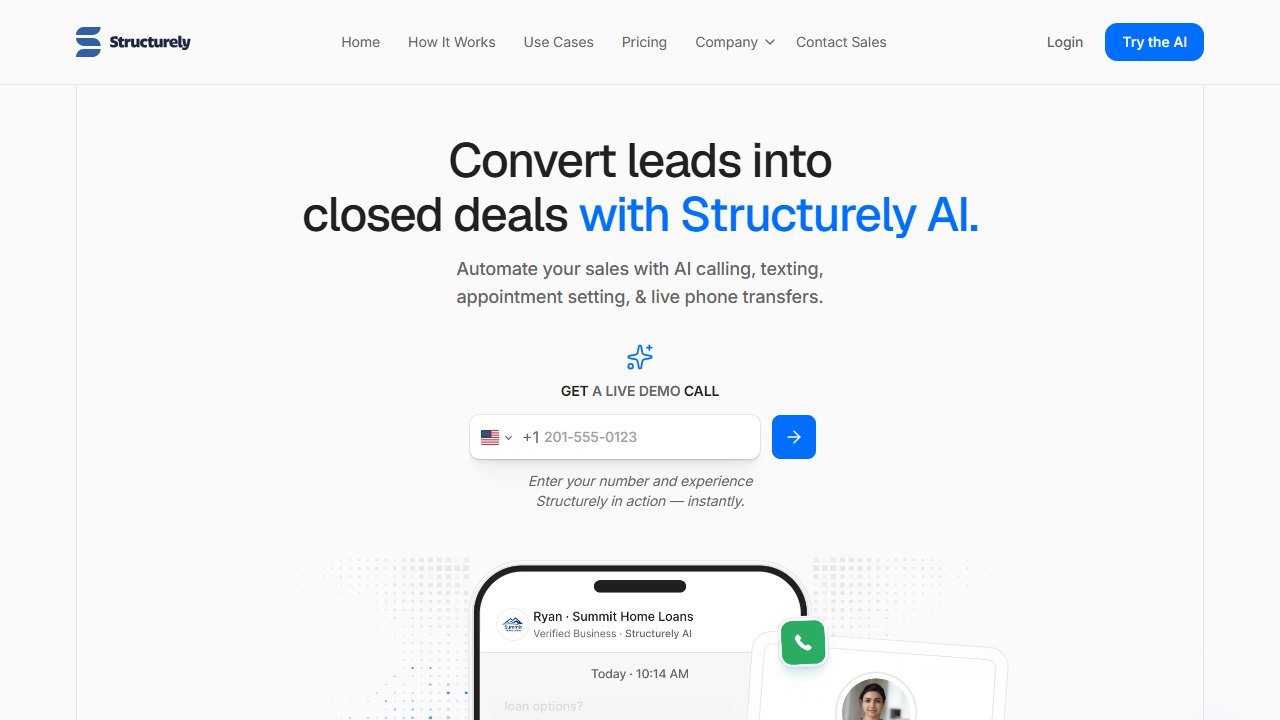
Since the January 2026 CapStone acquisition, Structurely does not publish pricing. Its pricing page was quote-gated when we checked it on 5 August 2026, with no figures shown for plans, per-action credits, onboarding or contract terms. Figures for Structurely circulate second-hand, and we are not going to repeat them as though the vendor had confirmed them. Ask for a written quote covering the monthly fee, any per-action or credit charges, onboarding, and whether month-to-month carries a premium over an annual commitment. That commitment is the main barrier, which makes Structurely a considered purchase for teams with steady lead flow rather than a casual trial. Note that Structurely was acquired by CapStone Holdings in early 2026, so ask about roadmap and pricing before a long agreement. For a team that generates its own leads and wants a tireless, proven nurture engine, it is the top pick. Read our full Structurely review.
Structurely repriced to an action-credit model after its January 2026 acquisition, and the old tier numbers floating around the web are stale. Our Structurely pricing breakdown documents the current credit math.
2. Ylopo: best for lead generation plus nurture
Ylopo runs Facebook and Google lead-generation campaigns and hands the leads to its AI layer, now branded Ylopo AI, which qualifies and nurtures by text and voice across a roughly ninety-day window and beyond. It is the strongest choice for teams that want their lead generation and their nurture from a single vendor rather than stitching two tools together, at a price Ylopo does not publish. Its pricing page shows an ROI calculator and client results rather than a rate card, so budget on a quote rather than on a figure you read elsewhere. The tradeoff is that you are paying for the lead-gen engine as well, which is only a bargain if you actually need it. If you already have a lead source, a standalone ISA is usually better value.
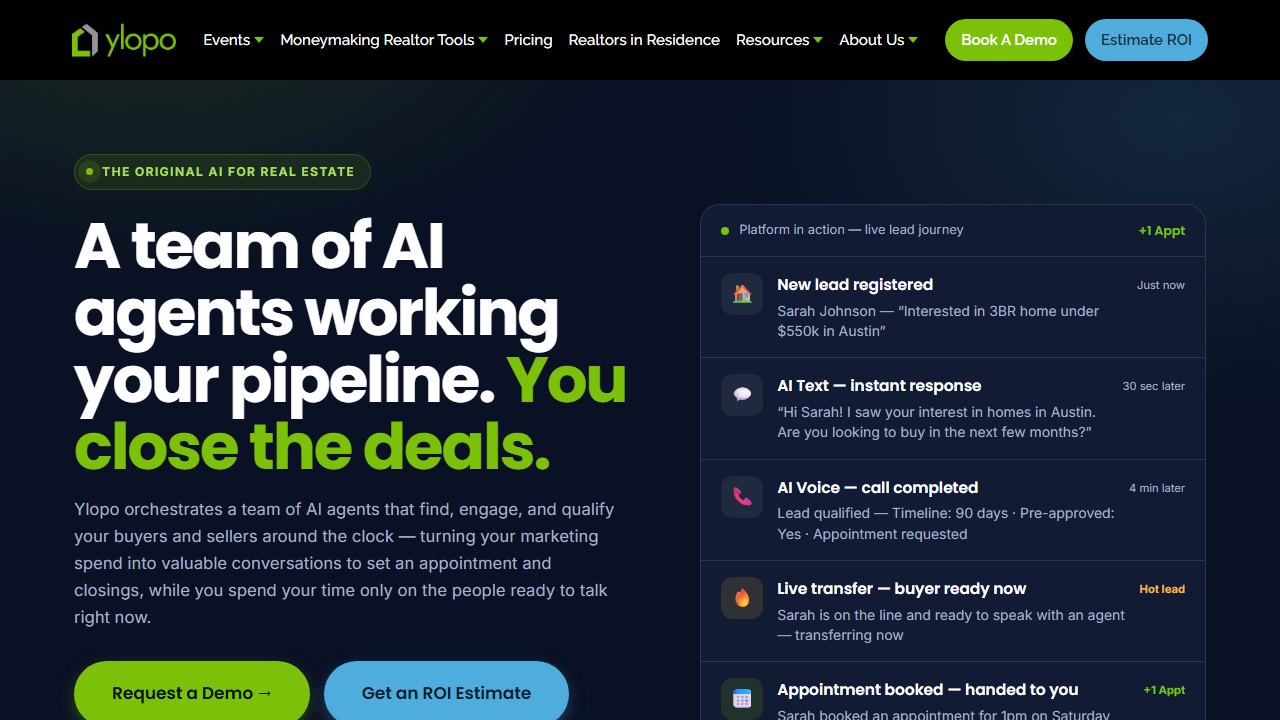
Ylopo quotes every deal individually, so budget before the demo: our Ylopo pricing guide reconciles the reported figures into realistic all-in totals.
3. Perspective AI: best for conversational lead capture
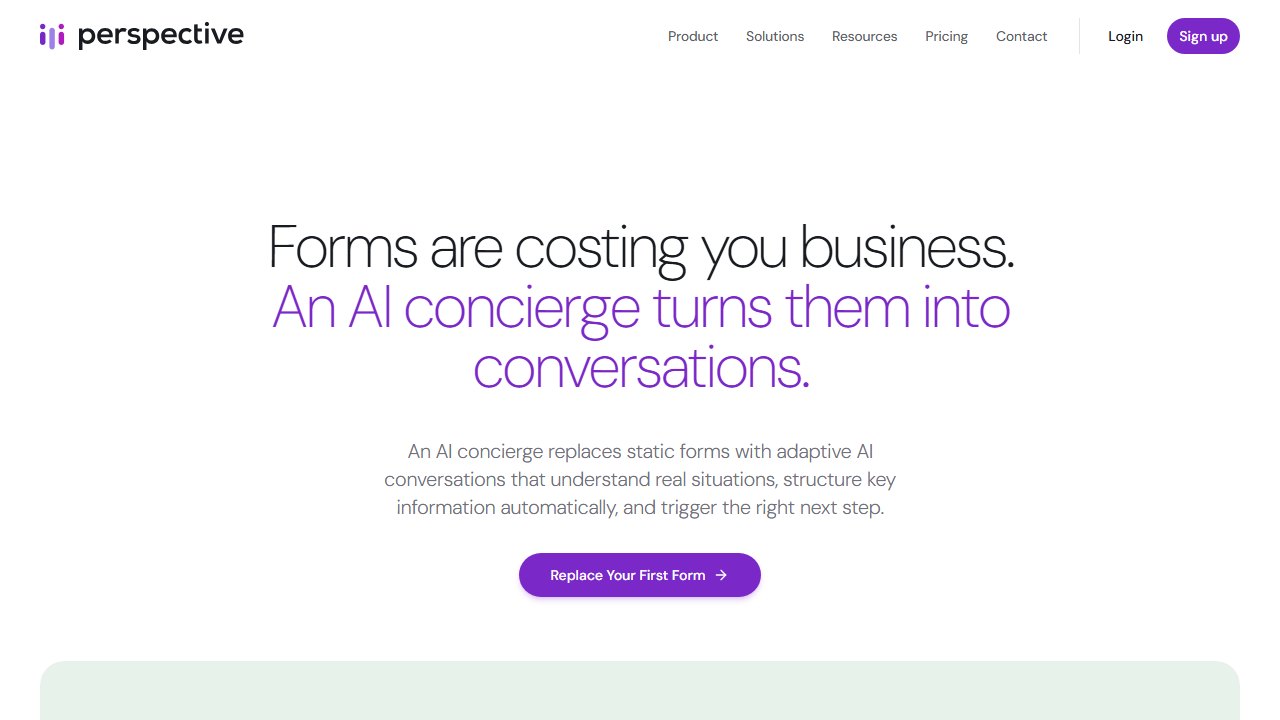
Perspective AI attacks the problem one step earlier, at capture. It replaces the static contact form, the biggest leak in an agent’s funnel, with an adaptive AI conversation that qualifies budget, timeline, financing, and motivation in the prospect’s own words. You build flows from templates in minutes, and it produces a rich, qualified lead instead of a bare name and email. There is a free tier and a Pro plan from $99 per month. It is a general conversational platform rather than a real-estate-native ISA, so wire it to your CRM and pair it with a nurture tool behind it. As a front door to the funnel, it is excellent. Read our full Perspective AI review.
4. Roof AI: best lightweight chat qualifier
Roof AI is a chat and messaging assistant that qualifies and routes leads across your website and social channels, at a published price: a free tier capped at 5 leads a month, Core at $349 a month for unlimited leads, Intelligence at $749 a month adding AI-qualified leads with intent and timeline, and a custom Full service tier sold annually. Quarterly billing is advertised at up to 20% off, with no setup fee and no card required to start. It is a good fit for agents who want a messaging-first layer that is lighter and faster to deploy than a full ISA, without the setup fee and commitment that come with the heaviest tools. You give up the deep, months-long nurture cadence of a dedicated ISA, but for many agents a fast, capable qualifier is exactly the right first step.

5. FusionSync: real-estate-specific qualifier
FusionSync positions itself specifically as an AI lead qualifier for real estate, which makes it worth trialing against Roof AI and Perspective AI to see which conversational style best fits your leads. Qualification tools vary more in tone and feel than their feature lists suggest, so the right choice often comes down to which one talks to your prospects in a way that matches your brand.

Already on Structurely and rethinking it after the price restructure? Our guide to the best Structurely alternatives maps replacements by switch scenario.
Worth knowing if you are already on CINC: its CINC AI texting add-on is Structurely-powered, and a $200 a month starting figure is widely cited for it, though we could not confirm that on either vendor’s current pricing page. Our CINC pricing breakdown runs the full platform math around it.
Which one should you choose?
- You generate your own leads and lose them to weak follow-up: Structurely.
- You want leads and nurture from one vendor: Ylopo.
- You have site traffic but poor form conversion: Perspective AI.
- You want a fast, light qualifier without a big commitment: Roof AI or FusionSync.
And if Ylopo’s stack tax is the sticking point, our roundup of the best Ylopo alternatives compares the credible replacements, including the platforms with published pricing.
How to tell whether the tool paid for itself
Real estate software is unusually easy to evaluate honestly, because the outcomes are countable. Most teams still do not do it, and the renewal conversation becomes an argument about impressions.
Pick the metric the tool is supposed to move
For a lead platform it is cost per closed transaction. For property management software it is hours of admin per unit per month, and days to fill a vacancy. For staging it is days on market and list-to-sale ratio. For screening it is time to approve and the rate of problem tenancies. Each of those is available from records you already keep, and each needs a figure from before you started.
Take the baseline before you switch anything on
You need last year of the metric from a source the project did not touch. This is the step that gets skipped and it is the reason most of these purchases can never be evaluated. It costs an hour. Ask the two or three people whose work will change to record how long the target task takes them this month, because time saved is measurable in advance and unprovable afterwards.
Give it a full cycle before judging
Leasing and transactions are seasonal, so a six week read tells you very little. Judge lead tooling over at least two quarters, and property management tooling over a full turnover cycle, because the value shows up at move-out and move-in rather than in the quiet middle. Say that at the outset so an unremarkable month one is understood as expected.
Write the stop condition down first
Before purchase, name the result at twelve months that would mean you do not renew. It converts renewal from a default into a decision and it is the most effective discipline against a subscription that quietly becomes permanent. If nobody can name a result that would end it, the evaluation was never real.
How these purchases go wrong, and the early warning signs
Four patterns cover most of what we hear a year after a real estate software purchase, and all four are visible in the first month.
The migration that never finishes
The new system goes live, the old one stays open “for historical records”, and eighteen months later half the team still works in both. This is the most common and most expensive failure in property management software. Before signing, agree a cutover date, a named owner, and what specifically will not be migrated. Running two systems is worse than either.
Tenant-facing features nobody told the tenants about
Online payments, maintenance portals and application flows only save time when residents actually use them, and adoption depends entirely on how the change is communicated. A portal with 20% adoption creates more work than paper did, because you now run two processes. Plan the resident communication before go-live and measure adoption at thirty days.
The tool one person runs
One capable person builds the workflows and produces every report. They leave and it stops the same week. The warning sign is that nobody else has ever done a full month-end in the system. Have a second person do it once a quarter from written steps.
The fees that arrive after the subscription
Payment processing, screening, e-signatures, bank account setup and inspections are all charged separately by most vendors in this category and all of them are published. A business case built on the subscription alone will be wrong in year one, usually by a four figure sum. Build the model from the fee schedule, not the plan cards.
The bottom line
There is no single best AI ISA, only the best one for where your funnel leaks. Structurely wins on proven long-cycle nurture, Ylopo on bundled lead generation, Perspective AI on capture, and the lighter qualifiers on speed and simplicity. Start where you lose the most money, add one tool, measure whether it moves your lead-to-appointment rate, and expand from there. For the full workflow picture, see our guide to the best AI tools for real estate agents.
More AI tool guides worth reading: REimagineHome vs Collov, Structurely vs Ylopo and How to Use AI for Real Estate Lead Follow-Up.
More AI tool guides worth reading: Best AI Listing Description Generators and Best AI Property Management Software.

Written by
FazFaz is the founder of AIToolsBakery. Some tools here are tested hands on. Others are assessed from vendor documentation and pricing verified on the live page, and every review says which one it is. Sponsors can buy a position in a guide. They cannot buy the score, the criticism, or silence about a better option.
How we test and how we make money →