Givebutter’s pricing page leads with a number every development director loves: 0% platform fees. And it is true, with an asterisk the size of a donation form. The free model runs on donor tips, the forms default to a 15% tip, and the math looks very different depending on which side of the checkout you are standing on. Vendor pages show you the nonprofit’s side. The TruthInAdvertising watchdog coverage shows you the donor’s side. Nobody puts both on one page, so we did, with worked examples on a $100 donation and the first neutral breakdown of the new Givebutter Plus contact-based tiers.
This page is fee math only. For the feature verdict, our full Givebutter review covers the platform itself, and Givebutter vs Fundraise Up covers the head-to-head. All figures below were verified on givebutter.com/pricing on July 14, 2026.
Givebutter fees at a glance
Before you sign. This page covers the fees. Our Givebutter company evaluation covers the contract around them, including the caps on the fee-credit programme that are published only inside your account, and the clause that treats discouraging donor tips as misuse.
| Fee or plan | Tips enabled | Tips disabled |
|---|---|---|
| Platform fee | 0% on all campaign types | Flat 3% |
| Card processing | 2.9% + 30c per transaction | 2.9% + 30c per transaction |
| ACH processing | 1.9% + 30c per transaction | 1.9% + 30c per transaction |
| Net on a $100 card gift (donor covers nothing extra) | $96.80 | $93.80 |
| Donor’s total charge on a $100 gift (default 15% tip) | $115.00 | $100.00 |
| Givebutter Plus | $29/mo up to 250 contacts ($348 billed annually), $79/mo at 1,000, $129/mo at 2,500; overage in 100-contact increments | |
| Direct mail add-on | 95c per letter on Plus, 99c per letter without Plus | |
| Payouts | Free; direct deposit in 2 to 3 business days | |
How the 0% platform fee actually works
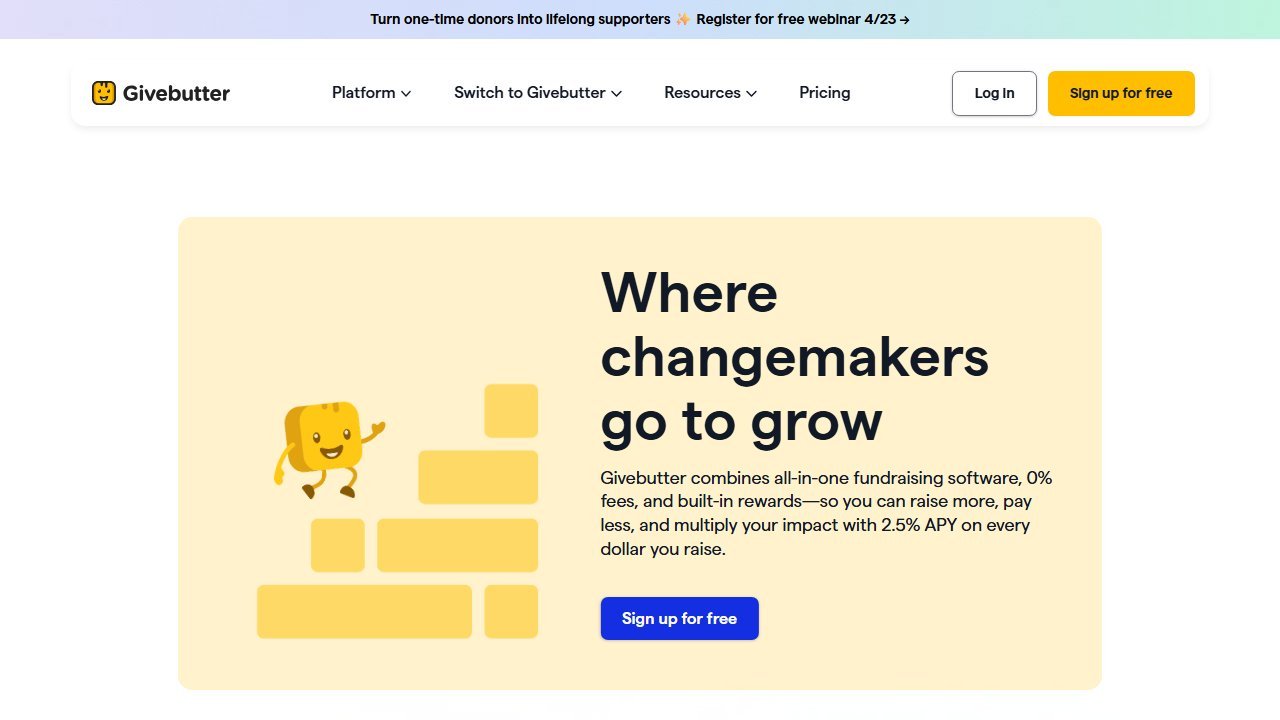
Givebutter applies a 0% platform fee across all campaign types, from donation forms to events to peer-to-peer pages, as long as donor tips are enabled. Tips are the business model: at checkout, the donor is asked to add an optional contribution on top of their gift, and that contribution goes to Givebutter, not to your organization.
Two numbers define how this plays out in practice. Givebutter states that 92% of donors leave a tip, and watchdog reporting notes the forms default to a 15% tip. Donors can change the amount or set it to zero, but defaults are powerful, which is exactly why the model sustains a free platform.
The important accounting point: the tip never touches your books. Your nonprofit receives the donation amount minus processing (unless the donor covers processing too, which Givebutter also offers at checkout). The tip is a separate payment from your donor to Givebutter. That is not a hidden fee on you, but it is real money your donors are spending that does not reach your mission, and you should decide deliberately whether you are comfortable with it.
The $100 donation, both ways
Here is the math that vendor pages and watchdog pieces each show half of. We are showing both halves.
Scenario 1: tips on (the default)
A supporter enters a $100 donation. The form suggests a 15% tip, and like most donors, they accept the default.
- Donor’s card is charged: $100 gift + $15 tip = $115.00
- Platform fee to Givebutter: $0 (0% with tips on)
- Card processing on the gift: 2.9% of $100 + $0.30 = $3.20
- Your nonprofit nets: $100.00 − $3.20 = $96.80
- Givebutter receives: the $15.00 tip
From your side of the ledger, this is a 3.2% all-in cost. Excellent. From the donor’s side, their $100 of generosity cost them $115, and $15 of it went to a software company. Both statements are true at the same time. If the donor also checks the box to cover processing, you net the full $100.00 and their charge climbs a few dollars higher still.
Scenario 2: tips off
You disable tips because you do not want donors asked for extra money. Now the flat 3% platform fee applies.
- Donor’s card is charged: $100.00
- Platform fee: 3% of $100 = $3.00
- Card processing: 2.9% of $100 + $0.30 = $3.20
- Total fees: $6.20
- Your nonprofit nets: $93.80
That is a 6.2% all-in cost on cards, which is in the same neighborhood as Fundraise Up’s effective rate before donor fee coverage. On ACH the picture improves: 3% platform + 1.9% + $0.30 processing = $5.20 in fees, so a $100 bank transfer nets $94.80. For large gifts, steering donors toward ACH is the single easiest fee optimization on the platform.
Tips on or tips off: how to decide
The honest framing is that someone always pays for the software. With tips on, your donors pay, mostly without thinking about it. With tips off, you pay, predictably, at 3%.
Tips on makes sense when you are small, budget-constrained, and your donors skew casual (event attendees, peer-to-peer givers, one-time supporters who will not scrutinize a checkout page). It is how a genuinely free stack stays free, which is why Givebutter anchors our best AI tools for small nonprofits thinking on the fundraising side.
Tips off makes sense when your donor base includes major donors, foundations, or repeat givers who notice checkout mechanics, or when your brand position is “100% of your gift goes to the mission” and a suggested 15% tip undercuts it. Budget the 3% as a cost of doing business and move on.
One more wrinkle worth knowing: the tip ask has drawn watchdog attention. TruthInAdvertising’s coverage of tip-funded platforms flags the default-tip pattern as easy for donors to miss. That has reputational implications if a donor later feels nickel-and-dimed, so if you keep tips on, we suggest mentioning it plainly in your donation page copy. Transparency costs nothing and preempts the complaint.
Givebutter Plus: the paid tier explained
The free platform is genuinely full-featured for fundraising, which we cover in the review. Givebutter Plus is the upgrade layer, and it prices on contacts, not on features or seats.
| Plus tier | Contacts included | Monthly price |
|---|---|---|
| Base | Up to 250 | $29/mo ($348 billed annually) |
| Mid | Up to 1,000 | $79/mo |
| Upper | Up to 2,500 | $129/mo |
Above those brackets, pricing scales in 100-contact overage increments, so growth raises your bill gradually rather than in cliff jumps. A few contract terms worth noting because they are unusually friendly for this category:
- Cancelable anytime. Cancellation takes effect at the end of the current billing period. No multi-year lock-in, no early termination clause to negotiate around, which is a sharp contrast with the annual contracts common among nonprofit CRMs like the ones in our DonorPerfect pricing breakdown.
- Payouts stay free on Plus and non-Plus accounts alike, with direct deposit in 2 to 3 business days.
- Direct mail add-on runs 95 cents per letter on Plus versus 99 cents without it. At 1,000 letters a year that is a $40 difference, so mail volume alone will not justify Plus, but it sweetens the math if you are upgrading anyway.
The contact-based model has one budgeting quirk: your bill tracks your database size, not your usage. If you import a 3,000-contact legacy list of which 400 are active, you are paying upper-tier prices for dead records. Clean your list before you connect it. This is the same discipline that contact-priced CRMs like Bloomerang force on you, just at a much lower price point.
What a real budget looks like
A worked example for a small shop: say you raise $150,000 a year online at a $75 average gift, roughly 2,000 transactions, with tips on and half your donors covering processing.
- Platform fees: $0
- Processing you absorb: about 1,000 transactions x ($75 x 2.9% + $0.30) = about $2,475
- Givebutter Plus at the 2,500-contact tier: $129 x 12 = $1,548
- All-in annual cost: about $4,000, or 2.7% of online revenue
Run the same revenue through a tips-off setup and platform fees alone add $4,500 (3% of $150,000), before processing. The gap between those two numbers is what the donor tips are worth to your budget, and it is exactly the trade described above.
What about the AI features?
Givebutter ships an AI text assistant that can summarize, improve, and translate campaign copy, but it is in Early Access beta as of July 2026, not general availability. Do not build a workflow on it yet, and do not let it tip a pricing decision. If AI-assisted fundraising is a core requirement, our best AI fundraising tools for nonprofits roundup covers platforms where the AI is shipped and named, and our peer-to-peer software comparison breaks down which P2P platforms have real AI versus marketing copy.
One honest limitation
The fee structure itself has no hidden traps that we found: the numbers on the pricing page are the numbers you pay. The limitation is structural. Because the free model depends on tips, Givebutter has an incentive to keep the tip ask prominent, and you cannot control its presentation the way you could with a platform you pay directly. You choose on or off; the default percentage and the checkout framing are Givebutter’s call. Organizations that want full control over every pixel of the donor experience will feel that constraint, and it is worth weighing against a paid-platform alternative like Donorbox where the relationship is simpler: you pay, they serve you.
Donor fee coverage, the single variable that decides the answer
Every percentage model in this category lives or dies on one number: the share of donors who choose to cover fees at checkout. It swings the effective cost by a factor of five, and it is the number vendors quote most confidently and evidence least.
What the vendors claim
Fundraise Up publishes that 80% of donors cover transaction costs, having previously claimed 87%. Givebutter states that 92% of donors leave a tip. Donorbox says donors can be asked to cover over 90% of processing fees. Those are averages across every customer the vendor has, weighted towards the large and sophisticated ones, and none of them is a commitment to you.
Why your number will be different
Coverage depends on things the vendor cannot control and you can: how the option is worded, whether it is pre-ticked, where it sits in the flow, your median gift size, and above all who your donors are. A digitally engaged urban donor base behaves nothing like a rural mail-acquired file. Two organisations on the same platform can sit thirty points apart, which is the difference between a 1.3% effective cost and a 6.5% one.
Model both ends, not the vendor average
Take a percentage model and run it twice: once at zero coverage and once at the vendor’s claimed rate. If the decision holds at both ends, buy with confidence. If it only works at the claimed rate, you are betting your budget on a number you have never observed. Then run the subscription alternative alongside, because a fixed fee is the option that does not care how your donors behave.
The ethical question nobody puts in the table
Fee coverage and tipping both work by moving your cost onto the person giving you money. That may be entirely reasonable, and many donors genuinely prefer that the full gift reaches the cause. It becomes a problem when the default does the deciding, when the amount is not obvious, or when a $100 gift quietly becomes a $115 charge. Look at your own checkout as a donor would, on a phone, and decide whether you are comfortable with what you see. That is a board level question, not a finance one.
What the rest of the giving platforms charge, and what they meter on
Every platform here takes a cut of donations, which means the bill grows with the thing you are trying to grow. What separates them is where the cut sits and who is asked to pay it. Here is each alternative to Givebutter, read from its own pricing page on 4 September 2026.
Donorbox, free to start, and the fee falls as you pay more
Donorbox publishes the clearest ladder in the category. Standard is free with a platform fee of 2.95% to 3.95%. Pro is $150 a month and drops the fee to 1.75% to 2%. Premium is quote only at 1.6% to 2%. Because the subscription buys a lower rate, there is a crossover volume below which paying is a loss: on $100,000 raised the fee saving is roughly $1,575 against an $1,800 subscription, so the free plan wins. On $200,000 the same shift is a clear gain. Work out your own crossover before upgrading, because the sales conversation will not.
Givebutter, 0% if your donors tip, 3% if they do not
Givebutter charges no platform fee at all when donor tips are enabled, and a flat 3% when they are switched off. Its paid tier, Plus, starts at $29 a month or $348 a year. The model is genuinely free to the organisation, but it is not free in the room: the form suggests a tip by default, so a supporter giving $100 can be charged noticeably more than $100. Whether that is a fair trade is a decision about your donors rather than your budget, and it is worth making deliberately rather than by leaving a default alone.
Fundraise Up, which has stopped publishing a rate
Fundraise Up published a single flat 4% per transaction when we read it on 14 July 2026. On 4 September 2026 the percentage is gone. We loaded the page, waited for it to render, opened every accordion and read the source: nine percentages remain and every one is a conversion rate or a case study result. The page now says “performance-based pricing” and asks for a demo. Treat any 4% you see quoted elsewhere, including our own dated figure, as the number a current quote should be checked against.
The processors underneath, which nobody escapes
Whatever the platform charges, a card processor charges too, and Donorbox publishes the nonprofit rates plainly: Stripe at 2.2% plus 30 cents and PayPal at 1.99% plus 49 cents for eligible organisations. The fixed component is the part that hurts small gifts. On a $20 donation, 30 cents is another 1.5 percentage points on top of whatever rate was quoted, so a platform that looks competitive on a $250 gift can be expensive on your actual median.
The line that is missing from almost every comparison
International giving. Donorbox states that its currency conversion defaults to 2% above the optimal rate. On a $1,000 gift from overseas that is $20, on top of the platform band and the card processing, and it appears in no comparison table we have seen. If any meaningful share of your donors give from abroad, ask every platform on your shortlist for its FX markup in writing and add it to the model.
What you are actually signing, beyond the monthly figure
A published rate card tells you the list price. The contract decides what you pay, and four terms do most of the work.
Term length and the annual-billing discount
Nearly every figure quoted in this market, Givebutter included, assumes annual billing. Monthly billing is routinely 20 to 30% higher, so the headline you compare against a rival may be a different commitment entirely. Check which basis each number is on before putting two of them in the same sentence, because vendors do not always label it.
Mid-term expansion, priced now or priced later
The band you cross, the seat you add, the module you switch on: agree what each costs before you sign, and specifically whether the discount you negotiated applies to anything added mid-term. It very often does not. Discovering that at the moment you need to grow is how a good first-year deal becomes an expensive second year.
The renewal cap is the term worth most and asked for least
At renewal the vendor knows your usage, your dependency and your switching cost, and in a market where most rivals publish nothing you have no rate card to anchor against. Blackbaud publishes no figures at all, and Virtuous publishes none while banding its tiers at $5 million in fundraising revenue. Against that, a capped uplift stated as a percentage is worth more than a larger first-year discount, and it is only negotiable while you still have a choice.
What happens to your data at the end
Ask what a full export contains, in what format, how long after termination you can request one, and whether live recurring gift schedules and their payment tokens transfer. Tokens are the ones that usually do not, and if they cannot move, every monthly donor has to re-enter card details and a share will not. Get the answer in writing during procurement, not during the exit.
Published does not mean fixed
Keela raised every band between late August and early September 2026, entry moving from $134 to $164, a rise of roughly 15 to 22% across the range in under two weeks. Neon retired an entire tier structure. A published price is a snapshot with a date on it, and if the figure you are comparing does not carry one, you do not know what you are looking at.
Verdict: what Givebutter actually costs
For the fundraising platform alone, Givebutter costs your organization between 0% and 3% in platform fees depending on the tips decision, plus standard processing of 2.9% + 30 cents on cards or 1.9% + 30 cents on ACH. A $100 card donation nets $96.80 with tips on and $93.80 with tips off, and with tips on your donor’s real charge is $115 at the default 15% tip. Givebutter Plus adds $348 to $1,548+ per year depending on contact count, cancelable anytime.
Before any sales conversation, decide three things: tips on or off (run the math at your average gift size), your true active contact count (it sets your Plus tier), and whether you will push ACH for large gifts (it saves a full point of processing). Get those right and there is nothing left to negotiate, which is, honestly, the nicest thing we can say about a pricing model.

Written by
FazFaz is the founder of AIToolsBakery. Some tools here are tested hands on. Others are assessed from vendor documentation and pricing verified on the live page, and every review says which one it is. Sponsors can buy a position in a guide. They cannot buy the score, the criticism, or silence about a better option.
How we test and how we make money →