If you googled “iWave pricing” and landed on a page quoting $4,150 a year, you are reading a fossil. iWave does not exist as a standalone company anymore. In February 2024, iWave merged with UC Innovation, the maker of the Ascend CRM, to form a new company called Kindsight. Today iwave.com 301-redirects straight to kindsight.io, where iWave is pitched as “Kindsight’s award-winning prospect research software.”
That matters for your budget because the pricing moved with the brand. Kindsight publishes a live rate card, and it does not match the numbers still circulating on Capterra, G2, and half the nonprofit software roundups on page one. We pulled the current figures directly from kindsight.io/pricing on July 14, 2026, lined them up against the stale aggregator numbers, and added the one piece almost nobody covers: what the Engage AI add-on costs on top.
This page is fee math only. If you want the feature verdict on prospect research tools, start with our donor research tools guide and the donor intelligence roundup, then come back here to budget.
Disclosure: Zilwaris, the consultancy run by AI Tools Bakery’s founder, does paid advisory work for Gratefully, which did not pay for any placement on this page and is assessed on the same criteria as everything else on this site.
Before the numbers, one comparison worth holding in mind. iWave lands around $4,500 to $7,000 for most teams. DonorSearch has a published partner sheet listing per-record screening at $0.25 down to $0.10 and plans from $228 a year, covered in our DonorSearch pricing guide. A donor intelligence layer, which does the opposite job of working the file you already hold, starts free at Gratefully and runs $499 a month for a five-person team. Overlapping budgets, three different problems.
The current Kindsight rate card for iWave (July 2026)
Here is what Kindsight actually publishes, verified on kindsight.io/pricing on July 14, 2026.
| Tier | Published price | Users | Live profiles | Screens | Notes |
|---|---|---|---|---|---|
| iWave Starter | From $4,500/yr | 1 | 750 | 1,500 | Entry tier for a solo researcher |
| iWave Professional | From $5,800/yr | 3 | 2,500 | 5,000 | Small development teams |
| iWave Premium | Custom quote | 5 | 10,000 | 20,000 | Includes 7,000 append credits |
| Engage AI add-on (Starter) | $545/yr | 1 | n/a | n/a | Generative AI layer, sold separately |
| Engage AI add-on (Professional) | $1,095/yr | 3 | n/a | n/a | Sold separately |
| Engage AI add-on (Premium) | $3,295/yr | 10 | n/a | n/a | Sold separately |
| Ascend CRM / full Fundraising Platform | Custom quote only | Not stated | Not stated | Not stated | Connect portal included with Ascend |
Two things jump out from that table. First, the “from” language: $4,500 and $5,800 are starting prices, and your actual quote can climb with add-ons, data volume, and contract terms. Second, the AI is not included. If you assumed the generative AI features ride along with the base subscription, budget again. More on Engage below.
What happened to iWave: the 90-second version
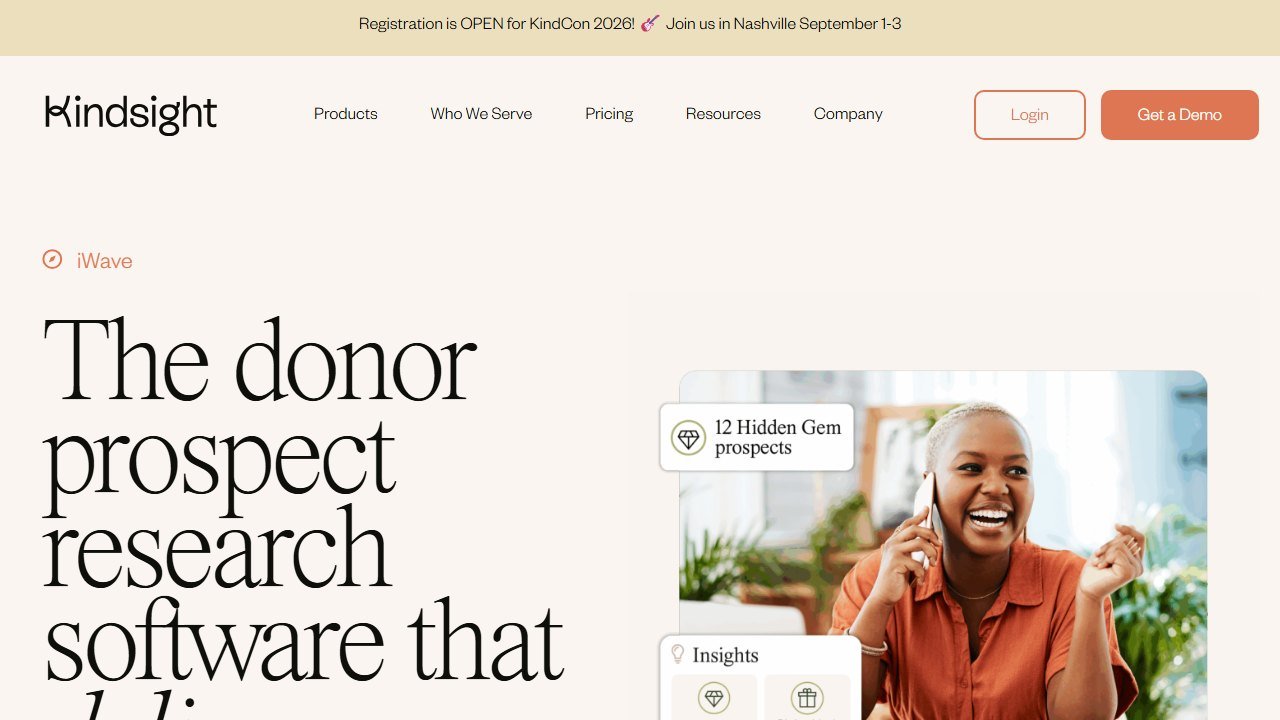
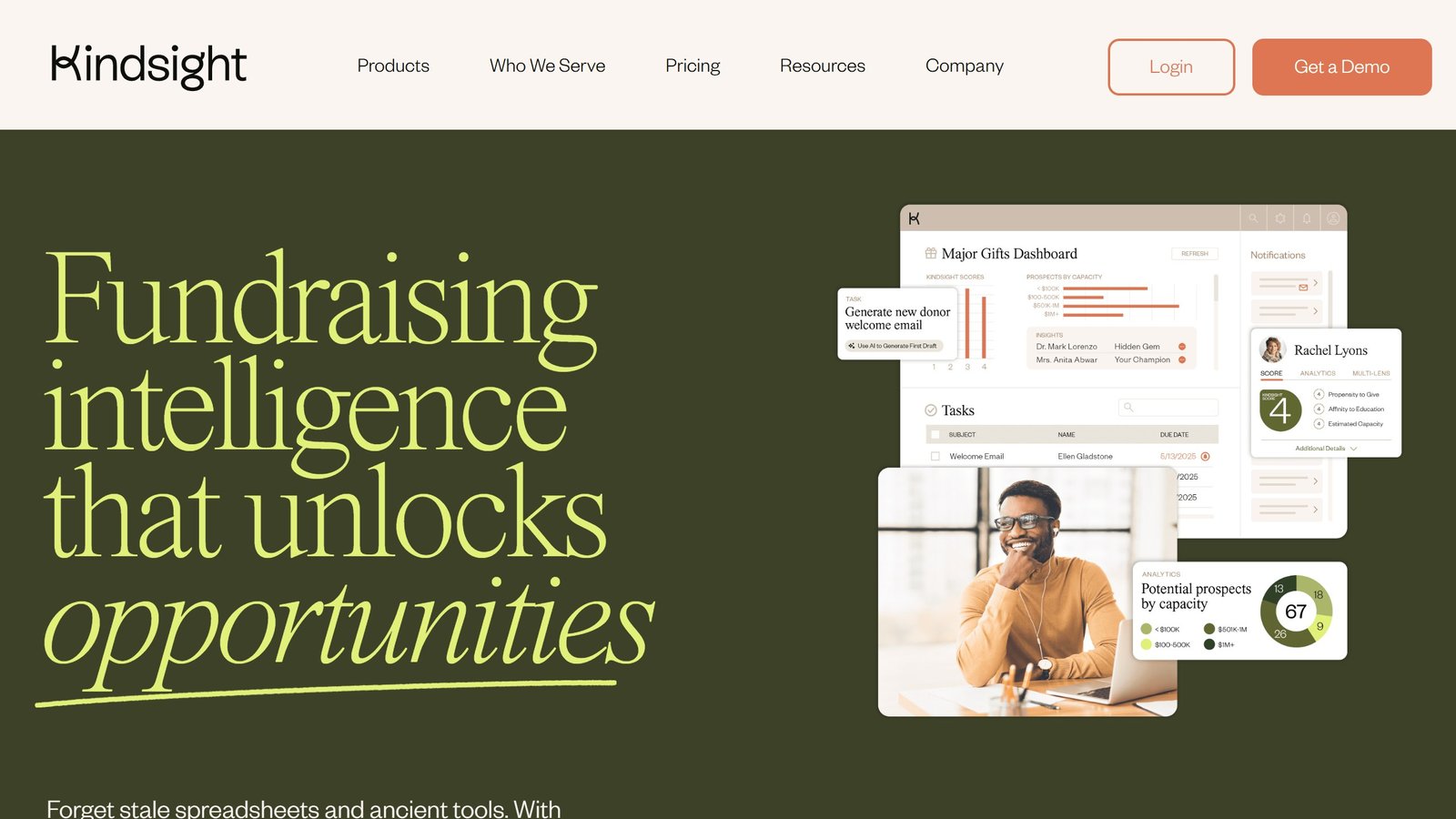
The short story: Kindsight is the company formed when iWave merged with UC Innovation, announced in February 2024 via PR Newswire. UC Innovation brought Ascend, a Salesforce-based CRM for advancement teams. iWave brought the prospect research engine most fundraisers know it for, plus a generative AI layer it had picked up by acquiring NonprofitOS in October 2023. Kindsight rebranded that AI layer as Engage.
So in 2026, “buying iWave” really means buying one module of a three-part Kindsight platform:
- iWave: the prospect research and wealth screening product. This is the piece with published pricing.
- Engage: the generative AI add-on, born from NonprofitOS. Also published, priced separately.
- Ascend CRM and the full Fundraising Platform: custom quote only. The Connect donor portal comes included with Ascend.
The practical consequence: the sales conversation has changed. You are no longer talking to a point-solution vendor. You are talking to a platform company that would love to expand your contract from prospect research into CRM territory. That is not sinister, it is just worth knowing before the demo, because the platform pitch is where quotes get bigger. If you are weighing the platform question against a standalone screening vendor, our iWave vs DonorSearch comparison covers exactly that fork, and it accounts for the merger, which most comparisons still do not.
Stale aggregator numbers vs the live Kindsight rate card
Here is the part that sent us down this rabbit hole. Search “iWave pricing” and the page-one review aggregators still quote pre-rebrand figures. They contradict the vendor’s own live page.
| Tier | Aggregator-reported (stale) | Kindsight live page (verified 2026-07-14) | Gap |
|---|---|---|---|
| Starter | $4,150/yr | From $4,500/yr | +$350/yr |
| Professional | $5,350/yr | From $5,800/yr | +$450/yr |
| Premium | Varies by listing | Custom quote | n/a |
To be fair to the aggregators: those numbers were probably accurate once. They just never got updated when iWave became Kindsight and the rate card moved. But if you carried $4,150 into your board budget and the quote comes back at $4,500 plus an AI add-on you did not know existed, that is an awkward meeting. Budget from the live vendor page, treat every third-party number as reported rather than official, and expect the final contract to land at or above the published “from” price.
What you get at each iWave tier
A quick decode of the units in that rate card, because they drive which tier you actually need.
Live profiles are the full wealth-and-philanthropy profiles you can pull on individual prospects. Starter’s 750 sounds like a lot until you are prepping a major gift portfolio review and burning 20 profiles per meeting. Screens are batch wealth screening credits, the bulk operation where you run a chunk of your donor file through the engine at once. Starter’s 1,500 covers a small file or a segment of a bigger one, not a full-database screening for a mid-sized shop.
Starter, from $4,500/yr. One user, 750 live profiles, 1,500 screens. This fits a one-person research shop or a small development office where a single gift officer doubles as the researcher. The single seat is the real constraint: no sharing logins across a team without violating terms.
Professional, from $5,800/yr. Three users, 2,500 profiles, 5,000 screens. The jump from Starter is $1,300 for triple the seats and roughly triple the volume, which makes it the obvious tier for any team where more than one person touches prospect research. On per-user math, Professional is meaningfully cheaper than Starter.
Premium, custom quote. Five users, 10,000 profiles, 20,000 screens, and 7,000 append credits (data appends to enrich your existing records). No published price, which usually signals negotiable territory. If your file size justifies Premium, everything below is your anchor: you know Professional starts at $5,800, so price the incremental volume accordingly.
For a sense of where this spend sits in a broader stack, our guide to what donor intelligence actually is breaks down the categories, and the major gift fundraising with AI guide shows where screening output feeds the pipeline.
Engage add-on pricing: the AI line item nobody covers
This is the piece missing from nearly every iWave pricing writeup we found. Kindsight’s generative AI, Engage, is not part of the iWave subscription. It is a separately priced add-on with its own three tiers:
- Engage Starter: $545/yr for 1 user
- Engage Professional: $1,095/yr for 3 users
- Engage Premium: $3,295/yr for 10 users
Engage traces back to NonprofitOS, the generative AI company iWave acquired in October 2023, a few months before the Kindsight merger. Kindsight folded it in as the AI writing and intelligence layer across the platform.
The budgeting takeaway: a solo researcher who wants iWave Starter plus the AI is really looking at $5,045/yr minimum ($4,500 + $545), not $4,500. A three-person team on Professional with Engage is at $6,895/yr minimum ($5,800 + $1,095). Those are the honest all-in floors, and they are the numbers to put in front of your finance committee.
One caution: we have verified the prices, not the value. Whether Engage’s AI output justifies its line item for your team is a feature question, and this page deliberately stays out of feature verdicts. Test it in the demo with your own donor scenarios before you sign for it.
What to negotiate before you sign
Kindsight publishes floors, not ceilings, so there is room to work. Going into the sales call:
- Anchor on the published “from” price. The rep knows you can see $4,500 and $5,800 on their own site. Any quote above that needs an itemized justification: which add-on, which volume bump, which service tier.
- Ask what happens when you exhaust profiles or screens mid-contract. Overage pricing and mid-term top-ups are exactly the kind of terms that never appear on pricing pages. Get the per-unit cost in writing.
- Price Engage separately, and ask for it bundled. Since Engage is a distinct line item, it is natural discount material. A rep trying to close an iWave deal has an obvious lever: throw in Engage Starter for year one.
- If they pitch Ascend or the full platform, slow down. Platform pricing is custom quote only, which means the number is whatever the conversation supports. Do not let a prospect research purchase quietly become a CRM migration decision. Those are different projects with different stakeholders.
- Ask about multi-year terms. Vendors coming off a rebrand tend to value logo retention. We have no verified figures on Kindsight’s multi-year discounting, so treat this purely as a question to ask, not a promise.
How this compares to the alternatives, briefly
The obvious head-to-head is DonorSearch, which takes the opposite pricing posture: it publishes nothing at all. Its pricing page is a demo-request form, and every dollar figure you see for it online is third-party reported. That makes iWave the more transparent option of the two on price alone, whatever you conclude on features. Our full iWave vs DonorSearch breakdown covers the feature and data comparison post-merger, our DonorSearch review has the hands-on verdict, and our DonorSearch pricing guide consolidates the reported quote ranges if you want the budgeting view from that side.
What you are actually signing, beyond the monthly figure
A published rate card tells you the list price. The contract decides what you pay, and four terms do most of the work.
Term length and the annual-billing discount
Nearly every figure quoted in this market, iWave included, assumes annual billing. Monthly billing is routinely 20 to 30% higher, so the headline you compare against a rival may be a different commitment entirely. Check which basis each number is on before putting two of them in the same sentence, because vendors do not always label it.
Mid-term expansion, priced now or priced later
The band you cross, the seat you add, the module you switch on: agree what each costs before you sign, and specifically whether the discount you negotiated applies to anything added mid-term. It very often does not. Discovering that at the moment you need to grow is how a good first-year deal becomes an expensive second year.
The renewal cap is the term worth most and asked for least
At renewal the vendor knows your usage, your dependency and your switching cost, and in a market where most rivals publish nothing you have no rate card to anchor against. Blackbaud publishes no figures at all, and Virtuous publishes none while banding its tiers at $5 million in fundraising revenue. Against that, a capped uplift stated as a percentage is worth more than a larger first-year discount, and it is only negotiable while you still have a choice.
What happens to your data at the end
Ask what a full export contains, in what format, how long after termination you can request one, and whether live recurring gift schedules and their payment tokens transfer. Tokens are the ones that usually do not, and if they cannot move, every monthly donor has to re-enter card details and a share will not. Get the answer in writing during procurement, not during the exit.
Published does not mean fixed
Keela raised every band between late August and early September 2026, entry moving from $134 to $164, a rise of roughly 15 to 22% across the range in under two weeks. Neon retired an entire tier structure. A published price is a snapshot with a date on it, and if the figure you are comparing does not carry one, you do not know what you are looking at.
Which nonprofit vendors publish a price, and which will not
This is the most useful single fact about the market and it is rarely stated plainly. Roughly half the category publishes a rate card you can read without speaking to anyone; the other half runs a quote form. That split, not the software, decides how your evaluation has to be run.
| Vendor | Publishes a figure | Entry price, verified 4 Sep 2026 | What it meters on |
|---|---|---|---|
| Little Green Light | Yes, every band | $45/mo | Constituents |
| Salesforce Nonprofit Cloud | Yes | $70/user/mo (4 Oct 2026), 10 free | Users |
| Neon CRM | Model yes, full list no | $99/mo | Fundraising revenue |
| Bloomerang | Yes, by product | $125/mo | Product mix |
| Keela | Yes, every band | $164/mo | Contacts |
| Dataro | Yes, but unlinked page | $15,000/yr + $0.10/donor | Active donors |
| Blackbaud | No | Quote form only | Not disclosed |
| Virtuous | No | Quote form only | Bands at $5m revenue |
| GoFundMe Pro | Model only | Subscription + transaction fee | Donations |
Why the split matters more than the prices
If three of your shortlist publish and three do not, you cannot run a like-for-like comparison, and the quote-only vendors know that. The practical move is to price a published alternative precisely at your own seat count and list size, then make that the number every quote has to justify itself against. It is the only figure in the room that both sides can verify.
Nine different meters, which is the real problem
Constituents, users, fundraising revenue, product mix, contacts, active donors, donation volume. Seven distinct meters across nine vendors means the cheapest platform is a property of your organisation, not of the market. Whichever of your numbers, people or records or revenue, is growing fastest should decide which pricing model you buy into, and that question is almost never asked before a shortlist is drawn.
How to run the procurement so a quote means something
Get every quote onto the same basis before comparing
Ask each vendor, including iWave, for the same seat count, the same contract length, implementation quoted separately from subscription, every add-on itemised, and payment processing stated as inside or outside the platform fee. A single blended annual number cannot be compared against anything, and vendors know it.
Establish the total first-year cost, not the subscription
Onboarding, data migration, integration work and training are frequently larger than the first year of licence fees in this category and are rarely in the headline figure. Ask for the all-in number, then ask which parts of it are one-off and which recur.
Negotiate the renewal before you sign the first contract
This is the single most valuable term and the one most often left out. A capped renewal uplift, stated as a percentage, is worth more than a bigger first-year discount, because at renewal the vendor knows your usage, your dependency and your switching cost while you have no public rate card to argue against.
Insist on a trial with your own data
A demo runs on a dataset chosen because the product handles it well. Ask to load a sample of your own records, including the messy ones: duplicate households, lapsed donors with old addresses, a recurring gift that failed. How a platform handles your actual data quality is the thing that decides whether staff use it, and it is invisible in a scripted walkthrough.
Name the person who will own it
Every platform in this category rewards an owner and punishes shared responsibility. Before signing, name the person whose job description includes this system and check they have the hours. Software does not create that role, and its absence is the most common reason a nonprofit CRM purchase disappoints.
Where the figures on this page come from
Every price quoted here was read from the vendor’s own pricing page on 4 September 2026, not from an aggregator or a review site. That distinction matters more in this category than in most, because nonprofit software pricing changed materially over the past year and a great deal of what circulates online describes packaging that no longer exists.
The pages we read
Little Green Light publishes every constituent band from $45 a month. Salesforce Nonprofit Cloud publishes $70 per user per month (as of 4 October 2026) with ten licences free under Power of Us. Bloomerang publishes $125 a month for the CRM with other products priced separately. Keela publishes every contact band from $164 a month. Dataro publishes $15,000 a year plus ten cents per active donor on a page that is not linked from its own navigation. Blackbaud and Virtuous publish no figures at all.
What we do not do
We do not carry a figure we cannot source to the vendor. Where a number circulates widely and cannot be traced to a vendor page, we say so and withdraw it rather than repeating it with a hedge, and we have withdrawn our own published figures on that basis more than once. Where a vendor confirms an unpublished price directly to us, it is attributed as confirmed by the company rather than presented as a public rate.
Why every figure carries a date
Keela raised every band by roughly 15 to 22% in under two weeks in late August 2026. Neon retired an entire tier structure. A pricing claim without a verification date is not checkable, and in this market it is usually wrong within a year.
Verdict: budget $4,500 to $7,000 for most teams, and ignore the aggregators
iWave pricing in 2026 is Kindsight pricing, full stop. The published floors are $4,500 for a solo seat and $5,800 for a three-seat team, listed by Kindsight with no billing period against them and read here as annual, with the Engage AI add-on stacking $545 to $3,295/yr on top. For most small-to-mid development shops, an honest all-in budget lands between $4,500 and $7,000 per year depending on seats and whether you take the AI.
The stale $4,150 figure still ranking on review sites is the cautionary tale here: it is off by $350 on the entry tier and silent on the AI add-on entirely. Verify on kindsight.io, walk into the demo with the published floors as your anchor, and make the rep earn every dollar above them.

Written by
FazFaz is the founder of AIToolsBakery. Some tools here are tested hands on. Others are assessed from vendor documentation and pricing verified on the live page, and every review says which one it is. Sponsors can buy a position in a guide. They cannot buy the score, the criticism, or silence about a better option.
How we test and how we make money →