
Search “Rentvine vs AppFolio” and there is something you should know before you read a single result: Rentvine controls three of the top eight or so pages for this query. Its own compare post, its own top-AppFolio-alternatives post, and the comparison on RentFinder.ai, which Rentvine has owned since October 2025. That is not a scandal, it is smart content marketing, but it does mean most of what ranks for this matchup was written by one of the two contestants.
So we went looking for the numbers ourselves, and found the irony that anchors this whole comparison. Rentvine’s entire positioning against AppFolio is pricing transparency: one plan, everything included, no tier games. Yet as of July 22, 2026, Rentvine’s pricing page says “as low as $1.50 per unit” while its own FAQ says $2.50 per unit with a $199 monthly minimum. Two different rates, one website. Meanwhile AppFolio has gone fully quote-only and publishes nothing at all. The transparency challenger has two prices, the incumbent has zero, and a buyer trying to compare them gets a clean number from neither.
Fine. We will do the math both directions, dated and labeled, and then call the verdict by portfolio size, because this matchup has one segment where the decision is made for you before you even open a browser tab.
Rentvine vs AppFolio at a glance
Every figure below is dated and labeled official or reported, because this SERP is littered with dead prices. The “verified” column tells you which numbers came off a live page and which are buyer reports.
| Category | Rentvine | AppFolio | What we verified (July 22, 2026) |
|---|---|---|---|
| Published pricing | Yes, sort of: pricing page says “as low as $1.50/unit,” FAQ says $2.50/unit + $199/mo minimum | None. Quote-only across Core, Plus, and Max | Both Rentvine pages live and contradictory as of July 22, 2026. AppFolio publishes no rates |
| Minimums | $199/mo revenue minimum, NO unit minimum | Explicit 50-unit minimum on Core; “minimum spend and units apply” unspecified on Plus/Max | Both official, on each vendor’s live site |
| Reported entry cost | $199/mo (official minimum) | ~$280 to $298/mo (buyer reports through 2026) | Rentvine figure official; AppFolio range reported, not published |
| Setup / onboarding fee | One-time setup fee exists; amount NOT published | Buyer-reported onboarding fees by tier, not published | Rentvine’s fee is confirmed to exist on its pricing page; neither vendor prints an amount |
| Plan structure | Single all-inclusive plan, open API included | Three tiers (Core, Plus, Max) with feature gates | Both official |
| AI | Fixie agentic maintenance intake, included, no add-on fee | Realm-X Assistant + Messages on Core; Realm-X Flows (agentic automation) starts at Plus | Feature gating confirmed on vendor materials, July 2026 |
| Mobile app | None (most-cited con in reviews) | Yes, mature iOS/Android apps | Review corpus + vendor sites, July 2026 |
| G2 rating | 4.7 (44 reviews) | 4.5 (1,888 reviews) | Pulled July 2026 |
| Ownership | Founder-led (Dave Borden); $74M Mainsail Partners investment, Aug 2024 | Public company (NASDAQ: APPF) | Public record |
First, the SERP disclosure: who wrote the pages you are reading
We flagged it in the intro and it deserves its own two paragraphs, because it shapes everything a buyer finds on this query. Rentvine publishes its own Rentvine-vs-AppFolio comparison. Rentvine publishes its own “top AppFolio alternatives” post. And RentFinder.ai, a comparison site that ranks for this query, has been a Rentvine property since Rentvine acquired it in October 2025. Three of the top results, one owner, and that owner is a contestant.
Rentvine’s own compare post is also a genuinely funny exhibit for this batch’s theme. It attacks AppFolio’s pricing opacity at length, and then prints zero dollar figures for Rentvine’s own pricing. Not the $1.50, not the $2.50, not the $199 minimum, nothing. The claims it does make, 45-day onboarding, 80 percent of your migration handled for you, 35-minute average support response, are vendor claims, and we treat them as such: plausible, unverified, and exactly the kind of numbers you ask a sales rep to put in the contract. When the transparency company’s comparison page goes numberless, you learn something about how much work “transparency” is doing in the positioning.
Rentvine pricing: two numbers, one website
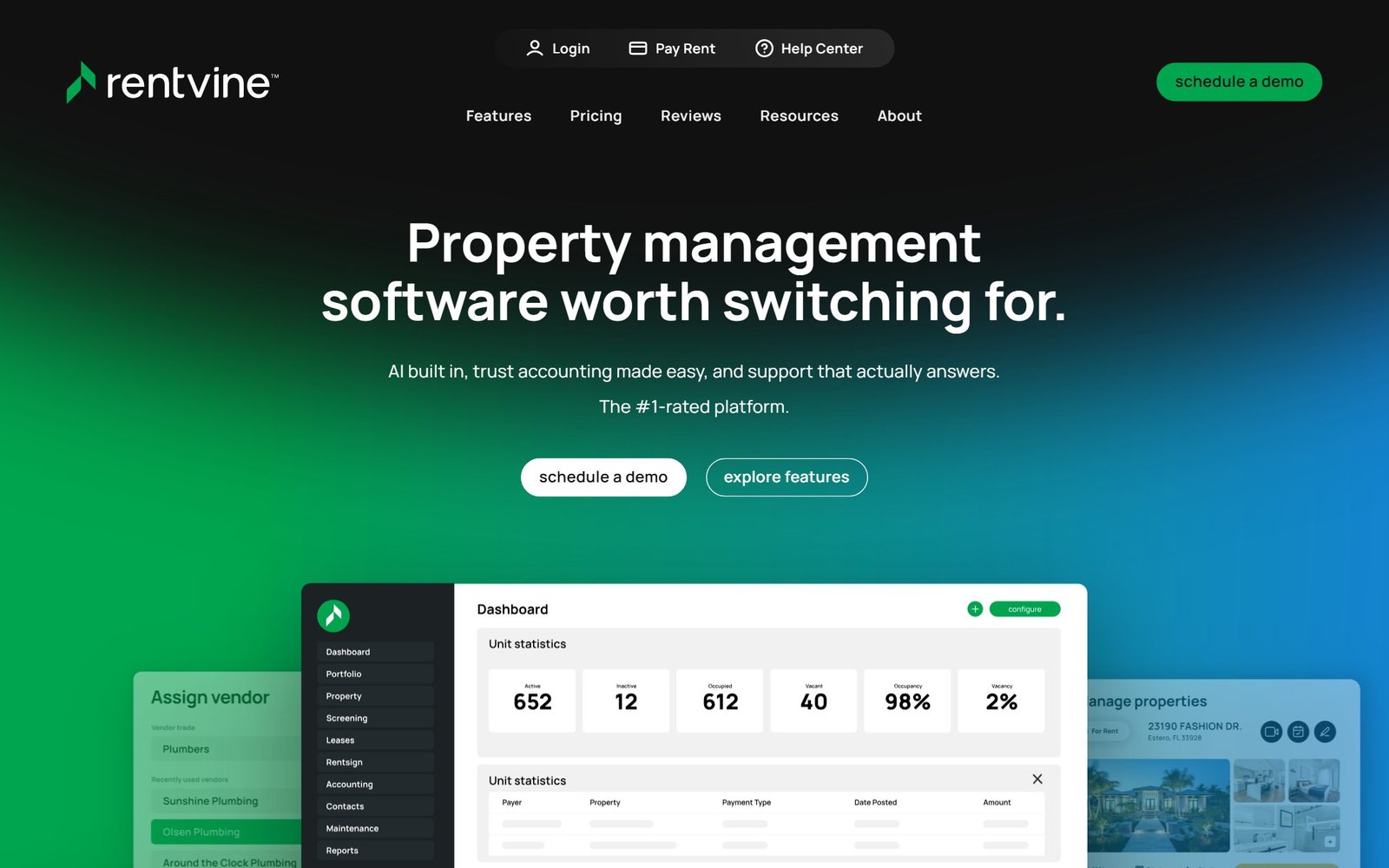
Rentvine sells one all-inclusive plan. No tiers, no feature gates, open API included, every module in the box. That single-plan structure is real and we like it. The published price of that plan is where it gets strange. As of July 22, 2026, both of these are live on rentvine.com:
- The pricing page: “as low as $1.50 per unit,” plus a one-time setup fee (amount not stated), plus a “no hidden fees” claim.
- The FAQ: $2.50 per unit, $199 per month minimum, no unit minimum.
Those are not the same number, and the site does not explain the gap. “As low as” language usually signals a volume rate, so the most charitable read is that $2.50 is the standard rate and $1.50 is what large portfolios negotiate down to. But that is our inference, not Rentvine’s statement, and a company whose entire pitch is that AppFolio hides the ball should not be making buyers infer its base rate from a contradiction between two of its own pages.
Two more things a buyer needs to hold onto. First, the setup fee: Rentvine confirms one exists and does not publish the amount. We are not going to guess it, and neither should you, but “no hidden fees” and “unpublished setup fee” is a sentence with visible tension in it. Ask for the figure in writing. Second, the minimum-fee math, because the $199 floor quietly reshapes the per-unit price for smaller portfolios. At the FAQ’s $2.50 rate, the $199 minimum means a 40-unit portfolio pays about $4.98 per unit effective, roughly double the sticker. The $2.50 rate only becomes your real rate above roughly 80 units. Below that, you are paying the minimum, not the rate.
The good news, and it is genuinely good: no unit minimum. A 10-door or 30-door management company can buy Rentvine today at $199 a month. Hold that thought for the next section, because it turns out to be the single most decisive fact in this comparison. For the full Rentvine picture beyond pricing, including where it earned its 4.3, our Rentvine review owns that verdict.
AppFolio pricing: nothing published, and a door that closes at 50 units
AppFolio publishes no prices at all. As of July 22, 2026, the pricing page lists three tiers, Core, Plus, and Max, with quote-only pricing, an explicit 50-unit minimum on Core, and “minimum spend and units apply” language on Plus and Max with the actual numbers unspecified. Buyer reports through 2026 put the effective entry minimum around $280 to $298 per month, which at the 50-unit floor works out to roughly $5.60 to $5.96 per unit. Those are reported figures, not official ones, and our AppFolio pricing breakdown owns the full minimum-fee math if you want the long version.
The 50-unit minimum is the fact that decides an entire segment of this comparison. It is not a soft “we prefer larger portfolios” posture, it is printed on the pricing page. If you manage 30 doors, Rentvine versus AppFolio is not a decision you get to make. AppFolio has already made it for you.
One more exhibit for the dead-price file, because this query’s SERP is full of them: costbench.com still prints AppFolio at $1.49, $3.20, and $5.00 per unit, and appfoliopricing.com still prints $1.49 for Core, both live in 2026, both reprinting rates from a public rate card AppFolio deleted. Neither is a current price. If a comparison page quotes you a confident AppFolio per-unit number without a date and a source, it is quoting a ghost. If quote-only pricing is itself your dealbreaker, our AppFolio alternatives guide ranks the platforms that still publish rates.
The math, both directions
Neither vendor gives a clean number, so here is the comparison run at real portfolio sizes. Rentvine figures use the FAQ’s $2.50 rate and $199 minimum (the conservative case; if $1.50 applies to you, everything below gets cheaper). AppFolio figures are the reported $280 to $298 range and are directional, not quotes.
At 30 units. Rentvine: $199 per month, about $6.63 per unit effective. AppFolio: not for sale to you. Rentvine wins by forfeit, and $199 all-in for a full professional platform with an API and included maintenance AI is a fair deal at this size anyway.
At 50 units. Rentvine: $199 to $213 per month depending on how the minimum resolves against the rate ($2.50 x 50 = $125, so the $199 minimum still governs and you pay $199, about $3.98 per unit). AppFolio: $280 to $298 reported, $5.60 to $5.96 per unit, plus buyer-reported onboarding fees. Rentvine is roughly $80 to $100 a month cheaper at the exact portfolio size where AppFolio’s doors open.
At 100 units. Rentvine: $250 per month at the $2.50 rate, $2.50 per unit effective, clear of the minimum. AppFolio: reported entry range likely stretches with portfolio size, but with no published rate we will not print a per-unit figure. The honest statement is that Rentvine’s official number sits well under AppFolio’s reported floor, and AppFolio’s actual quote at 100 units is knowable only by asking AppFolio.
At 200+ units. Rentvine: $500 per month at $2.50, and this is the range where the pricing page’s “as low as $1.50” presumably enters the conversation, which at 300 units is the difference between $750 and $450 a month. AppFolio: this is where its quote gets most negotiable and where Plus-tier capabilities, including the automation we cover next, become the real argument. Get live quotes from both and make Rentvine reconcile its two rates in writing.
The pattern, same as everywhere in this category: below about 80 units, Rentvine’s minimum sets your price, not its rate. Below 50, AppFolio sets your price at infinity. The division, not the sticker, is the comparison.
AI head-to-head: Fixie vs Realm-X, and where the paywall sits
No other comparison in this SERP covers this properly, which is odd, because the two companies made opposite decisions about where AI lives in the price.
Rentvine ships Fixie in the box. Fixie is Rentvine’s agentic maintenance intake AI: it handles resident maintenance conversations, triages the issue, and moves work orders forward without a human dispatcher touching every ticket. It is included in the single all-inclusive plan at no add-on fee, which is consistent with the one-plan philosophy. There is no up-tier to buy because there are no tiers.
AppFolio splits Realm-X across the paywall. The gating here is more nuanced than most write-ups suggest, so let us be precise. The Realm-X Assistant and Realm-X Messages ship on Core, so every AppFolio customer gets conversational AI and AI-drafted messaging at the entry tier. Realm-X Flows, the agentic automation layer that strings tasks together and acts on your behalf, starts at Plus. So it is wrong to say AppFolio gates all its AI up-tier, and it is equally wrong to say Core buyers get the automation story from the keynote. Core gets the assistant. Plus gets the agent.
The comparison, stated plainly: Rentvine’s AI is narrower and included; AppFolio’s is broader and partially paywalled. If maintenance intake is the AI job you actually need done, Fixie at no extra cost against Flows at an up-tier premium is a lopsided value trade in Rentvine’s favor. If you want AI across leasing, accounting, and operations workflows, Realm-X is the deeper platform and the Plus quote is the price of admission. For the wider field beyond these two, our best AI tools for property managers roundup covers what else is out there.
What the reviews and the switchers say
The review scores. On G2 as of July 2026, Rentvine holds 4.7 across 44 reviews against AppFolio’s 4.5 across 1,888. Read that gap with the sample sizes in view: Rentvine’s score is excellent but rests on a review base one-fortieth the size. Both are strong products by the numbers.
Rentvine’s real cons. The most-cited complaint in Rentvine’s G2 and Capterra reviews is the absence of a native mobile app, which matters daily for field staff and is a genuine gap against AppFolio’s mature apps. Reviewers also cite no live phone support (support runs through tickets and chat; Rentvine’s claimed 35-minute average response is a vendor figure) and occasional portal and billing friction. One labeling note: Rentvine’s 1.5 rating on PissedConsumer comes from six reviews that are largely tenant-side complaints about portals and fees, which is a different constituency from the property managers buying the software. We note it for completeness, not as an operator verdict.
The switching traffic runs one way. In the review corpus and the case-study record, AppFolio-to-Rentvine switchers are easy to find; Rentvine-to-AppFolio stories are not visible. The themes switchers cite, tier fatigue, add-on creep, AI features moving up-tier, do corroborate against independent AppFolio reviews on Capterra, where cost creep is a persistent complaint, though we will flag that the tidiest versions of these switcher narratives originate in Rentvine’s own marketing, so we weight the independent reviews and treat the vendor case studies as directional. One-way migration evidence is meaningful, but remember the base rates: AppFolio has vastly more customers to lose.
Ownership: founder-led challenger vs public incumbent
Both cap tables are clean by this vertical’s standards. Rentvine is founder-led by Dave Borden and took a $74 million growth investment from Mainsail Partners in August 2024, which it has spent partly on acquisitions: RentFinder.ai in October 2025 (hence the SERP disclosure up top) and Bynnd. Growth equity is not a PE roll-up, but it does mean Rentvine is on an aggressive expansion clock, which cuts both ways: fast product velocity, and the pricing-page ambiguity of a company moving quickly. AppFolio is a publicly traded company on NASDAQ under APPF, with the quarterly-earnings incentives that come with it, which is one honest lens on why its pricing moved quote-only and its automation moved up-tier. Neither has RealPage or Thoma Bravo anywhere near it; if that is the axis you care about, our AppFolio vs Buildium breakdown covers the PE-owned side of the market.
Per unit, flat rate or free: what each actually costs you at scale
The pricing model matters more than the price, because the same portfolio produces wildly different bills under each. Here is the same arithmetic run three ways using figures published on 4 September 2026.
| Portfolio | Rentec Direct flat | DoorLoop per unit | Buildium tier | TurboTenant free |
|---|---|---|---|---|
| 5 units | $300/yr | $828/yr, Starter | From $744/yr | $0 plus tenant fees |
| 10 units | $300/yr | $828/yr, Starter cap | From $744/yr | $0 plus tenant fees |
| 25 units | Pro, from $600/yr | Pro, $1,788/yr | Growth, from $2,304/yr | Paid tier from $149/yr |
| 60 units | Pro or PM, scales | Premium, $2,508/yr | Growth or Premium | Outgrown |
The ten unit cliff is the one that catches people
Several vendors cap an entry tier at ten units, rentvine vs among the products where this pattern appears. Buying the eleventh door can cost more than the previous ten did, and the step is not proportional. Before committing, ask what the next tier costs, whether the change applies immediately or at renewal, and whether any discount you negotiated survives the crossing.
Vacancies are the difference between the models
Per unit pricing usually charges for a unit whether or not it is occupied, which means a vacancy costs you twice: no rent, and a bill for the privilege. Flat rate pricing does not care. If your portfolio has meaningful seasonal vacancy or you are mid-renovation on several doors, that single distinction can outweigh the headline difference between two platforms.
Free is a transfer, not a saving
The free tiers in this market are funded by tenant-paid fees: application and screening charges, card payment fees, and optional extras like rent reporting. That may be entirely reasonable and many residents prefer the convenience. It is still worth knowing that choosing the free platform is a decision about what your tenants pay, not only about what you pay, and it is worth looking at your own application flow as an applicant would before deciding.
What it costs to leave, which no pricing page mentions
Switching cost is why landlords and managers stay on systems they have outgrown. In this category it is unusually concrete, which means you can ask about it precisely.
Recurring payment authorisations rarely transfer
This is the big one. Tenant records, leases and ledgers export from almost any platform. Live recurring payment authorisations and the stored bank or card details behind them generally do not, which means every resident on autopay has to re-enrol. A share will not, and you will chase rent you were previously collecting automatically. Ask about this in writing during procurement, when you still have leverage.
Ask exactly what a full export contains
Standard fields usually come out cleanly. What often does not is the maintenance history with its photographs and correspondence, the document store of signed leases and addenda, the accounting history in a form your accountant can actually use, and the audit trail of who changed what. Ask for a sample export file during the trial rather than a description of one.
The accounting cutover has a right time and many wrong ones
Move at a period boundary, ideally the start of a financial year, and never mid-month with rent in flight. Plan to run a parallel reconciliation for one full cycle, and budget the hours for it. Migrations that go badly almost always went live at a convenient calendar date rather than a sensible accounting one.
Count the integrations before you sign, not when you leave
Listing syndication, accounting, screening providers, e-signature, banking, insurance and any owner portal are each work to disconnect and reconnect elsewhere. The count is always higher than anyone remembers, and it is the part that turns a two week migration into a six month one.
How these purchases go wrong, and the early warning signs
Four patterns cover most of what we hear a year after a real estate software purchase, and all four are visible in the first month.
The migration that never finishes
The new system goes live, the old one stays open “for historical records”, and eighteen months later half the team still works in both. This is the most common and most expensive failure in property management software. Before signing, agree a cutover date, a named owner, and what specifically will not be migrated. Running two systems is worse than either.
Tenant-facing features nobody told the tenants about
Online payments, maintenance portals and application flows only save time when residents actually use them, and adoption depends entirely on how the change is communicated. A portal with 20% adoption creates more work than paper did, because you now run two processes. Plan the resident communication before go-live and measure adoption at thirty days.
The tool one person runs
One capable person builds the workflows and produces every report. They leave and it stops the same week. The warning sign is that nobody else has ever done a full month-end in the system. Have a second person do it once a quarter from written steps.
The fees that arrive after the subscription
Payment processing, screening, e-signatures, bank account setup and inspections are all charged separately by most vendors in this category and all of them are published. A business case built on the subscription alone will be wrong in year one, usually by a four figure sum. Build the model from the fee schedule, not the plan cards.
The legal side of screening and automated pricing
Tenant screening and algorithmic rent setting are the two places where real estate software touches regulated activity directly, and where getting it wrong is expensive rather than embarrassing.
A screening report is a consumer report, with obligations attached
If you take an adverse action based on a screening report, in the United States that triggers notice obligations to the applicant, including telling them which agency supplied the report and that the agency did not make the decision. Ask any platform how it handles adverse action notices, whether it generates them automatically, and what record it keeps. A tool that produces a score but no notice workflow leaves the obligation with you.
Consistency is your best defence
Fair housing exposure comes from treating applicants differently, and inconsistency is much easier to demonstrate than intent. Written criteria applied identically to every applicant, with the decision and its reason recorded, is worth more than any feature on a vendor page. Software helps here by making the process uniform, which is a genuinely good reason to buy one, and it does not transfer the responsibility.
Automated rent pricing is under active scrutiny
Algorithmic rent setting, particularly where a tool draws on non-public competitor data, has attracted significant legal attention, and this is a live area rather than a settled one. Before adopting one, ask what data the recommendation is built on, whether it includes non-public data from other landlords, and whether you can see and override every recommendation. Keep the override log. If a vendor cannot answer those three, that is your answer.
Know what the tool is deciding and what you are deciding
The safest posture with any of this is that the software recommends and a named person decides, with the decision recorded. That is slower than full automation and it is the difference between a defensible process and one you cannot explain. Write down who that person is before you switch anything on, because the question only ever gets asked afterwards.
How to tell whether the tool paid for itself
Real estate software is unusually easy to evaluate honestly, because the outcomes are countable. Most teams still do not do it, and the renewal conversation becomes an argument about impressions.
Pick the metric the tool is supposed to move
For a lead platform it is cost per closed transaction. For property management software it is hours of admin per unit per month, and days to fill a vacancy. For staging it is days on market and list-to-sale ratio. For screening it is time to approve and the rate of problem tenancies. Each of those is available from records you already keep, and each needs a figure from before you started.
Take the baseline before you switch anything on
You need last year of the metric from a source the project did not touch. This is the step that gets skipped and it is the reason most of these purchases can never be evaluated. It costs an hour. Ask the two or three people whose work will change to record how long the target task takes them this month, because time saved is measurable in advance and unprovable afterwards.
Give it a full cycle before judging
Leasing and transactions are seasonal, so a six week read tells you very little. Judge lead tooling over at least two quarters, and property management tooling over a full turnover cycle, because the value shows up at move-out and move-in rather than in the quiet middle. Say that at the outset so an unremarkable month one is understood as expected.
Write the stop condition down first
Before purchase, name the result at twelve months that would mean you do not renew. It converts renewal from a default into a decision and it is the most effective discipline against a subscription that quietly becomes permanent. If nobody can name a result that would end it, the evaluation was never real.
What property management software actually costs, vendor by vendor
This market splits sharply between tools priced for a landlord with a handful of doors and tools priced for a management company, and the meters are different enough that a headline comparison is close to meaningless. Here is each alternative to rentvine vs, read from its own pricing page on 4 September 2026.
The free and near-free tier, aimed at small landlords
TurboTenant runs a genuinely free plan at $0 a month with paid tiers from $12.42 and $16.48. Avail publishes Unlimited at $0 per unit with Unlimited Plus at $9 per unit per month. Hemlane has a free forever tier, then per unit pricing that resolves to $30, $48 and $86 a month including a $28 platform fee. The thing to notice is that free here usually means the tenant pays instead, through screening and payment fees, so read the fee schedule before calling anything free.
The flat-rate middle, which suits a stable portfolio
Rentec Direct charges a flat $25 a month for up to ten properties, with Pro and PM starting at $50 and scaling. RentRedi publishes $29.95 monthly, or $12 a month total on the annual plan saving $215.40 a year, and $20 on a six month term. Landlord Studio has a free tier for one to three units then $12 and $28 a month, with an annual toggle saving 20%. Flat rates are the friendliest structure for a portfolio that is not growing, because the bill does not move when a unit turns over.
Per unit pricing, where the arithmetic changes with scale
TenantCloud publishes $18, $35 and $60 a month, falling to $15, $29.17 and $50 on annual billing, with a Business tier from $100. DoorLoop publishes Starter at $69 a month billed yearly for up to ten units, Pro at $149 and Premium at $209, and usefully also publishes the per unit equivalents at $6.90, $14.90 and $20.90. Buildium starts at $62, $192 and $400 a month across Essential, Growth and Premium with a 10% annual saving. Per unit is the honest structure for a growing manager and the expensive one for a landlord with vacancies.
The vendors that did not publish a figure we could read
We attempted AppFolio, Innago, Top Producer and Hostaway on 4 September 2026 using the same method that read every vendor above, and could not extract a rate from any of them. We are not going to claim they publish nothing on that basis, because a failed read is not evidence of absence. Treat any figure you find for those four elsewhere as unverified until the vendor confirms it in writing.
The question that picks your tier
Not how many units you own, but how many you expect to own in two years and how often they turn over. A flat rate is cheapest for a static portfolio, per unit is cheapest for a portfolio with vacancies you are not paying for, and a free tier with tenant-paid fees is cheapest for you and most expensive for your residents. Decide which of those three you are optimising before comparing any two prices.
Verdict: who wins at your portfolio size
Under 50 units: Rentvine, by default and on merit. AppFolio’s explicit 50-unit Core minimum means it will not sell to you, so the comparison is over before it starts. But this is not just a forfeit win: $199 a month all-in, no unit minimum, an API, and Fixie included is a legitimately strong offer for a small professional operator. Just get the setup fee amount and your actual per-unit rate in writing.
50 to 200 units: Rentvine, for most buyers. Rentvine’s official numbers ($199 minimum, $2.50 per unit) undercut AppFolio’s reported $280 to $298 entry, the AI you most likely need at this size (maintenance intake) is included rather than up-tiered, and the switcher traffic in this segment runs toward Rentvine, not away. Choose AppFolio here if the mobile app gap is disqualifying for your field team, or if Realm-X Flows automation is worth a Plus-tier quote to you. Both are defensible; price them both and make each vendor commit numbers to paper.
200+ units: get both quotes, and lean AppFolio if automation depth is the job. This is where AppFolio negotiates, where Plus-tier Flows automation compounds across a bigger operation, and where the 1,888-review track record and mature mobile apps de-risk a bigger migration. It is also where Rentvine’s “as low as $1.50” rate should be on the table, which at scale is real money. The honest answer at this size is a bake-off, not a default.
Everyone, regardless of size: neither of these companies has handed you a clean price. AppFolio publishes nothing; Rentvine publishes two numbers that disagree. Screenshot the pages, date your quotes, and put every figure in the contract. If that dance is exactly what you are done with, the published-price platforms in our AppFolio alternatives guide are the exit ramp, and if you are weighing the other big incumbent instead, our AppFolio vs Yardi comparison runs this same math against Breeze.

Written by
FazFaz is the founder of AIToolsBakery. Some tools here are tested hands on. Others are assessed from vendor documentation and pricing verified on the live page, and every review says which one it is. Sponsors can buy a position in a guide. They cannot buy the score, the criticism, or silence about a better option.
How we test and how we make money →