The short answer
What to compare against while you wait for a quote. Cognism publishes no price, so there is nothing here to model a budget from. Our SDR API comparison gives you the published rates of seven vendors that do, which is the number worth having before that sales call.
Cognism does not publish a price. We loaded cognism.com/pricing in a browser on 4 September 2026 and read the fully rendered page. There is no figure on it in any currency: no starting-from number, no per-seat rate, no per-credit rate, no published minimum spend. The calls to action are Talk to sales and Book a demo.
We say “in a browser” deliberately. Several vendors we checked the same week publish prices that only appear once JavaScript has run, so a plain request returns a page with no numbers even though the numbers are there. Cognism is not one of those cases. The rendered page genuinely carries no figure.
That is where most articles about Cognism pricing stop, which is why most of them are useless. Cognism publishes a great deal about how it charges you, just not what it charges. That structure is enough to work out roughly where you will land and, more usefully, what will move the number when you get on the call.
What Cognism actually publishes
Two packages, and both start at five seats
Sales Prospecting comes in Standard and Pro. Pro is flagged as most popular. The detail that matters for budgeting, and that we have not seen named in any competing article, is that both packages state “5 seats included”.
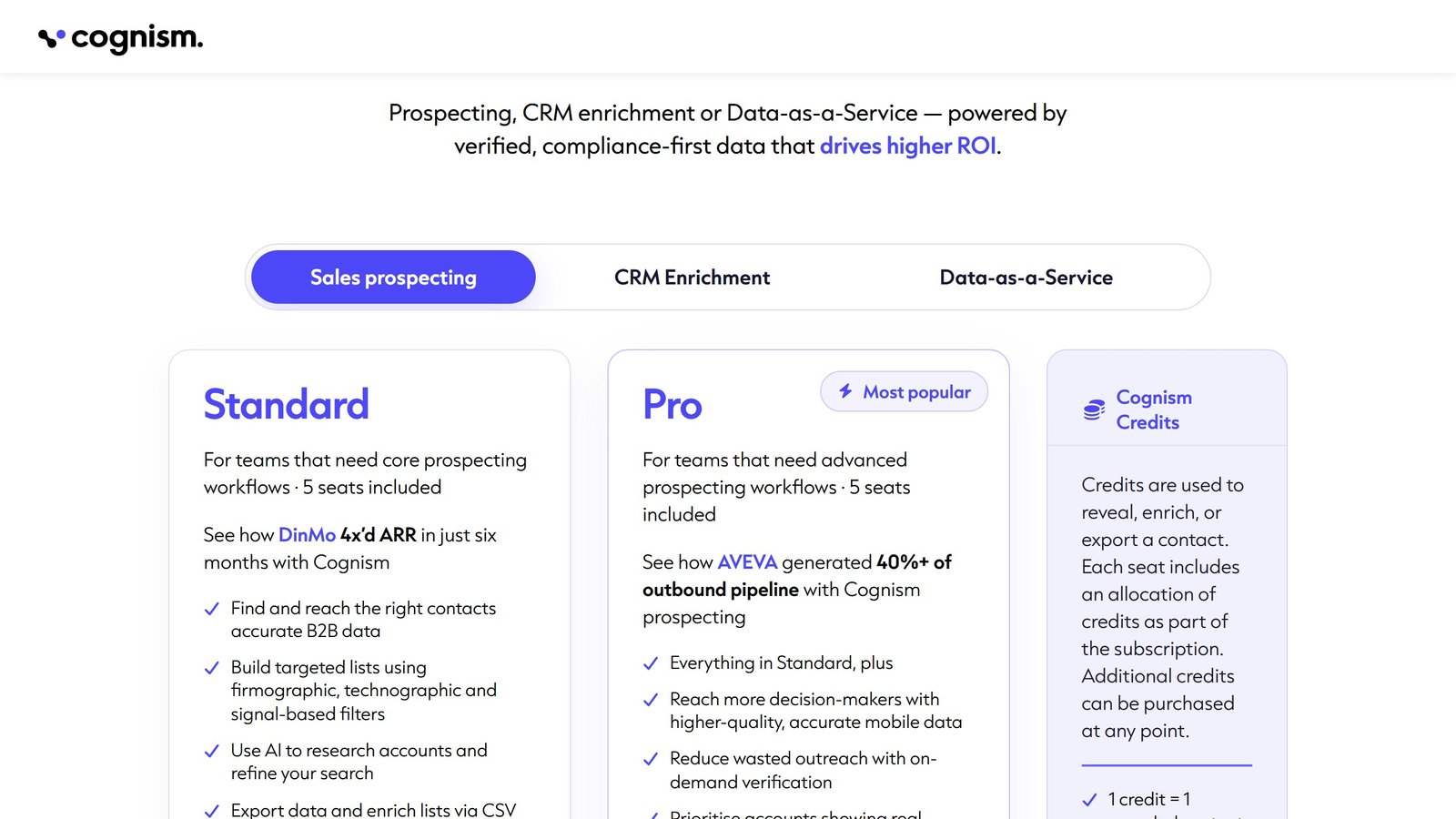
That is a floor. If you are a two-person team hoping to buy two seats, the published packaging says you are buying five. It also reframes any per-seat comparison against a tool like Apollo, where you can genuinely buy one seat: the honest comparison is five Cognism seats against five Apollo seats, not one against one.
The credits model, and the rule that makes it cheaper than it looks
Cognism runs on credits. Its page states that one credit reveals one contact, that each seat comes with an allocation of credits inside the subscription, and that more can be bought at any point. Two published rules matter more than the headline:
- “No charge for viewing previously revealed contacts.” Once you have spent a credit on a record, looking at it again is free.
- From their own FAQ: “A credit is only used again if that contact changes jobs.” The record stays yours for the contract term.
- The same credits work across the prospecting platform, Enrich and the API “without extra cost”, so you are not buying three separate pools.
That job-change rule is the single most consequential thing on the page for a heavy user. Credit models that re-charge on every reveal punish teams who work the same accounts repeatedly. Cognism’s published rule does not.
Three product lines, priced separately
Sales Prospecting is one of three. CRM Enrichment keeps your existing records current and, per their FAQ, “can be purchased as a standalone product or as an add-on”. Data-as-a-Service delivers data by API or bulk, and Cognism says its price “depends on how you want data delivered, the volume you need and the types of data fields required”.
So a Cognism quote is rarely one number. It is a package, plus a credit allocation, plus whichever of the other two lines you take.
Standard versus Pro: what the higher tier actually buys
Cognism publishes a full feature matrix even though it publishes no price, so the shape of the upgrade is clear.
| What Cognism publishes | Standard | Pro |
|---|---|---|
| Seats included | 5 | 5 |
| Price | Not published | Not published |
| Company revenue, headcount, HQ | Yes | Yes |
| Emails, mobiles, job titles, work history | Yes | Yes |
| Technology usage | Yes | Yes |
| Premium mobile filter | No | Yes |
| Mobile verification on demand | No | Yes |
| Intent data | No | Yes |
| AI company research, persona builder, AI search | Yes | Yes |
| SSO | Yes | Yes |
| CRM enrichment | Paid add-on | Paid add-on |
| API and bulk delivery | Data-as-a-Service add-on | Data-as-a-Service add-on |
| Account manager | No | Yes |
In their own words, Standard suits “teams that need reliable contact and company data for day-to-day prospecting” while Pro is for “teams that need more advanced targeting, better prioritisation and stronger visibility”, specifically naming intent data, on-demand mobile verification and enhanced dashboards.
The practical read on that split
The upgrade is really about three things: phone-verified mobiles on demand, buying-intent signals, and a named account manager. If your motion is email-first and you do not act on intent data, Standard covers the data you will actually use. If your team lives on the phone, the premium mobile filter and on-demand verification are the reason Pro exists.
What actually determines your quote
With no rate card, the levers are what you negotiate against. Four things move a Cognism number.
1. Seats, from a floor of five
Seats are the primary multiplier, and the published five-seat inclusion is your starting point rather than a ceiling to negotiate down from.
2. Credit volume
Each seat carries an allocation and more can be bought at any time. Work out your genuine monthly reveal volume before the call, because this is the line most likely to be sized optimistically by a seller and most likely to be under-consumed by you.
3. Which product lines you take
CRM Enrichment and Data-as-a-Service are separate purchases. A quote that quietly bundles all three is not comparable to a competitor quote covering prospecting alone.
4. Contract length and region
Cognism sells annual contracts and markets heavily on compliance coverage across regions. Both are standard negotiation levers at the enterprise end of this category.
What the alternatives publish, with real numbers
The most useful thing we can give you in place of a Cognism figure is what its comparable competitors charge, verified at source the same day.
| Vendor | Publishes a price? | Entry figure, verified 4 September 2026 |
|---|---|---|
| Cognism | No | Quote only. Five seats included in both packages |
| Apollo.io | Yes | $49 per seat/month billed annually, or $65 monthly. Free tier at $0 |
| Clay | Yes | Published, priced on a credit slider with a monthly and annual toggle |
| ZoomInfo | No | Quote only |
| Outreach | No | Quote only |
| Salesloft | No | Quote only |
Apollo.io, the transparent benchmark
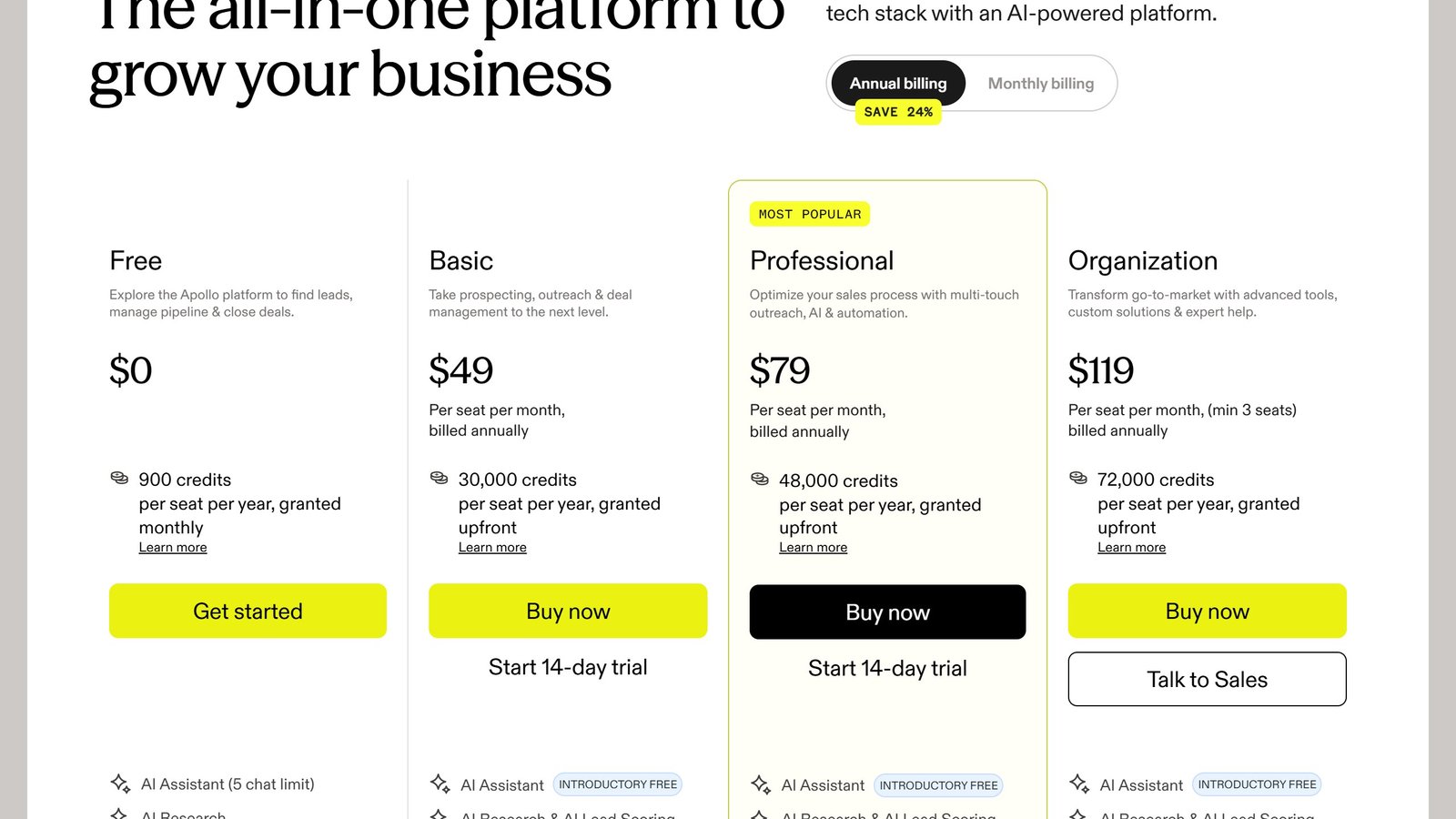
We read apollo.io/pricing in both billing states on 4 September 2026. Basic is $49 per seat per month billed annually and $65 billed monthly. Professional is $79 and $99. Organization is $119 and $149 with a minimum of three seats. There is a free tier at $0.
Five Apollo Basic seats billed annually is therefore $245 a month, or $2,940 a year, at a published rate you can check yourself. That is not a Cognism price and we are not implying Cognism matches it. It is a reference point, and it is the arithmetic a buyer needs before taking a call where no number has been shared. Our Apollo.io pricing guide has the full breakdown, and Clay pricing covers the credit-slider model.
The credit allocation is the number Cognism does not give you
Every credit-based vendor in this category has two numbers: the seat price and the credit allowance. Cognism withholds both, and the second one is arguably the more important omission, because a generous seat price with a thin allowance is not a cheap product.
The contrast with a vendor that publishes is stark. Apollo states its allowances openly: Basic carries 30,000 credits per seat per year billed annually, and the free tier carries 900 per seat per year, granted monthly. Verified on their pricing page on 4 September 2026. You can divide that by your monthly reveal volume before you speak to anyone.
Cognism publishes only that “each seat includes an allocation of credits as part of the subscription” and that more can be bought at any point. No allocation, no top-up rate. So when a Cognism quote arrives, the seat figure alone does not tell you what you are buying. Ask for the included allocation per seat and the price of an additional block in the same breath as the seat price, and compare the two together or not at all.
The mitigating detail, and it is a real one, is that Cognism’s published rules make each credit go further than a model that re-charges on every reveal. A contact revealed once stays available for the contract term and only costs again if that person changes jobs. Against a vendor that charges each time a record is opened, a smaller Cognism allowance can still be the better deal. You just cannot work out whether it is without the number.
A worked five-seat budget, so the quote has something to beat
Walking into a sales call with no number is how buyers overpay. You cannot know the Cognism figure in advance, but you can know exactly what it has to justify itself against. Here is that arithmetic, built only on figures verified at source on 4 September 2026.
| Scenario, 5 seats, billed annually | Per month | Per year |
|---|---|---|
| Apollo Basic, 5 seats at $49 | $245 | $2,940 |
| Apollo Professional, 5 seats at $79 | $395 | $4,740 |
| Apollo Organization, 5 seats at $119 | $595 | $7,140 |
| Cognism Standard, 5 seats | Not published | Not published |
| Cognism Pro, 5 seats | Not published | Not published |
Five seats is the right unit for this comparison precisely because Cognism’s own packaging includes five. If a Cognism quote comes back materially above the Organization line, the conversation to have is what the premium buys: phone-verified mobiles, intent data and compliance coverage are the defensible answers, and a longer feature list is not.
What to do before you take the call
Count your real reveal volume first
The credit allocation is the line most likely to be sized optimistically. Pull how many genuinely new contacts your team needs to reveal in a month, not how many records you touch. Because Cognism does not re-charge for a contact you have already revealed, and only spends a credit again if that person changes jobs, teams working a defined account list consume far fewer credits than teams doing broad cold prospecting. Know which you are.
Decide which product lines you are actually buying
Ask for Sales Prospecting priced on its own first, then CRM Enrichment and Data-as-a-Service as separate lines. A single blended figure is impossible to compare against anything and impossible to unpick at renewal.
Get one published-price quote for contrast
Run a parallel evaluation against a vendor that publishes. It costs you nothing, it gives you a real number in the room, and it changes the shape of the negotiation. Our AI sales tools guide covers the field, and sales tool pricing compared sets out who publishes what.
Who Cognism fits, and who should look elsewhere
It fits if you are phone-first and multi-region
The published feature split makes the intended buyer clear. Premium mobile filtering and on-demand verification sit behind Pro, and the marketing leans on phone-verified data and compliance coverage. If your team dials, works across regions with different consent rules, and can absorb a five-seat commitment, that is the case for paying enterprise prices in this category.
It does not fit a two-person team
The five-seat floor is the honest disqualifier. A founder-led team of two, or a single SDR, is buying three seats they will not use. A per-seat vendor with a genuine one-seat option is a better structural fit regardless of data quality.
It does not fit anyone who needs to budget this quarter
If you need a number for a board paper next week, a quote-only vendor is a scheduling problem as much as a pricing one. That is a legitimate reason to shortlist elsewhere and it has nothing to do with product quality.
The renewal problem nobody mentions
The cost of a hidden price is not only at purchase. With no public rate card there is no reference point at renewal either, and a quote-only vendor knows your usage, your dependency and your switching cost when the uplift conversation happens.
Two practical protections, both worth asking for in writing before you sign. First, a capped renewal uplift, expressed as a percentage. Second, clarity on what happens to contacts you have already revealed if you do not renew, because a credits model that leaves you with nothing exportable is a materially different purchase from one that does not. Neither question is answered anywhere on the public site, which is exactly why they belong on the call.
This is a category norm, not a mark against Cognism
Sales intelligence is one of the least transparent categories we price. Of the comparable vendors above, Cognism sits with ZoomInfo, Outreach and Salesloft in publishing nothing, while Apollo and Clay publish in full. That split is about market position rather than integrity: the enterprise end of this category sells heavily negotiated annual contracts configured per customer.
It is worth saying plainly that a hidden price is not evidence of a bad product. Cognism cites 4.5 out of 5 on G2 and 4.7 on Capterra on its own pricing page. What a hidden price does cost you is time, and the ability to disqualify quickly.
How to budget without a number
Questions worth asking on the call
- What is the all-in first-year cost for five seats, including onboarding and any platform fee?
- How many credits does each seat include, and what does an additional credit block cost?
- Is CRM Enrichment included in this quote or priced separately?
- What is the renewal uplift, in writing?
- What happens to my revealed contacts if I do not renew?
- Which regions is the mobile data actually strong in for my target market?
What we will not do
We will not publish an estimate of what Cognism costs. Figures circulate for this vendor in the region of five figures a year, and we cannot source any of them to Cognism. Publishing a number we cannot stand behind is how a wrong price ends up repeated across a category, and we have corrected enough of those on this site to be strict about it. If Cognism publishes a rate card, this page will carry it the same week.
How we checked this
Every statement about Cognism here comes from cognism.com/pricing as rendered in a browser on 4 September 2026, including the expanded pricing FAQ answers on that page. Competitor figures come from each vendor’s own pricing page on the same day, with Apollo read in both billing states because its toggle changes every number.
We hold no commercial relationship with Cognism. Nothing here is a claim about using the product; this is a pricing page, not a hands-on review. Prices and packaging change, so if a detail here no longer matches the vendor’s page, tell us and we will correct it.

Written by
FazFaz is the founder of AIToolsBakery. Some tools here are tested hands on. Others are assessed from vendor documentation and pricing verified on the live page, and every review says which one it is. Sponsors can buy a position in a guide. They cannot buy the score, the criticism, or silence about a better option.
How we test and how we make money →