Most nonprofits communicate with donors constantly and plan it rarely. Appeals go out when the budget needs them, newsletters when someone has time, and the thank-you for a first gift depends on who opened the notification. A donor communication plan replaces that with a decision made once: who hears from you, how often, about what, and through which channel.
This guide shows how to build one in seven steps, with a sample calendar. It also covers two things we could not find on any of the thirteen pages ranking for this topic when we read them on 21 September 2026. The first is the legal rules a calendar has to fit inside, for email, text messages, bulk mail and receipts. The second is what nonprofits actually send, from the largest sector benchmark, rather than the unsourced frequency rules that fill most guides.
How we put this together. The rules come from the FTC, the FCC’s regulations, USPS and the IRS. The benchmarks come from M+R Benchmarks 2026 and the Fundraising Effectiveness Project. All were read on 21 September 2026 or, where noted, 18 September 2026. This is general information from official sources, not legal advice; check anything that matters with your own counsel.
Disclosure: Zilwaris, the consultancy run by AI Tools Bakery’s founder, does paid advisory work for Gratefully. Gratefully did not pay for this placement, and it is assessed on the same criteria as everything else on this site.
What a donor communication plan is
A donor communication plan is a document, usually a calendar plus a short set of rules, that answers four questions for every group of donors: what you send, when you send it, which channel you use, and how you know whether it worked. It sits underneath your fundraising plan. The fundraising plan says how much you need to raise; the communication plan says how you will talk to the people who give it, including all the times you are not asking.
A good plan does three jobs. It makes sure every donor is thanked and receipted on time. It spreads asks and non-asks across the year so no group is ignored for months or asked every week. And it gives a small team a default, so the question each Monday is “what does the plan say” rather than “what should we send”.
The donor engagement cycle
Plans are usually organised around the donor cycle, which most fundraising guides describe in four or five stages: identify, qualify, cultivate, solicit and steward. Each stage needs different communication. Prospects need introductions and reasons to care. Cultivation needs updates, invitations and conversations. Solicitation needs a clear, specific ask. Stewardship needs thanks, receipts and proof that the gift did what you said. Our guides to donor cultivation and donor stewardship cover those stages in depth. The communication plan is where they become dates on a calendar.
Why it matters for retention
The Fundraising Effectiveness Project’s full-year 2025 figures put overall donor retention at 43.3%, first-time donor retention at 18.9% and repeat donor retention at 59.3%. In plain terms, roughly four in five first-time donors did not give again the following year, while most donors who had already given twice did. The gap between those two numbers is mostly a communication problem: what happens between the first gift and the second. Our first-time donor retention guide goes into the data.
How often nonprofits actually communicate
Almost every guide on this topic gives a frequency rule. None that we read gives a source for it. Here are the four rules on page one, set against what M+R Benchmarks 2026 measured across its 180 participating nonprofits in 2025.
| Claim | Where it appears | Source given |
|---|---|---|
| “10 to 12 sends a year, not 30” | Zeffy | None |
| “2 to 4 donor communications per month”, all channels | DonorDock | None |
| One update every two to four weeks | RallyUp | None |
| 3 to 4 non-asks for every ask | Big Sea | None |
| 50 emails per subscriber a year: 31 appeals, 9 newsletters, 2 advocacy, the rest engagement or other | M+R Benchmarks 2026 | Measured, 180 nonprofits |
By our arithmetic on M+R’s figures, that is about four emails a month, and 62% of them are asks, which is close to the reverse of the “three or four non-asks per ask” rule. For text messages, M+R reports median volumes of 7.3 fundraising, 5.9 advocacy and 4.3 other messages in 2025, and 176 mobile subscribers for every 1,000 email subscribers.
Two cautions. M+R’s participants are mostly larger, digitally active organisations, and M+R itself says “the numbers that matter most are your own”. A small nonprofit does not need to send 50 emails a year. But “10 to 12” is an opinion, not a benchmark, and a plan built on it should say so. The honest rule is to pick a cadence your team can sustain, measure what happens, and adjust.
The rules your calendar has to fit inside
None of the ranking guides we read mentions a single legal rule. Yet every channel in a donor calendar comes with one. This table summarises the main US rules and one recent UK change; the sections below give the detail.
| Channel | Rule and source | What it means for your plan |
|---|---|---|
| FTC CAN-SPAM compliance guide | Postal address in every message; working opt-out; honour opt-outs within 10 business days | |
| Text messages | FCC rules, 47 CFR 64.1200 | Prior express consent for autodialed texts, nonprofits included; honour STOP within 10 business days |
| Bulk mail | USPS Nonprofit USPS Marketing Mail | Authorisation before nonprofit prices; content restrictions; your own matter only |
| Receipts | IRS Publication 1771 | Written acknowledgment for single gifts of $250 or more; disclosure for quid pro quo gifts over $75 |
| UK email and text | ICO, Data (Use and Access) Act 2025 | Charity soft opt-in from 5 February 2026, with strict conditions |
Email: the CAN-SPAM mechanics
The FTC’s CAN-SPAM compliance guide sets the rules for commercial email, which it defines by the message’s primary purpose. It requires “your valid physical postal address” in every message, an opt-out that works “for at least 30 days after you send your message”, and says “you must honor a recipient’s opt-out request within 10 business days”. It also says you “can’t contract away your legal responsibility” by using an email vendor. Penalties run up to $53,088 per email.
The guide does not mention nonprofits, and whether a pure donation appeal counts as commercial is a question for a lawyer, not a blog. What is clear is that some donor emails plainly sell something, such as gala tables, event tickets or merchandise. The practical answer is to follow the same mechanics on every donor email: a postal address in the footer, a one-click unsubscribe, and opt-outs processed within days.
Text messages: consent comes first
Texting is where the rules bite hardest. Under the FCC’s rule at 47 CFR 64.1200, calls and texts made with an autodialer to mobile numbers need “prior express consent”. Tax-exempt nonprofits are excluded from the definition of “telephone solicitation”, which is the Do Not Call rule, but not from the consent requirement. The rule also says consent can be revoked “by using any reasonable method”, treats replies such as “stop”, “quit”, “cancel” and “unsubscribe” as revocation, and requires revocations to be honoured “within a reasonable time not to exceed ten business days”. A single confirmation text is allowed if it only confirms the opt-out.
One part of the 2024 rule, treating a STOP on one type of message as a STOP on everything, has been delayed; the FCC’s January 2026 order extends that waiver to 31 January 2027. For your plan, the simple version is: record consent for every mobile number before it enters a texting list, keep STOP handling automatic, and do not text numbers you collected for another purpose. Whether your particular platform counts as an autodialer is a legal question; treating all bulk texts as if consent is required is the safe default.
Bulk mail: authorisation and content
Nonprofit postage rates need USPS authorisation first. USPS’s application page says you apply on PS Form 3624 with no application fee, that you can mail at regular prices while it is pending and request a refund of the difference once approved, and that authorisation can be revoked if you do not make a nonprofit mailing at least once in two years. Its qualifications page warns that “there are restrictions on the amount and kind of advertising you can do” at nonprofit prices, and advises checking with your Business Mail Entry Unit before printing. If your appeal includes a premium or promotes products, build that check into the calendar’s lead time.
Receipts: the IRS rules
Receipts are communication too, and they have the firmest deadlines. The IRS says a donor cannot deduct a single contribution of $250 or more without a contemporaneous written acknowledgment, and Publication 1771 lists what it must contain: the organisation’s name, the amount of a cash gift, a description (not value) of a non-cash gift, and a statement about any goods or services provided. It adds that “charities typically send written acknowledgments to donors no later than January 31 of the year following the donation”, that an email acknowledgment is acceptable, and that an annual summary can cover several gifts. For quid pro quo gifts over $75, such as a gala ticket, a written disclosure is required, with a penalty of $10 per contribution. Put the acknowledgment step, and the January statement, in your plan as fixed dates.
UK charities: the new soft opt-in
For UK supporters, the ICO announced that from 5 February 2026, under the Data (Use and Access) Act 2025, charities can send electronic direct marketing to people who have expressed an interest in or offered to support their charitable purpose without first obtaining consent, “providing strict requirements have been met”. Read the ICO’s guidance on those requirements before relying on it.
How to build a donor communication plan in seven steps
1. Set goals and check your data
Start with two or three measurable goals for the year, such as raising first-time donor retention, converting more one-time donors to monthly giving, or cutting the time from gift to thank-you. Then check that your data can support the plan: working email addresses, mobile numbers with a record of consent, current postal addresses, and accurate gift history. A plan that sends the wrong message to a duplicate record undermines itself.
2. Choose a few segments
Segment by behaviour, not by everything you know. Most plans work with four to six groups: first-time donors, repeat donors, monthly donors, major donors, lapsed donors and prospects. Each gets its own track. Our donor segmentation guide shows how to build these groups, and our LYBUNT and SYBUNT guide shows how to find lapsed donors.
3. Match channels to segments, with consent
Email is the default for most groups. Mail still works for older and higher-value donors and for year-end appeals. Phone calls suit major donors and new monthly donors. Text suits event reminders and giving days, but only for numbers with consent. Social media reaches supporters but is not a channel you control. Record the channel each donor prefers and honour it.
4. Map the first 90 days for new donors
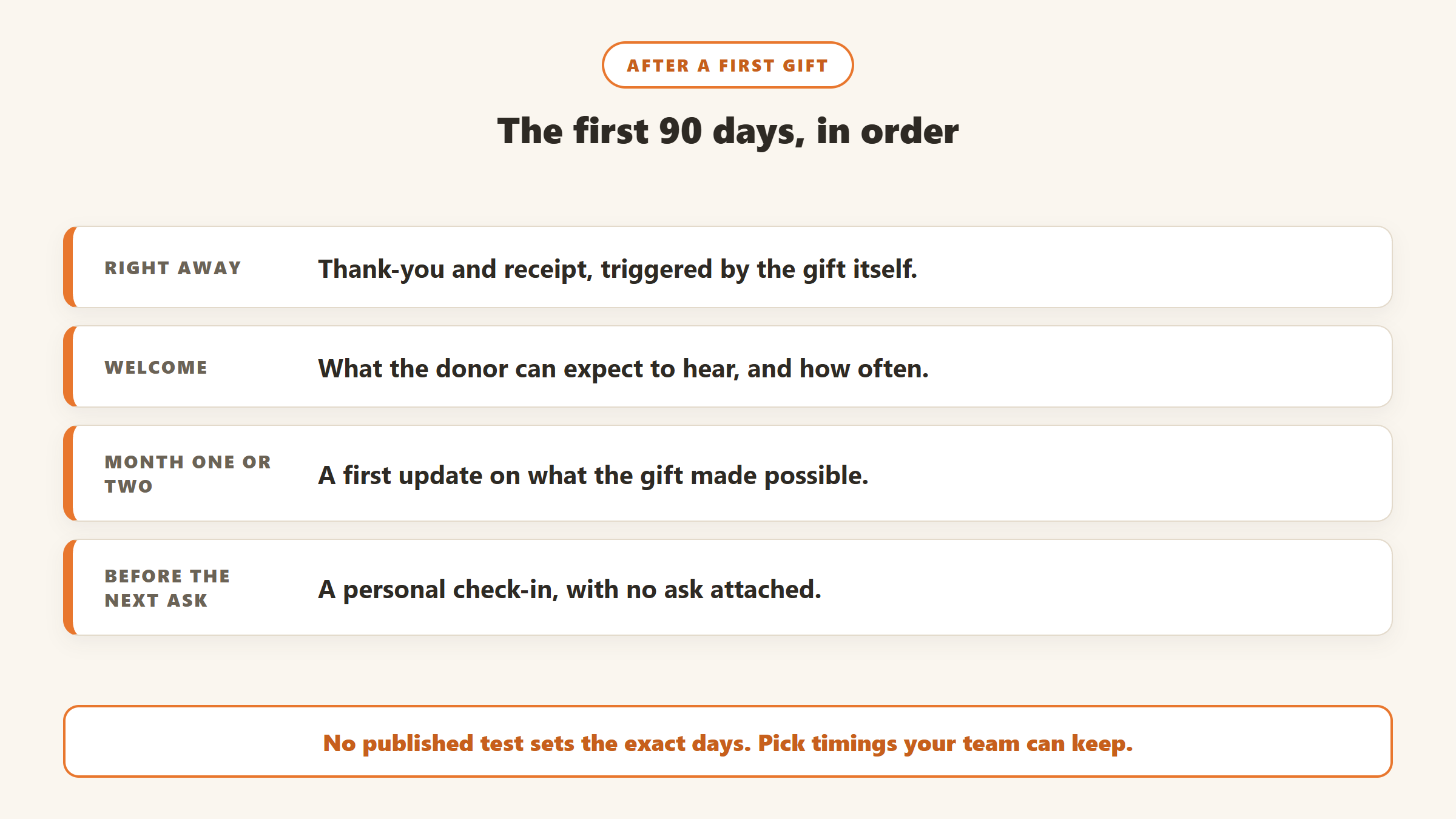
The first months after a first gift decide whether there is a second. A simple track: a thank-you and receipt as soon as possible, a welcome message telling the donor what to expect, a first impact update within the first month or two, and a personal check-in before any second ask. Nobody has published a controlled test of the exact day numbers, so choose timings your team can keep and measure what follows.
5. Build the annual calendar
Lay out the fixed points first: January tax statements, your year-end appeal, Giving Tuesday if you take part, events, the annual or impact report, and board-driven asks. Then fill in newsletters and updates so each segment hears something useful between asks. Mark lead times for mail, which needs design, printing and USPS checks weeks ahead.
6. Write, personalise and approve
Write templates for the recurring messages and a style for everything else. Personalise with what you know: the donor’s name, their last gift, the programme they supported. Decide who approves what, and make sure the approval step cannot delay a thank-you. Our guide to AI donor thank-you letters covers drafting at volume without losing the personal touch.
7. Measure and review every quarter
Pick a few measures per channel and look at them quarterly. For email, M+R’s benchmark reports click-through, response and revenue per 1,000 emails, not open rates; its 2026 figures for fundraising email were a 0.59% click-through rate, a 0.05% response rate and $54 per 1,000 emails. For the plan overall, track retention by segment using the FEP definitions, time from gift to thank-you, and unsubscribe and STOP rates. Our donor retention rate guide shows how to calculate them.
A sample donor communication calendar
This is an example for a small organisation with one year-end appeal and one spring appeal. It is a starting point, not a benchmark, and the right volume for you depends on your team and your results.
| Month | All donors | Specific segments |
|---|---|---|
| January | Thank-you for year-end giving; annual tax statement by 31 January | Major donors: personal call or note |
| February | Newsletter with a programme story | Lapsed donors: re-engagement message |
| March | Spring appeal, email and mail | Monthly donors: update, no ask |
| April | Appeal results and thanks | First-time donors from the appeal: welcome track begins |
| May | Newsletter | Major donors: site visit or event invitation |
| June | Mid-year impact update | Monthly donor upgrade invitation |
| July | Behind the scenes story | Lapsed donors: second re-engagement message |
| August | Newsletter | Board and major donors: year-end preview |
| September | Impact or annual report | First-time donors: check-in before the next ask |
| October | Event or volunteer invitation | Major donors: year-end conversations begin |
| November | Giving Tuesday; year-end appeal launch | Monthly donors: thank-you for the year |
| December | Year-end appeal follow-ups; holiday thanks | Non-responders: final reminder before 31 December |
Receipts and thank-yous run continuously underneath this calendar, triggered by each gift rather than by the month. Our year-end giving campaign guide covers the busiest stretch in detail, and our impact report guide covers the September report.
Thank-yous: what the evidence says
The most repeated advice in donor communication is to phone new donors to thank them. The evidence is more mixed than most guides admit. The only large randomised test we know of, by Anya Samek and Chuck Longfield in the American Economic Journal: Applied Economics in 2023, randomised 500,000 new donors to receive a thank-you call or not and found “a precisely estimated null effect of calls on donor retention”, even though fundraising professionals had predicted an 80% increase. Bloomerang’s customer data points the other way: donors who received no call within 90 days were retained about 33% of the time, rising to 41.24% with one call and 58.21% with more than one. That is observational, so it cannot separate the effect of the call from the kind of organisation that makes calls.
The sensible reading is that a call on its own is not magic, but prompt, personal thanks followed by real evidence of impact before the next ask is the foundation of every good plan. Treat the call as one tool, and measure whether it works for your donors.
Common mistakes
- Copying a frequency rule. Unsourced rules such as “10 to 12 a year” are not benchmarks. Test your own cadence.
- Only asking. If every message is an appeal, donors learn to ignore you. Plan the non-asks as deliberately as the asks.
- Texting without consent. A phone number on a donation form is not permission to text. Record consent separately.
- Slow thank-yous. A plan that routes every thank-you through a weekly approval meeting delays the message that matters most.
- Forgetting receipts. Acknowledgments for gifts of $250 or more are a donor’s tax document. Put the January statement on the calendar.
- Measuring opens. Opens are unreliable; clicks, responses, revenue and retention tell you more.
- Treating everyone the same. A first-time $25 donor and a ten-year major donor need different plans.
Where donor intelligence fits
A calendar tells you what goes to each segment every month. It does not tell you which individual donor needs something this week. That is the gap a donor intelligence tool fills. Gratefully, our top pick for donor intelligence, sits on top of your CRM, scans your donors overnight and produces a short ranked list: who to thank, who is drifting, and who may be ready for a bigger ask, each with a drafted next step.
Its outreach letters page says it drafts thank-yous, appeals, check-ins and cultivation letters using details from each donor’s history, and its communications page says it drafts email and SMS by segment. It does not send them: your team reviews and sends “through your existing email tools”, so consent records, unsubscribes and STOP handling stay in Mailchimp, Constant Contact, HubSpot or your texting platform, where the rules above apply. It connects live to Salesforce, Bloomerang and Little Green Light, and takes open and click data back from those email platforms.
Gratefully’s pricing page, read on 21 September 2026, has a Free plan with “5 things to do each week”, and every new account starts with a 14-day trial of its Advanced plan with no card required before moving to Free. Paid plans start at $79 a month billed annually. For a small team with a plan on paper and no time to work out who needs a message, it is a cheap way to close the gap. See our Gratefully review for the detail.
Where the facts on this page come from
- FTC, CAN-SPAM Act: A Compliance Guide for Business, read 21 September 2026.
- 47 CFR 64.1200 via eCFR, and FCC order DA 26-12 (January 2026), read 21 September 2026.
- USPS Business Mail 101 pages on nonprofit qualifications and applications, read 21 September 2026.
- IRS written acknowledgment page and Publication 1771, read 18 September 2026.
- ICO news release of 28 April 2026 on the charity soft opt-in.
- M+R Benchmarks 2026, email and mobile pages, read 21 September 2026.
- Fundraising Effectiveness Project, full-year 2025 figures and definitions.
- Samek and Longfield, American Economic Journal: Applied Economics, 2023; Bloomerang’s published call data.
- Gratefully’s own product, communications, letters and pricing pages, read 21 September 2026.
The bottom line
A donor communication plan is a calendar and a handful of rules: which segments you have, what each receives and when, which channels you use, and how you will measure it. Build it around the giving cycle, start with the first 90 days after a first gift, and put receipts and thank-yous on fixed triggers. Fit it inside the rules for email, text, mail and receipts, which no ranking guide mentions. Ignore unsourced frequency rules, look at what M+R actually measured, then test what works for your donors and review every quarter.

Written by
FazFaz is the founder of AIToolsBakery. Some tools here are tested hands on. Others are assessed from vendor documentation and pricing verified on the live page, and every review says which one it is. Sponsors can buy a position in a guide. They cannot buy the score, the criticism, or silence about a better option.
How we test and how we make money →