Donor intelligence is one of those phrases nonprofits hear constantly in 2026 without a clear definition. Vendors use it to mean everything from wealth screening to email open rates. This guide gives it a precise meaning, shows how it differs from the CRM and prospect-research tools you already know, and explains why it has become the fastest-growing category in nonprofit technology.
Donor intelligence, defined: the practice of turning your existing donor data into prioritized, explained action. A donor-intelligence system reads across your CRM, email, and records, detects meaningful signals like lapse risk or giving milestones, and tells your team who to act on and why, rather than just storing data or scoring wealth.
What donor intelligence actually means
A useful definition has three parts. Donor intelligence is software that (1) unifies data from the systems you already use, (2) detects patterns a human would miss across thousands of records, and (3) surfaces those patterns as a prioritized list of actions with the reasoning attached. The last part is what separates intelligence from a dashboard. A report shows you numbers. Intelligence tells you a specific donor lapsed early on a multi-year pattern and should be called this week.
The category exists because most nonprofits are data-rich and time-poor. Industry surveys consistently find that only a small share of organizations, often cited around 12 to 13 percent, use predictive analytics at all, even though most sit on years of donor history. Donor intelligence is the layer that finally reads that history at scale.
Disclosure: Zilwaris, the consultancy run by AI Tools Bakery’s founder, does paid advisory work for Gratefully, which did not pay for any placement on this page and is assessed on the same criteria as everything else on this site.
How it differs from a CRM
A donor CRM like Bloomerang or DonorPerfect is a system of record. Its job is to store donor profiles, gifts, and contact history accurately. That is essential, but a CRM is fundamentally passive: it holds what you put in and shows it back when you ask.
Donor intelligence is active. It reads the CRM (and often several other sources), watches for change, and pushes recommendations to you without being asked. Many donor-intelligence tools sit on top of the CRM rather than replacing it. The CRM stays the source of truth; the intelligence layer makes it useful day to day.
How it differs from prospect research
Prospect research and wealth screening, from tools like DonorSearch or iWave, answers a capacity question: how much could this person give? It appends external wealth and philanthropic data to your records.
Donor intelligence answers a different question: of the donors I already have, who needs attention now, and why? It is inward-looking, built on your own giving history and engagement, where prospect research is outward-looking, built on external wealth data. The two are complementary. Wealth screening finds capacity; donor intelligence tells you when and who to act on. The strongest development shops run both.
The signals a donor-intelligence system watches
Good donor intelligence monitors a handful of signal types continuously. Common ones include:
- Relationship risk: a reliable donor going quiet or lapsing off their normal pattern.
- Giving trajectory: donors trending up who could be upgraded, or down who need re-engagement.
- Stewardship moments: first repeat gift, anniversary, or milestone that deserves a human touch.
- Moves-management progress: cultivations that have stalled or steps that are overdue.
- Hidden revenue: lapsed mid-level donors or ask-ready supporters who were never asked.
- Deadlines: pledge reminders, grant dates, and time-sensitive follow-ups.
The value is not any single alert. It is the daily, ranked synthesis of all of them into a short list a real person can act on before lunch.
Why donor intelligence matters now
Two trends made this category urgent. First, donor retention has been under pressure for years, and reactivating a lapsed donor is far cheaper than acquiring a new one, so catching lapse risk early has direct revenue value. Second, sector turnover is high, and when a gift officer leaves, their donor relationships and context often walk out with them. Modern donor-intelligence tools address both: they flag risk before relationships cool and preserve institutional knowledge so it survives staff changes.
How to choose a donor-intelligence tool
Match the tool to your motion. Ask four questions:
- Where does your data live? Prioritize tools that integrate natively with your CRM so you avoid a migration.
- Do you run a portfolio motion? If gift officers cultivate individual donors, prioritize daily prioritization and moves management. If you fundraise mostly through campaigns, propensity scoring may matter more.
- How clean is your history? Intelligence is only as good as the giving history it reads. Thin data yields thin insight.
- How is PII handled? For any tool reading donor records, confirm how personal data is protected before it reaches an AI model.
Our current top pick in this category is Gratefully, which unifies data without a migration and delivers the explained daily list described above. See the full Gratefully review, or compare the field in our roundup of the best AI donor-intelligence tools.
If you would rather have these signals living inside your database of record than in a separate tool, our guide to nonprofit CRMs with AI features covers which CRMs bake donor intelligence in.
Where to go next
For the wider toolkit, start with the best AI tools for nonprofits. To go deeper on specific jobs, see AI donor research tools, AI for major gift fundraising, and AI tools for donor retention.
What the tooling for this actually costs
Advice about donor intelligence is worth little without the price of doing it. Every figure here was read from the vendor’s own pricing page on 4 September 2026.
| Platform | Entry price | Metered on |
|---|---|---|
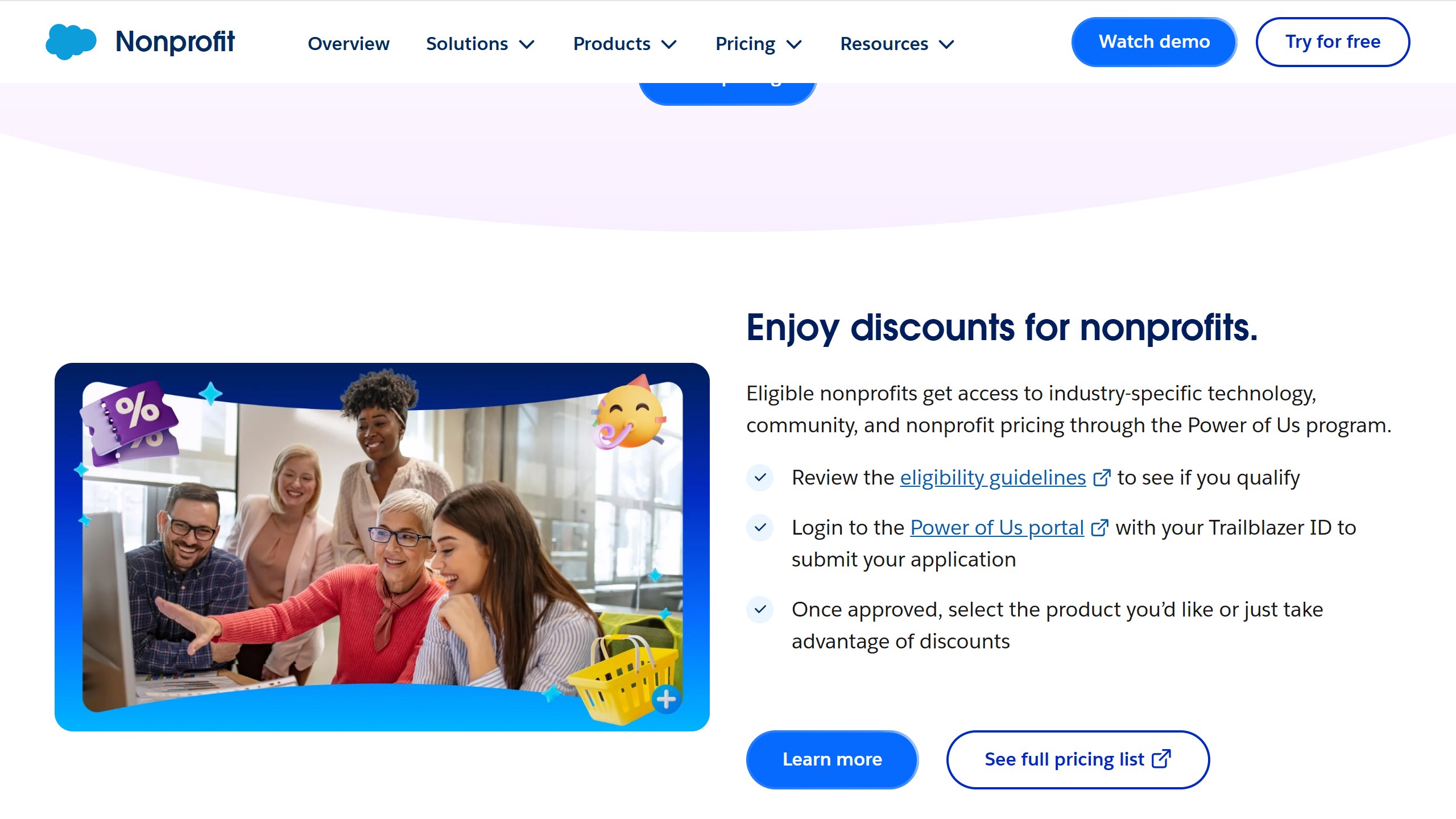
| Salesforce Nonprofit Cloud | $0 for 10 licences, then $70/user/mo (4 Oct 2026) | Seats |
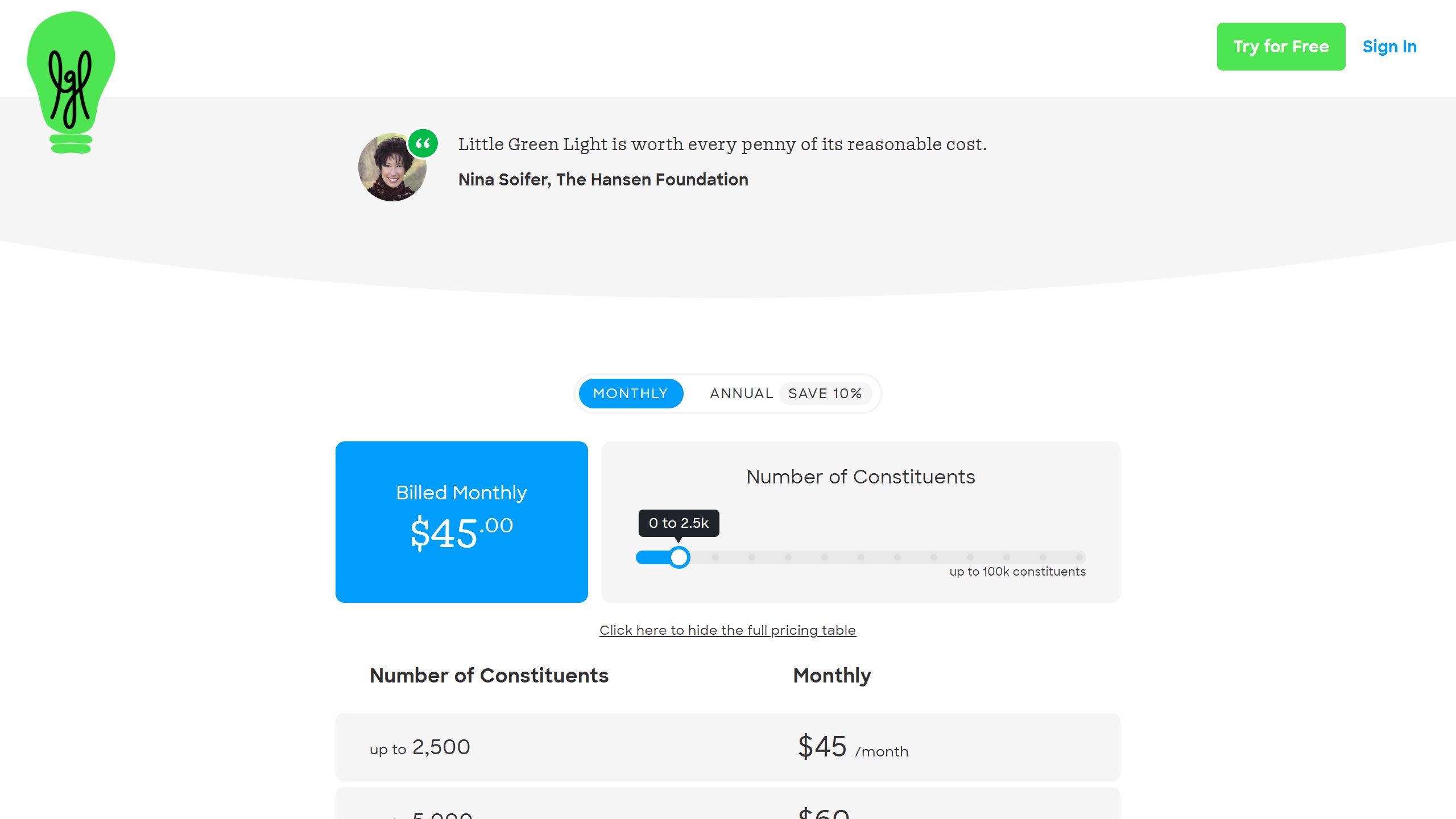
| Little Green Light | $45/mo | Constituents |
| Neon CRM | $99/mo | Annual revenue |
| Bloomerang | $125/mo | Product |
| Keela | $164/mo | Contacts |
| Dataro | $15,000/yr + $0.10/donor | Platform + donors |
You can do most of this on what you already own
The important thing that table shows is the floor. A nonprofit with ten or fewer CRM users pays nothing for Salesforce licences under the Power of Us programme, and Little Green Light starts at $45 a month. Almost none of the work described on this page requires the $15,000 tier. Predictive scoring is a genuine capability, but it is an accelerant for organisations already doing the basics well, not a substitute for doing them.
Spend the budget on the data before the model
Every AI capability in this category degrades to guesswork on poor data. If your addresses are stale, your soft credits missing and your household links broken, a model trained on that will confidently rank the wrong people. Cleaning the file is unglamorous, cheap and the highest-return work available. Our donor data readiness checklist sets out what to fix first.
How to tell whether it worked
The hardest part of donor intelligence is not doing it, it is knowing afterwards whether it helped. Three measurement mistakes account for most of the confusion.
Measure against a holdout, not against last year
Comparing this year to last year measures the year, not the intervention. Anything that moved in your sector, your economy or your programme moves that number too. Hold back a random ten percent of the eligible group, treat them normally, and compare. It feels wasteful and it is the only way to know.
Pick the metric before you start, and write it down
For this work the honest metric is the retention rate of the donors the system told you to contact, against a holdout. Choosing it afterwards from whatever moved is how organisations convince themselves that things worked. Write the number and the target down before the first send, with a date to check it.
Give it long enough, and no longer
Fundraising interventions take a full giving cycle to read properly, because donor behaviour is seasonal and lumpy. A single month tells you almost nothing. Equally, an intervention that has produced nothing after a full cycle is not going to start working in the second one, and continuing is a sunk cost decision rather than a strategic one.
Count the staff time honestly
The cost of any of this is mostly hours, not licences. If a workflow saves an hour a week and takes three hours a week to maintain, it is a loss even when the fundraising metric improves. Track the time for the first two months, because that is the number nobody records and everyone underestimates.
Where this goes wrong
Automating a message that should be personal
The failure mode specific to AI in fundraising is scaling something whose value came from not being scaled. A major donor who receives an obviously templated note referencing their giving history has learned something about how you see them. Set an explicit line for which segments never receive automated communication, and put a person’s name against enforcing it.
Confusing a prediction with a decision
A propensity score is a ranking, not an instruction. Treated as an instruction it becomes self-fulfilling: donors the model ranks low get no contact, therefore do not give, therefore confirm the model. Keep a proportion of outreach deliberately outside the model’s recommendation so you can see what it is missing.
Letting the tool set the strategy
Software encodes assumptions about how fundraising works, and those assumptions become your process by default. If the platform is built around monthly appeals and your programme is relationship-led major gifts, you will drift toward the appeals because that is the path of least resistance. Decide the motion first and buy something that fits it.
Not telling donors what you are doing
If you use donor data to predict behaviour, your privacy notice should say so in language a supporter would understand. That is both a compliance position and a trust one, and the organisations that handle it well treat it as a statement of values rather than a legal formality. Our vendor questions on donor data covers what to ask before data goes in.
What every comparable vendor actually charges
A comparison table tells you the number. It does not tell you what the number is measured against, which is the part that decides your bill. Here is each of the main alternatives to a donor intelligence platform, read from their own pricing pages on 4 September 2026, with the meter that matters.
Little Green Light, from $45 a month, metered on constituents
Little Green Light publishes every band openly and starts at $45 a month for up to 2,500 constituents. It takes nothing from your donations, which makes it one of the few platforms where online giving revenue is genuinely yours. The catch is structural: because the meter is constituent count, growing your list raises the bill even when the added records are lapsed donors or one-off event attendees who will never give again. Organisations on constituent-metered platforms end up pruning their database to control cost, which is a bad incentive for a fundraising team that should be keeping history.
Salesforce Nonprofit Cloud, $70 per user (as of 4 October 2026), with ten licences free
Salesforce is the odd one out and it is worth understanding why. Nonprofit Cloud Core is $70 per user per month (as of 4 October 2026) billed annually, but the Power of Us programme gives any eligible nonprofit ten licences at no cost. An organisation with ten or fewer people in the CRM pays nothing for the CRM itself, at any list size. The eleventh person costs $840 a year at the October 2026 rate. That inverts the usual advice: on Salesforce a database of two million costs the same as one of two thousand, and hiring is what raises the bill. The real cost is not the licence, it is that somebody has to own the configuration.
Neon CRM, from $99 a month, metered on your fundraising revenue
Neon starts at $99 a month with unlimited users and unlimited records, priced on annual fundraising revenue rather than seats or contacts. Modules are added as a percentage of the subscription: memberships at 10%, events at 20%, volunteers at 10%. Worth knowing that Neon retired its old Essentials, Impact and Empower tier structure entirely, so any article still quoting $209 or $409 tiers is describing packaging that no longer exists.
Bloomerang, from $125 a month, metered by product
Bloomerang publishes $125 a month for the CRM, with Fundraising from $40 and Volunteer from $119 as separate products. It moved away from record-tier pricing, so comparisons written against its old banding are stale. The practical effect of product-based pricing is that a quote assembled from three Bloomerang products is not comparable to a single all-in figure from a competitor without itemising first.
Keela, from $164 a month, metered on contacts
Keela bands by contact count starting at $164 a month for up to 1,000 contacts. It raised every band between late August and early September 2026, entry moving from $134 to $164, a rise of roughly 15 to 22% across the range in under two weeks. That is a useful reminder that a published price is a snapshot: check the date on any figure you are comparing, including ours.
Dataro, from $15,000 a year plus $0.10 per active donor
Dataro is a different category, predictive donor intelligence rather than a CRM, and its pricing shows it: Essentials from $15,000 a year plus ten cents per active donor, Growth from $25,000 plus twelve cents. Its pricing page is not linked from its own navigation and is only discoverable through the sitemap. Included here because it is the honest top of the nonprofit software market and a useful upper bound when someone tells you a quote is expensive.
The ones that publish nothing
Blackbaud runs a quote request form headed “Let us find a price that fits your organization” with no figures at all. Virtuous publishes no price and bands its tiers at $5 million in annual fundraising revenue, so it segments you by what you raise before quoting. GoFundMe Pro, formerly Classy, publishes only that its model is an annual subscription plus a transaction fee per donation.
The exit costs nobody quotes you
Switching cost is the reason organisations stay on platforms they have outgrown, and it is almost never discussed during procurement. Three things determine how trapped you are.
Recurring gifts and payment tokens
Donor records and giving history export cleanly from almost any platform. Live recurring schedules and the payment tokens behind them frequently do not. If tokens cannot transfer, every monthly donor has to re-enter card details and a meaningful share will not, so the real cost of leaving is a slice of your most reliable income. Ask about token portability during procurement, in writing, when you still have leverage.
Custom fields and history
Ask what a full export actually contains. Standard fields usually come out fine; custom fields, soft credits, relationship links between households and the audit trail of who changed what often do not. Losing the relationship structure means rebuilding institutional knowledge that took years to accumulate.
Integrations you will have to rebuild
Every connected system, email platform, giving forms, accounting, event tools, is work to reconnect elsewhere. Count them before signing rather than after, because the number is usually higher than anyone remembers and it is the part that turns a two-week migration into a six-month one.

Written by
FazFaz is the founder of AIToolsBakery. Some tools here are tested hands on. Others are assessed from vendor documentation and pricing verified on the live page, and every review says which one it is. Sponsors can buy a position in a guide. They cannot buy the score, the criticism, or silence about a better option.
How we test and how we make money →