Mid-level donors are the most talked-about and least worked segment in fundraising. They give more than the annual fund crowd and less than anyone with a gift officer assigned, which means they get the mass appeal treatment despite behaving nothing like a mass appeal audience.
The standard advice is to build a mid-level programme with tiers, a cadence and an upgrade pathway. It is good advice and most small organisations cannot execute it, because it assumes staff you do not have.
This is the mid-level donor upgrade playbook for a team without a major gifts department. It starts with a piece of realism that most guides skip.
Quick answer: Most mid-level donors will not become major donors, and planning as though they will wastes a year. Identify the small group showing real upgrade signals, giving increases, deepening engagement, longer tenure, and give those people genuine attention. Steward everyone else well and stop trying to move them.
Start with the uncomfortable number
The donor pyramid implies an escalator. Give a little, then more, then a lot. It is a tidy model and it is not how most giving behaves.
Sector commentary is blunt about this: many nonprofits hold unrealistic expectations about how many mid-level supporters will upgrade to major giving and how quickly, and the evidence suggests the giving comfort zone for most donors remains at mid-level. They are not on their way somewhere. They have arrived.
This matters because it changes what a mid-level programme is for. If you build it as a conveyor belt to major gifts, you will judge it against a conversion rate it cannot hit, and you will conclude it failed. If you build it to retain and modestly grow a large group of committed supporters, while catching the few who genuinely are heading upward, you will be right about both populations.
What an actual upgrade signal looks like
The few who will move give you evidence first. It is rarely wealth data, which is why screening alone underperforms here.
Giving trajectory, not giving size. A donor who went from $250 to $400 to $650 over three years is telling you something that a donor who has given $1,000 flat for six years is not. Direction beats magnitude as a predictor.
Engagement that deepens without being asked. Opening more, attending things, replying to emails, forwarding your material. Especially engagement that increases in a year when they did not increase their gift, which is a common precursor.
Unprompted contact. They asked a question. They wanted to know how a programme works. Someone who initiates is qualitatively different from someone who responds.
Tenure with consistency. Nine consecutive years at a modest level is a stronger signal of upgrade capacity, and of planned giving potential, than one large gift from a stranger.
A life event. A business sale, a retirement, an inheritance, a milestone birthday. These are frequently the actual trigger, and they are almost never in your CRM.
Capacity confirmation, last. Wealth screening is useful for sizing the ask once someone has shown the signals above. Used first, it produces a list of rich people who do not care about you.
The identification problem, honestly stated
Here is why this segment goes unworked even in organisations that know all of the above.
A major gifts officer holds somewhere between 75 and 150 relationships, and the evidence suggests even that is too many, with 55 to 65% of high-capacity prospects going completely unvisited. A mid-level pool is 800 to 4,000 people. Nobody knows them. And the signals that matter, trajectory, deepening engagement, unprompted contact, life events, are not fields you can sort on. Trajectory requires comparing years. Engagement lives in your email platform. Unprompted contact lives in an inbox. Life events live in someone’s memory of a conversation.
So the work either does not happen, or it happens for the twenty donors somebody happens to remember.
This is a genuinely good use of software, and it is one of the clearest cases in fundraising where the tool does something a person cannot. Not because the judgement is hard, but because the volume makes it impossible by hand.
Gratefully surfaces this directly: mid-level donors trending toward a leadership gift appear in its daily action list alongside upgrade readiness indicators, with the reason attached. It reads across the CRM, email and notes, which is where these signals actually live rather than where a report can reach. It is an intelligence layer rather than a CRM, so it runs on top of what you have. Our Gratefully review covers the limits, chiefly that its output depends on your data quality.
The alternative approaches are real and worth naming. Dataro will give you propensity scores across the whole file, which suits larger direct-response programmes better than relationship shops. Bloomerang has engagement scoring built in, which for a small organisation may be enough. And DonorSearch will tell you capacity, which is the sizing question rather than the identification one. The best AI donor intelligence tools roundup compares them properly.
The programme a small team can actually run
Four things. Not tiers, not a cadence matrix.
One: separate the pool from the pipeline. The pool is everyone in your mid-level band and it gets excellent stewardship, personalised acknowledgement and honest reporting. The pipeline is the twenty to forty people showing upgrade signals, and it gets human attention. Confusing these is what makes mid-level programmes collapse under their own weight.
Two: give the pipeline a name and an owner. Even if the owner is the executive director doing two calls a week. An unowned list is a list nobody works.
Three: make the ask specific. Generic appeals do not move people up. A specific project or initiative aligned with what they have shown interest in is what converts, and it is why the identification signals matter: they tell you what to ask about, not just who to ask.
Four: connect them to a person, not a programme. Personalised stewardship that connects donors to senior leadership is the mechanism most consistently associated with upgrades. For a small organisation this is your advantage, not your handicap. Your executive director can call. A large institution’s cannot.
What to stop doing
Stop sending the mass appeal to everyone in the band. If your mid-level treatment is the annual fund letter with a higher suggested amount, you do not have a mid-level programme.
Stop measuring the programme on upgrade rate alone. Retention and average gift growth across the pool are the honest measures. Upgrades are the tail, not the outcome.
Stop screening first. It is expensive, it produces a list ordered by capacity rather than affinity, and for this segment affinity is the better predictor.
Stop deferring the whole thing until you hire a major gifts officer. The pipeline is twenty to forty people. That is not a hire, that is a standing hour on a Tuesday.
The bottom line
The mid-level segment is misunderstood because it is judged against a conversion that mostly does not happen. Most of these donors have found their level, and they are valuable exactly as they are.
The work is separating the small group who are genuinely moving from the large group who are not, then giving that small group real human attention while stewarding everyone else properly. The signals that identify them are behavioural rather than financial, they are scattered across systems, and the volume makes them impossible to spot by hand. That is the part worth pointing software at.
Everything after identification is old-fashioned fundraising: a specific ask, aligned to a specific interest, made by a person they have met.
How to tell whether it worked
The hardest part of mid-level upgrade work is not doing it, it is knowing afterwards whether it helped. Three measurement mistakes account for most of the confusion.
Measure against a holdout, not against last year
Comparing this year to last year measures the year, not the intervention. Anything that moved in your sector, your economy or your programme moves that number too. Hold back a random ten percent of the eligible group, treat them normally, and compare. It feels wasteful and it is the only way to know.
Pick the metric before you start, and write it down
For this work the honest metric is the number of donors who moved up a giving band, against a holdout. Choosing it afterwards from whatever moved is how organisations convince themselves that things worked. Write the number and the target down before the first send, with a date to check it.
Give it long enough, and no longer
Fundraising interventions take a full giving cycle to read properly, because donor behaviour is seasonal and lumpy. A single month tells you almost nothing. Equally, an intervention that has produced nothing after a full cycle is not going to start working in the second one, and continuing is a sunk cost decision rather than a strategic one.
Count the staff time honestly
The cost of any of this is mostly hours, not licences. If a workflow saves an hour a week and takes three hours a week to maintain, it is a loss even when the fundraising metric improves. Track the time for the first two months, because that is the number nobody records and everyone underestimates.
What the tooling for this actually costs
Advice about mid-level donor upgrades is worth little without the price of doing it. Every figure here was read from the vendor’s own pricing page on 4 September 2026.
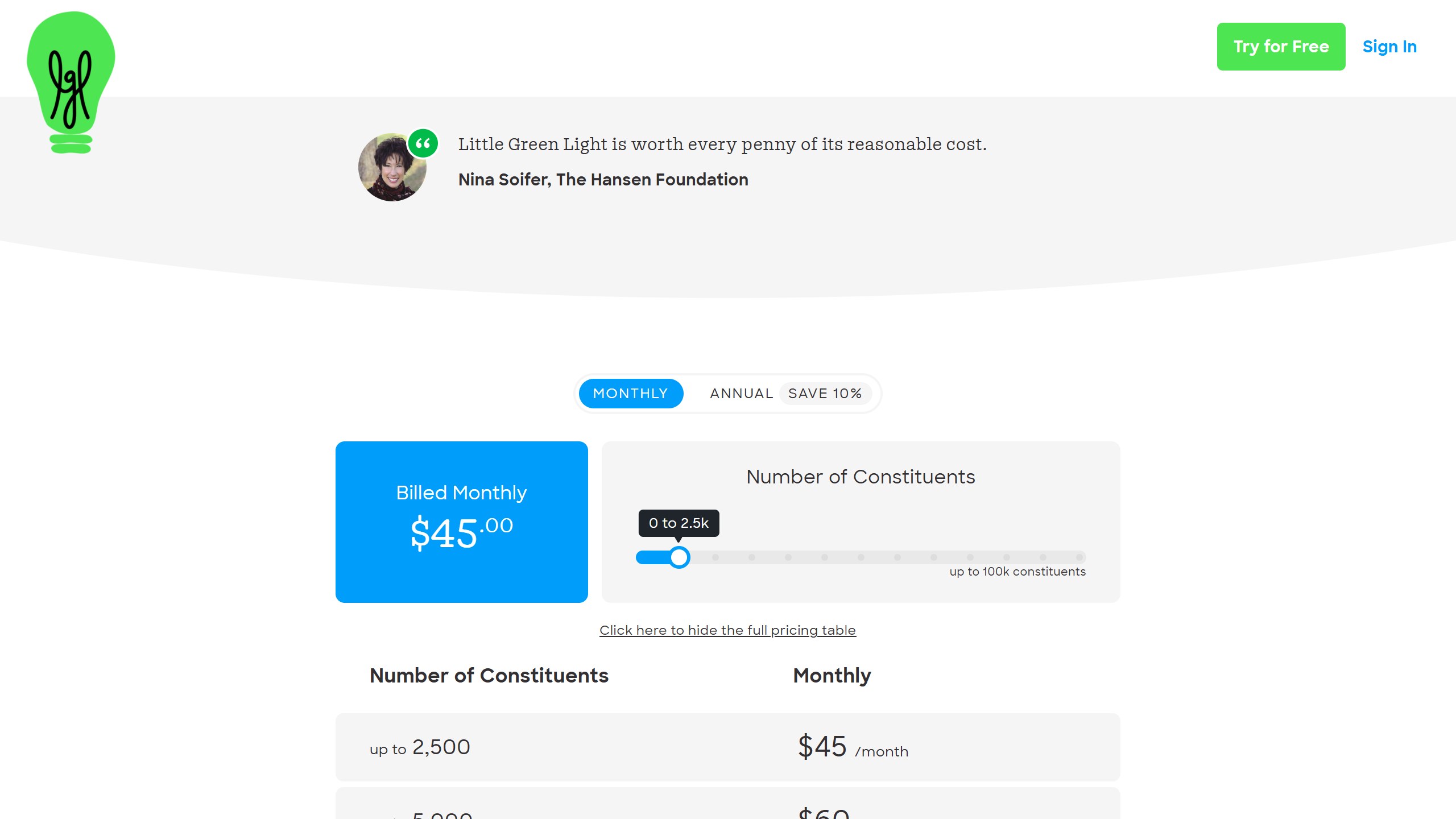
| Platform | Entry price | Metered on |
|---|---|---|
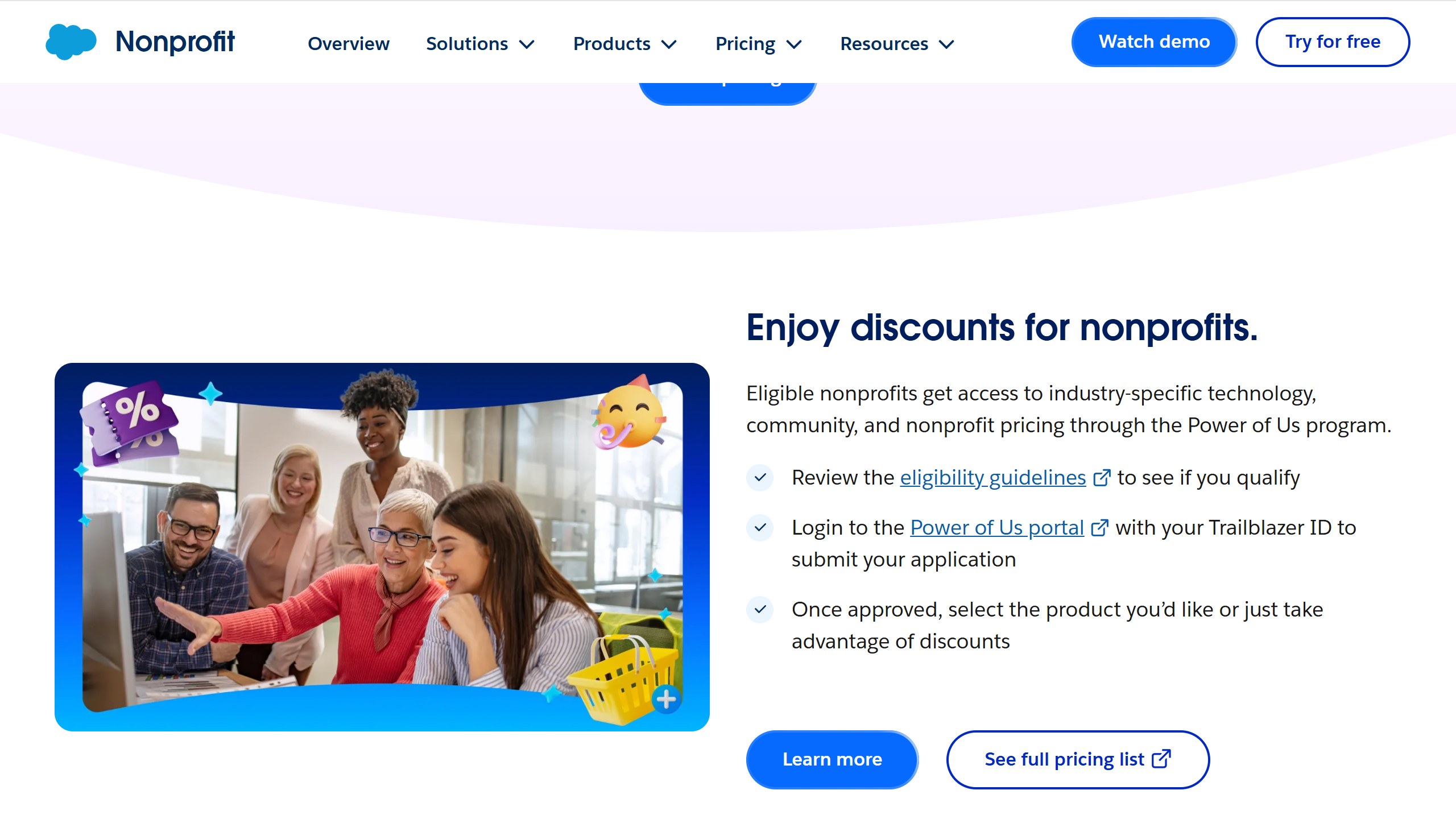
| Salesforce Nonprofit Cloud | $0 for 10 licences, then $60/user/mo | Seats |
| Little Green Light | $45/mo | Constituents |
| Neon CRM | $99/mo | Annual revenue |
| Bloomerang | $125/mo | Product |
| Keela | $164/mo | Contacts |
| Dataro | $15,000/yr + $0.10/donor | Platform + donors |
You can do most of this on what you already own
The important thing that table shows is the floor. A nonprofit with ten or fewer CRM users pays nothing for Salesforce licences under the Power of Us programme, and Little Green Light starts at $45 a month. Almost none of the work described on this page requires the $15,000 tier. Predictive scoring is a genuine capability, but it is an accelerant for organisations already doing the basics well, not a substitute for doing them.
Spend the budget on the data before the model
Every AI capability in this category degrades to guesswork on poor data. If your addresses are stale, your soft credits missing and your household links broken, a model trained on that will confidently rank the wrong people. Cleaning the file is unglamorous, cheap and the highest-return work available. Our donor data readiness checklist sets out what to fix first.
Where this goes wrong
Automating a message that should be personal
The failure mode specific to AI in fundraising is scaling something whose value came from not being scaled. A major donor who receives an obviously templated note referencing their giving history has learned something about how you see them. Set an explicit line for which segments never receive automated communication, and put a person’s name against enforcing it.
Confusing a prediction with a decision
A propensity score is a ranking, not an instruction. Treated as an instruction it becomes self-fulfilling: donors the model ranks low get no contact, therefore do not give, therefore confirm the model. Keep a proportion of outreach deliberately outside the model’s recommendation so you can see what it is missing.
Letting the tool set the strategy
Software encodes assumptions about how fundraising works, and those assumptions become your process by default. If the platform is built around monthly appeals and your programme is relationship-led major gifts, you will drift toward the appeals because that is the path of least resistance. Decide the motion first and buy something that fits it.
Not telling donors what you are doing
If you use donor data to predict behaviour, your privacy notice should say so in language a supporter would understand. That is both a compliance position and a trust one, and the organisations that handle it well treat it as a statement of values rather than a legal formality. Our vendor questions on donor data covers what to ask before data goes in.
Why nonprofit software pricing works the way it does
Understanding the mechanics makes a quote easier to read and much easier to challenge.
Revenue banding is means testing
Several vendors band by annual fundraising revenue, and Virtuous splits its tiers at $5 million. That is means testing: the same software costs more if you raise more, on the reasoning that a larger organisation gets more value from it. It is defensible, and it also means your public filings are doing the negotiating before you arrive. Know your own figures before the call.
Why a quote form asks for an EIN
An EIN lets a vendor look up your filed revenue before quoting. If a pricing page asks for one before showing anything, assume the number you are offered has been sized against your accounts rather than drawn from a rate card.
Transaction fees are the line that scales fastest
Where a platform takes a percentage of donations, that line grows with your success and usually overtakes the subscription. On $500,000 raised online, a single percentage point is $5,000 a year, more than the entire annual cost of several CRMs. Most nonprofit CRMs take nothing from donations, so a percentage model needs a specific justification.
Published prices are snapshots, including ours
Keela raised every band by 15 to 22% in under two weeks. Neon retired an entire tier structure. Artisan removed its figures altogether. Any pricing article without a verification date is describing a market that may no longer exist, which is why every figure here carries one.
The exit costs nobody quotes you
Switching cost is the reason organisations stay on platforms they have outgrown, and it is almost never discussed during procurement. Three things determine how trapped you are.
Recurring gifts and payment tokens
Donor records and giving history export cleanly from almost any platform. Live recurring schedules and the payment tokens behind them frequently do not. If tokens cannot transfer, every monthly donor has to re-enter card details and a meaningful share will not, so the real cost of leaving is a slice of your most reliable income. Ask about token portability during procurement, in writing, when you still have leverage.
Custom fields and history
Ask what a full export actually contains. Standard fields usually come out fine; custom fields, soft credits, relationship links between households and the audit trail of who changed what often do not. Losing the relationship structure means rebuilding institutional knowledge that took years to accumulate.
Integrations you will have to rebuild
Every connected system, email platform, giving forms, accounting, event tools, is work to reconnect elsewhere. Count them before signing rather than after, because the number is usually higher than anyone remembers and it is the part that turns a two-week migration into a six-month one.

Written by
FazFaz is the founder of AIToolsBakery. Some tools here are tested hands on. Others are assessed from vendor documentation and pricing verified on the live page, and every review says which one it is. Sponsors can buy a position in a guide. They cannot buy the score, the criticism, or silence about a better option.
How we test and how we make money →