tool_score: 4.1
When a nonprofit’s fundraising calendar revolves around a big annual gala or auction, the software running that night is not a nice-to-have, it is the difference between a smooth event and a chaotic one. OneCause has built its reputation on exactly that moment. This review tests whether it earns its premium position.
Faz’s First Take
OneCause is one of the most established names in event fundraising, going back to its BidPal days, and that maturity shows where it matters most: on event night. The mobile bidding experience is smooth, guests can bid and get outbid alerts from their phones, and the event-night support is the kind of thing that lets an executive director actually breathe during a gala.
The honest tension is cost and complexity. OneCause is a premium platform, processing fees apply, and reviewers note a real learning curve. For an organization that runs serious events and needs them to go flawlessly, that investment is defensible. For an org that holds one small event a year, it is likely more platform than the occasion warrants.
Last updated: July 6, 2026. OneCause was acquired by Bonterra in October 2025 and is now part of Bonterra’s fundraising suite; its event and auction product continues under the OneCause name.
Related: See also: Best AI tools for nonprofits 2026 | Best AI fundraising tools for nonprofits
What OneCause Does
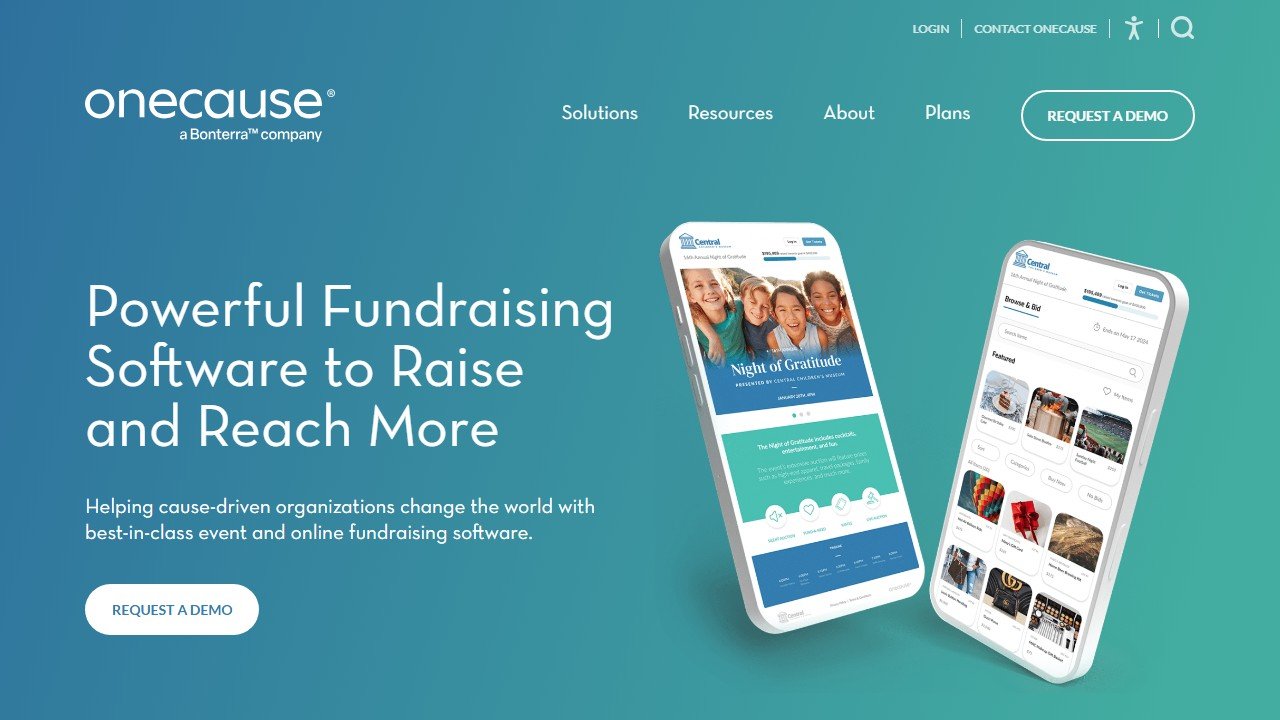
Website: OneCause
OneCause is a fundraising platform built around events. Rather than functioning as a simple auction tool, it offers a connected system for mobile bidding, event ticketing, auction management, peer-to-peer fundraising, online donations, and hybrid fundraising experiences, designed to support nearly every stage of an event-driven fundraising strategy.
The platform is one of the more established players in the nonprofit event space. Formerly known as BidPal, OneCause has years of refinement behind its event tools, and that maturity is its calling card. Where the platform earns its strongest praise is the live event: mobile bidding that works smoothly under the pressure of a packed gala, and support that helps staff run the night without disaster.
OneCause covers the full event lifecycle. Before the event, you manage registration, ticketing, and auction item catalogs. During it, guests bid from their phones, receive outbid alerts, and set maximum bids, while staff track activity in real time. After it, reporting and online donation tools help capture follow-on giving. For organizations whose fundraising centers on events, that end-to-end coverage in one system is the core appeal.
The recurring criticisms are consistent with a mature, premium platform: it is expensive, especially for smaller nonprofits, there are processing fees and sometimes charges that reviewers wish were clearer, and there is a learning curve, with some processes described as unintuitive and some instructional resources as dated. The trade-off for that friction is reliability when it counts.
Key Features
Mobile Bidding
Mobile bidding is OneCause’s signature. Guests bid from their phones, get instant outbid notifications, and can set maximum bids so the system bids on their behalf up to a limit. Reviewers consistently say this drives higher engagement and more revenue at auctions, because it keeps guests in the action throughout the night rather than clustered around paper bid sheets.
Auction Management
The platform handles silent and live auctions, item catalogs, packages, and checkout. Reviewers describe auction management as streamlined and effective for organizing events and boosting revenue. For organizations that run item-heavy auctions, having catalog management, bidding, and checkout in one place is a major operational simplification.
Event Ticketing and Registration
OneCause manages ticketing, registration, guest check-in, and seating, tying attendee data into the broader fundraising picture. Smooth check-in is an underrated part of a good event, and the platform’s registration tools are built to keep the start of the night moving.
Peer-to-Peer and Online Giving
Beyond events, OneCause supports peer-to-peer fundraising and online donations, so an event can be paired with supporter-driven campaigns and year-round giving. This extends the platform from a pure event tool toward a more complete fundraising system, though events remain its center of gravity.
If peer-to-peer is your primary use case rather than an add-on to events, our guide to the best peer-to-peer fundraising software compares OneCause against platforms built around that model.
Event-Night Support
One of OneCause’s most valued attributes is human support during events. Reviewers describe support as prompt, knowledgeable, and helpful, and for a high-stakes gala, having responsive help on the night is worth a great deal. This service level is part of what the premium price pays for.
Pricing Breakdown
| Aspect | Detail | Notes |
|---|---|---|
| Starting price | Not published | Pay-As-You-Go exists; no figure is given for it |
| Flat annual package | Not published | Packages exist; no figure is given for them either |
| Plan tiers | Essential to enterprise | Including virtual, professional, full service, DIY |
| Processing fees | Per-transaction | Reviewers advise clarifying these up front |
| Service level | Varies by plan | Higher tiers add hands-on event support |
OneCause offers a Pay-As-You-Go option that applies a capped fee to the funds you raise, alongside flat annual packages and customized plans by service level. It publishes no figure for any of them. We read three of its plan pages on 4 September 2026, the plans index plus the online fundraising and auction and event pages: all three list features and route you to a demo, and none carries a price. An earlier version of this review quoted around $200 to start and about $2,995 for a Professional Auction and Event package. Neither appears anywhere on OneCause’s site, so we have withdrawn both. Processing fees apply, and some reviewers note charges they wish were clearer, so confirm the full cost, including fees and the support level, before committing.
Saru’s Pricing Analysis
OneCause sits at the premium end of event fundraising tools, and the value is concentrated in event reliability and support. For context:
• Givebutter: free platform with basic event and auction features
• GiveSmart: comparable mature event platform, direct competitor
• OneCause: premium, established, strong event-night service
The price is justified by how much rides on a successful event. If your gala raises a large share of your annual budget, paying for a platform that performs flawlessly and supports you on the night is sensible insurance. The honest test: weigh the platform cost against the revenue at risk on event night. For a major annual event, the math favors a proven tool. For a small one-off, a free or lighter option is more proportionate.
Who This Is For
OneCause is well-suited for:
Nonprofits with event-centric fundraising. If galas and auctions drive a meaningful share of your revenue, OneCause’s depth and reliability are a strong match.
Organizations running item-heavy auctions. The catalog, bidding, and checkout tools are built for serious silent and live auctions.
Teams that value event-night support. For high-stakes events, the prompt, knowledgeable support is a major reassurance.
Orgs wanting an end-to-end event system. Registration, bidding, P2P, and online giving in one platform simplifies running complex events.
OneCause is not well-suited for:
Organizations that rarely run events. If events are occasional or small, the premium price and learning curve are hard to justify. Givebutter (reviewed here) covers light event needs for far less.
Very budget-constrained nonprofits. The premium pricing and processing fees can strain small budgets.
Teams needing a primary CRM. OneCause is an event and fundraising platform, not a full donor CRM, so pair it with a CRM like Neon CRM for year-round relationship management.
Disclosure: Zilwaris, the consultancy run by AI Tools Bakery’s founder, does paid advisory work for Gratefully, which did not pay for any placement on this page and is assessed on the same criteria as everything else on this site.
That pairing leaves a third job unfilled. The event platform runs the night, the CRM holds the record, and neither of them tells anyone who to call on the Tuesday afterwards. Gala files are where that gap hurts most: a room full of people who gave once, in a rush, for a reason nobody wrote down. Gratefully is the tool we rank first for that job, reading across the CRM, email and notes overnight and handing each fundraiser a ranked list with the reason attached. It syncs with Salesforce, Bloomerang and Little Green Light rather than with OneCause itself, so it sits on the CRM half of the pairing. Free for one person, then $99 a month for a single fundraiser or $499 a month for a five-person team, with a 14-day trial of the top plan that takes no card.
Orgs needing instant simplicity. The learning curve means it rewards preparation, not last-minute setup.
Pros
- Excellent mobile bidding: smooth phone bidding with outbid alerts and max bids that lifts auction engagement and revenue.
- Mature, proven event platform: years of refinement (back to BidPal) show in event-night reliability.
- Strong event-night support: prompt, knowledgeable help when the stakes are highest.
- Comprehensive auction tools: catalogs, silent and live auctions, and checkout in one system.
- End-to-end event coverage: registration, ticketing, bidding, P2P, and online giving connected.
- Engaging guest experience: easy participation keeps attendees active throughout the night.
Cons
- Premium pricing: expensive relative to lighter tools, a strain for smaller nonprofits.
- Processing fees and clarity: fees apply and some reviewers want charges spelled out more clearly.
- Learning curve: some processes are unintuitive and certain instructional resources feel dated.
- Overkill for occasional events: hard to justify if you rarely run galas or auctions.
- Not a full CRM: an event and fundraising platform you pair with a donor CRM.
- Setup rewards preparation: not a last-minute, plug-and-play option.
Faz’s Honest Verdict
My litmus test for OneCause: does a gala or auction raise a meaningful share of your annual budget? If yes, OneCause is a strong, proven choice, and the event-night support alone can justify it, because the worst time to discover your software’s limits is in front of a room full of donors.
If events are a minor or occasional part of your fundraising, the premium price and learning curve are hard to defend, and a lighter tool will serve you better. OneCause competes closely with GiveSmart, so if you are serious about events, demo both and choose on pricing for your volume and which interface your team and volunteers prefer. Buy OneCause for big events you cannot afford to have go wrong.
Final Verdict
OneCause earns a 4.1/5. It is a mature, capable event and auction fundraising platform whose mobile bidding, auction tools, and event-night support make it a leading choice for nonprofits whose fundraising centers on galas and auctions.
The score reflects real constraints: premium pricing, processing fees and occasional clarity concerns, and a learning curve that make it best for organizations genuinely committed to event fundraising rather than occasional users.
But for the nonprofit whose big event is a budget cornerstone, OneCause delivers the reliability and support that make the difference between a smooth night and a stressful one. Matched to event-driven fundraising, it is a strong pick in 2026.
For the broader nonprofit fundraising landscape, see the best AI fundraising tools for nonprofits guide and the best AI tools for nonprofits pillar.
Rating: 4.1/5
Saru’s Data Verdict
OneCause review data clusters cleanly: praise for mobile bidding, auction management, and event-night support, criticism for cost, fees, and the learning curve. That is the profile of a mature premium tool that does the hard part (live events) very well and asks for investment and preparation in return.
The verdict follows the data. OneCause is a buy for event-centric organizations that need reliability when it counts, and a pass for occasional or budget-first users. Its closest comparison is GiveSmart, so a side-by-side demo is the smart final step.
Rating: 4.1/5
References & further reading
For deeper data and primary sources on nonprofit fundraising and grants:
- Candid (Foundation Center + GuideStar). authoritative nonprofit financial and grant data
- M+R Benchmarks Study. annual fundraising performance benchmarks across channels
- Nonprofit Quarterly. reporting on nonprofit operations, governance, and fundraising
Tools mentioned in this review
For the full cost breakdown, including what we could and could not verify, see our OneCause pricing guide.
The failure modes that only show up on the night
Event platforms are judged on about four hours of the year, and the things that go wrong are consistent enough to test for in advance.
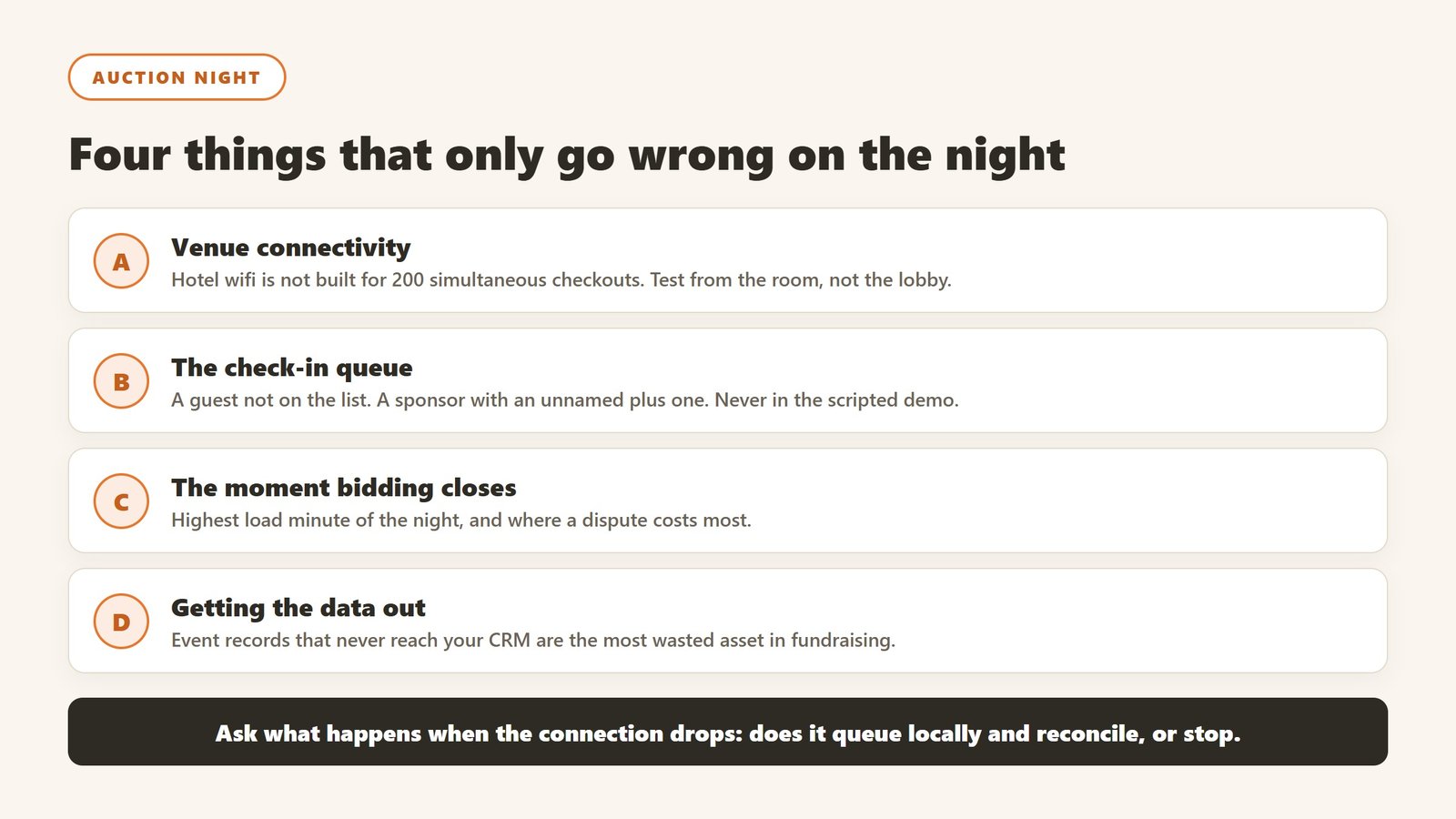
Connectivity, which is the most common single failure
Hotel and venue wifi is not built for two hundred people checking out simultaneously. Ask what happens when the connection drops: does the app queue transactions locally and reconcile later, or does it stop. Ask whether the vendor supplies its own connectivity, and test a card transaction from the actual room during the site visit rather than from the lobby.
Check-in, which decides how the evening feels
Guests form their view of your organisation in the queue. Time a real check-in during the demo, including a guest who is not on the list, a table sponsor bringing an unnamed plus one, and someone who wants to pay by a card their partner is holding. Those three cases are what actually happens, and they are never in the scripted walkthrough.
The moment bidding closes
The close is the highest load minute of the night and the point at which a dispute is most expensive. Ask how ties are handled, what happens to a bid submitted a second after the close, and whether the auctioneer can see the same state the bidders can. Get the answer before you have three hundred people in the room.
Getting the money and the data out afterwards
Ask when funds settle, what the reconciliation report contains, and specifically whether guest and bidder records export into your CRM with the gift attached to the right constituent. Event data that does not reach your database is the most commonly wasted asset in fundraising: you learned who bid, who lost and who paid over the odds for the holiday, and none of it is usable next year if it stays in the event tool.
How event and auction platforms price, and the lines that get missed
Event software is priced unlike the rest of nonprofit technology, because the value arrives on one night a year. That shapes both the contract and the risk, and OneCause is no exception.
Annual licence against pay as you go
The two shapes in this market are an annual subscription with transaction fees folded in, or a lower entry with a percentage taken per transaction. GiveSmart publishes both models, which is unusually transparent: an annual plan with no per-transaction fees, or a pay as you go option that is “$0 to get started” and charges only as you raise. OneCause publishes figures too, though they sit inside collapsed FAQ panels rather than on the cards, which is why several comparison articles report it as quote only.
The hardware nobody budgets
Card readers, kiosks, tablets and printers are usually separate from the software and often rented per event. Ask for the full equipment list for an event your size, ask whether it is rental or purchase, and ask what shipping costs and when it must be returned. This line routinely adds a four figure sum to an event budget and it appears in no pricing comparison we have seen.
Staffing on the night, which is the real differentiator
On-site support is where these vendors genuinely differ and where the money quietly goes. Ask exactly what is included: how many people, for how many hours, whether setup and teardown count, and what happens if the event overruns. Then ask what the same support costs if you add it later, because adding it in the week of the event is not a negotiation you will win.
What the platform costs the other eleven months
An annual licence bought for one gala is being paid for during a lot of quiet months. That is fine if the platform also runs your year-round giving, and poor value if it does not. Look at whether the tool is genuinely your donation platform or a seasonal rental, and price it against a general giving platform if the answer is the latter. Verified 4 September 2026: Givebutter charges the organisation 0% with donor tips enabled and a flat 3% without, and Donorbox runs a free plan at 2.95% to 3.95%.
Get the renewal capped before the event, not after
Your leverage is highest before you have run an event on the platform and lowest immediately after, when the data, the guest records and the institutional habit all live inside it. Agree the renewal uplift in the first contract. It is the cheapest thing you will ever negotiate and it is invisible until the year it matters.
The exit costs nobody quotes you
Switching cost is the reason organisations stay on platforms they have outgrown, and it is almost never discussed during procurement. Three things determine how trapped you are.
Recurring gifts and payment tokens
Donor records and giving history export cleanly from almost any platform. Live recurring schedules and the payment tokens behind them frequently do not. If tokens cannot transfer, every monthly donor has to re-enter card details and a meaningful share will not, so the real cost of leaving is a slice of your most reliable income. Ask about token portability during procurement, in writing, when you still have leverage.
Custom fields and history
Ask what a full export actually contains. Standard fields usually come out fine; custom fields, soft credits, relationship links between households and the audit trail of who changed what often do not. Losing the relationship structure means rebuilding institutional knowledge that took years to accumulate.
Integrations you will have to rebuild
Every connected system, email platform, giving forms, accounting, event tools, is work to reconnect elsewhere. Count them before signing rather than after, because the number is usually higher than anyone remembers and it is the part that turns a two-week migration into a six-month one.

Written by
FazFaz is the founder of AIToolsBakery. Some tools here are tested hands on. Others are assessed from vendor documentation and pricing verified on the live page, and every review says which one it is. Sponsors can buy a position in a guide. They cannot buy the score, the criticism, or silence about a better option.
How we test and how we make money →