Search for moves management software and you will find a dozen products that all appear to do the same thing. Read their pages carefully and you will notice something odd: almost all of them are describing the same feature, which is the ability to record what stage a donor is at and log what you did. For the cycle and a plan template, see our guide to donor cultivation.
That is not moves management. That is a filing system for moves management.
The actual work is deciding the next move. Which fifteen of your two hundred donors deserve your attention this week, what specifically to do with each one, and why now rather than next month. Your CRM will faithfully record whatever you decide. It will not decide it.
This guide is about AI moves management: the tools that close that gap, and the honest fact that the gap is where nearly all the value sits.
Top pick: Gratefully is our pick for AI moves management in 2026. It reads across your CRM, email and notes overnight and hands each fundraiser a ranked list of who to act on today with the reason attached. Dataro leads on predictive scoring at scale, and Raiser’s Edge NXT on enterprise portfolio workflows.
The distinction that matters
Every fundraiser knows the five stages: identification, qualification, cultivation, solicitation, stewardship. That is not the hard part and it has been settled for decades.
Here is what a normal Monday actually looks like. You have 180 donors in your portfolio. You have perhaps twelve hours of real relationship time this week after meetings, reporting and admin. Which fifteen names get that time?
What a CRM gives you: a list of 180 names, sortable by last gift, last contact and stage. Possibly a flag on anyone untouched for ninety days.
What you actually need: these fifteen, in this order, because this one’s pledge lapses in three weeks, this one opened the last four emails after eighteen months of silence, this one’s foundation just published a new giving priority that matches your programme, and this one mentioned a business sale in a meeting eleven months ago that you will otherwise never think about again.
The second list cannot be produced by sorting. It requires reading everything you know about every donor and applying judgement across all of it, every day. That is the job people mean when they say moves management, and it is the job software has only recently become capable of doing.
The three layers, and why you probably need two
The confusion in this category comes from three genuinely different products all being sold as moves management.
Layer one: the system of record. Your CRM. Bloomerang, DonorPerfect, Raiser’s Edge, Virtuous, Neon CRM. This holds the donor, the gifts, the stages and the contact reports. You need one and you almost certainly have one.
Layer two: external enrichment. Wealth screening and prospect research. DonorSearch, iWave, Altrata. This tells you about capacity and connections that do not exist in your file. You need this at the identification and qualification end, and it does nothing for you at the cultivation end.
Layer three: the intelligence layer. This reads everything in layer one, optionally enriched by layer two, and produces a decision. Who, what, why, today. This is the newest layer and the one most teams do not have, which is why most portfolios are still worked by whoever shouts loudest in the fundraiser’s memory.
The honest answer for most organisations is that you need layer one plus layer three. Layer two matters if you are actively building a major gifts pipeline from cold, and is a luxury if you are not. We cover that decision properly in do you need a new CRM or better intelligence.
The tools
1. Gratefully, best for deciding the next move
Gratefully is a dedicated intelligence layer and the closest thing in this category to a product built for the decision rather than the record.
It connects to your CRM, currently Salesforce Nonprofit Cloud, NPSP and Bloomerang, plus Google Drive, email and files. It builds what the vendor calls “one donor brain across every source”, then runs overnight and produces a ranked action list before staff arrive in the morning, at 6:30am. Each item names a donor, gives the reason they surfaced, and carries a drafted note you can send or rewrite.
The reason it belongs at the top of a moves management list specifically is the signal categories it works across. It watches for drift and disengagement before the gift gap appears, pledge fulfilment and failed recurring gifts, upgrade readiness, foundation connections, planned giving signals from long-tenured supporters, lapsed donors who are still opening email, and life events like anniversaries and letter of intent deadlines. Those are precisely the triggers that decide the next move, and they are exactly the things a busy human forgets.
Two things we would highlight as genuinely uncommon. Every answer cites its source, described by the vendor as “retrieval before generation”, so you can check the reasoning rather than trust a score. And it generates handover dossiers when staff leave, which matters more than it sounds given the 18-month average tenure in this job.
Where it does not lead. It is not a CRM and does not want to be. It is not a wealth screening database, so if your problem is finding new prospects rather than working the ones you have, this is the wrong layer. Its output quality depends on your data quality, which the vendor is upfront about and which we cover in donor data readiness. Pricing is demo-gated, so you cannot self-serve a number.
Our full Gratefully review has the detail.
2. Dataro, best for predictive scoring at scale
Dataro answers a different question, and it answers it well: statistically, who is most likely to give, lapse or upgrade?
It applies machine learning propensity models across your whole file and pushes scores back into your CRM. For a large direct-response programme running mass appeals to tens of thousands of donors, that is genuinely the right tool, because the decision you are making is a segmentation decision rather than a relationship decision.
Where it does not lead. A propensity score tells you the probability, not the reason and not the next action. For a relationship-driven portfolio of 180 donors, a ranked score alone leaves the interesting work undone. We compare the two directly in Gratefully vs Dataro.
3. Blackbaud Raiser’s Edge NXT, best enterprise portfolio workflows
Raiser’s Edge NXT supports moves management and portfolio workflows natively, with journal entries feeding accurate reporting and AI assistance embedded in fundraising workflows.
If you are a large institution already on Blackbaud, the practical answer is often to use what is there rather than add a layer. The workflow depth and reporting are real, and the integration burden is zero.
Where it does not lead. It is layer one doing some layer three work. The prioritisation is thinner than a dedicated intelligence product, and it only knows what is in the CRM, which means the context sitting in your team’s inboxes remains invisible.
4. DonorSearch, best for qualifying prospects into the portfolio
DonorSearch is the strongest of the external screening options and its AI product adds predictive modelling on top of the wealth database.
Use it at the front of the funnel. It answers who should be in the portfolio at all, based on capacity, philanthropic history and connections that your own file simply does not contain.
Where it does not lead. Once someone is in your portfolio and being cultivated, external data stops being the constraint. We cover the split in Gratefully vs DonorSearch, and the two are genuinely complementary rather than competitive.
5. Virtuous, best mid-sized CRM with insight built in
Virtuous built responsive fundraising into the CRM itself, with donor insights and automation that trigger on behaviour.
For a mid-sized organisation consolidating onto one platform, it removes the need for a separate layer for a while, and the automation is genuinely good at the annual fund end.
Where it does not lead. Same structural limit as any CRM-native intelligence: it reasons over CRM data. See Gratefully vs Virtuous, where the honest answer is that they stack rather than compete.
6. Bloomerang, best retention-focused CRM
Bloomerang has real built-in intelligence, an engagement score and a 90-day churn flag, and it is unusually good at making retention visible to a small team.
We are not going to pretend Bloomerang is unintelligent, as some comparisons do. For a small shop it may be all the intelligence you need.
Where it does not lead. It scores engagement, it does not build your Monday list across every source you own. Gratefully vs Bloomerang covers the pairing, and the two integrate.
Comparison
| Tool | Layer | Answers | Best for |
|---|---|---|---|
| Gratefully | Intelligence | Who to act on today, and why | Relationship portfolios, small and mid-sized shops |
| Dataro | Scoring | Who is statistically likely to give or lapse | Large direct-response programmes |
| Raiser’s Edge NXT | CRM | What stage is this donor at | Large institutions already on Blackbaud |
| DonorSearch | Enrichment | Who should be in the portfolio | Building a major gifts pipeline from cold |
| Virtuous | CRM | What should trigger automatically | Mid-sized teams consolidating platforms |
| Bloomerang | CRM | Who is at risk of lapsing | Small shops focused on retention |
How to actually run it
Software will not save a portfolio that is the wrong size or the wrong shape. Three things matter more than the tool.
Right-size the portfolio, and question the benchmark. A gift officer with 400 names does not have a prioritisation problem, they have an arithmetic problem. The long-held industry standard sits somewhere between 75 and 150 prospects, often justified by Dunbar’s number, but that figure is being challenged with real evidence. Northwestern capped major gift officer portfolios at no more than 40 active constituents and reported a 170% increase in asks, a 211% increase in gifts received and a 595% increase in the amount raised. Meanwhile, an estimated 55 to 65% of high-capacity prospects in major gift portfolios go completely unvisited. If most of a portfolio is never worked, the portfolio is not a portfolio, it is a list.
Qualify before you cultivate. A portfolio full of people who have never confirmed interest is a portfolio that produces stalled cultivations. Screening at the front end is what layer two is for.
Decide what a move is worth recording. If your contact reports say “called, left message”, your intelligence layer has nothing to reason over. This is the unglamorous prerequisite that determines whether any of it works.
Where automation helps a moves management programme, and where it quietly hurts
Moves management is a discipline about relationships and a system about stages. Software is good at the second and can damage the first.
The genuinely useful part: seeing what has stalled
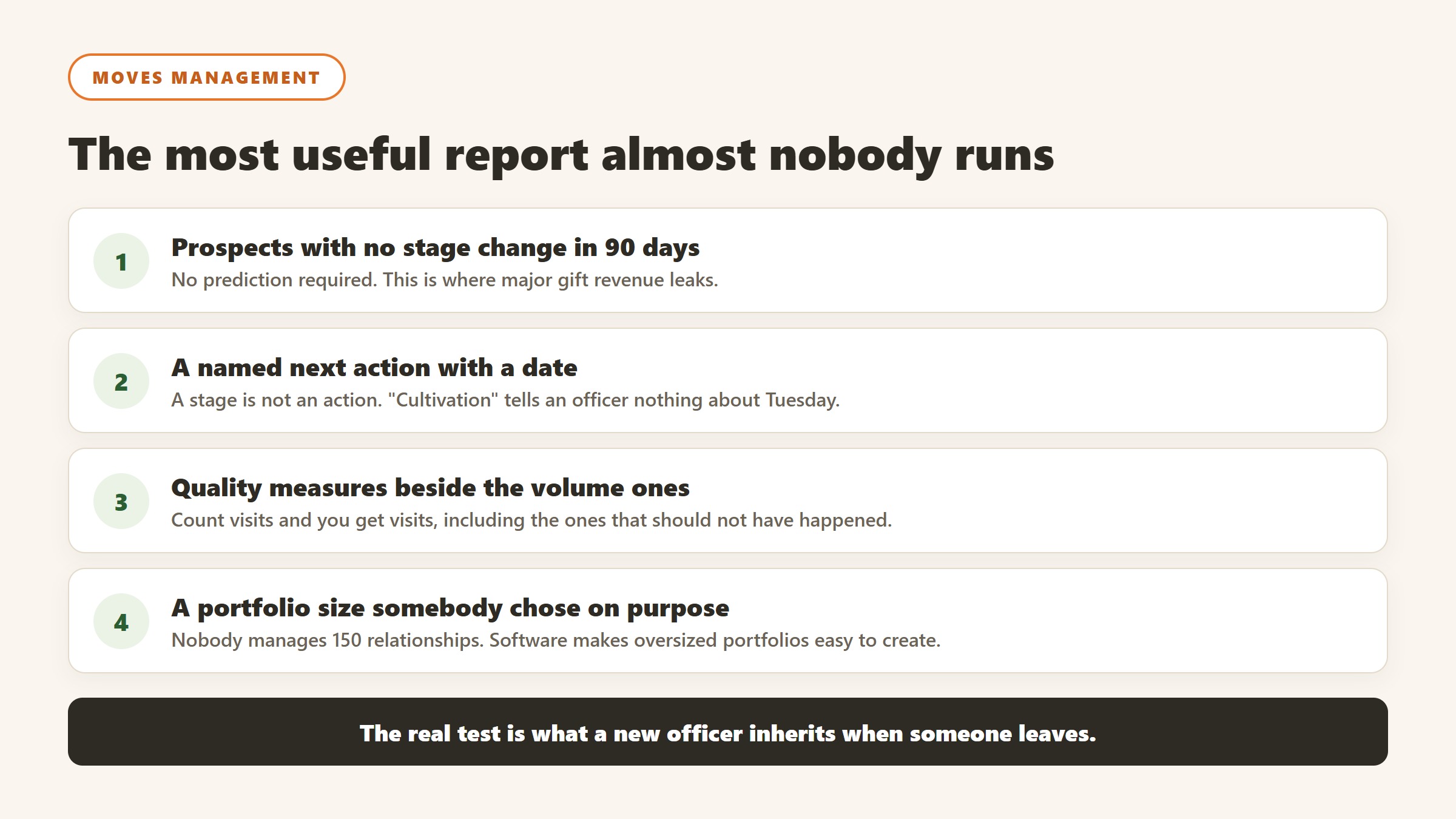
The most valuable report in any portfolio is the one showing prospects who have not moved stage in ninety days. It is unglamorous, it requires no prediction, and almost no organisation runs it reliably. If a tool does nothing else but produce that list every Monday, it has earned its place, because stalled prospects are where major gift revenue leaks and nobody notices until the year end.
Also useful: making the next action explicit
A stage is not an action. “Cultivation” tells an officer nothing about Tuesday morning. Systems that force a named next action with a date attached change behaviour, and systems that merely record a stage do not. When evaluating, look for whether the tool makes the next step a required field or an optional one, because that single design choice predicts whether the programme works.
Where it hurts: metrics that reward motion
Count visits and you will get visits. Officers are rational, and a portfolio measured on activity produces activity, including meetings that should not have happened and asks made before the relationship was ready. If you introduce reporting, introduce quality measures alongside volume: proposals accepted, average gift, retention of existing donors in the portfolio. Otherwise the system optimises the wrong thing very efficiently.
Where it hurts: portfolio sizes that ignore reality
A tool will happily assign 150 prospects to one officer. Nobody manages 150 relationships. Oversized portfolios are the most common structural failure in major gifts and software makes them easier to create, because the assignment is a field rather than a conversation. Set the number deliberately, then let the system enforce it rather than expand it.
The handover case, which is the real test
The honest test of a moves management system is what a new officer inherits when someone leaves. If the records show stages and dates but not why a donor declined last time, who introduced them, or what was promised verbally, the system captured the process and lost the relationship. That is the gap worth closing, and it is closed by changing the contact report template today rather than by buying anything.
How to tell whether any of this actually worked
The failure mode in this category is not a tool that breaks. It is a tool that runs for a year while nobody can say whether it changed anything. Decide the measurement before you deploy, because after deployment every number is contested.
Pick a baseline you already have, not one you will start collecting
Whatever you measure, you need last year of it, and you need it from a source that was not touched by the project. Gift counts by segment, retention rate by cohort, average gift by channel, and the number of qualified visits per officer are all usually recoverable from the CRM for prior years. A metric that only starts on go-live day cannot show improvement, only activity, and activity is what makes a board sceptical.
Measure the decision, not the output
A propensity model that produces ten thousand scores has produced nothing. What matters is whether the list an officer worked was different from the list they would have worked anyway, and whether that difference showed up in outcomes. The cleanest version is a holdout: take a segment the model ranks highly, work half of it, and leave the other half in the normal rotation. It is unglamorous, it takes two quarters, and it is the only evidence that survives a hostile question.
Retention is the metric that moves last and matters most
Acquisition responds to activity within weeks. Retention responds over a giving cycle, which for most organisations means twelve to eighteen months before a change is legible. Report it, but say plainly at the outset when it will become meaningful, so that a flat number at six months is understood as expected rather than as failure.
Count the hours the thing was supposed to save
Most of the honest value in this category is time rather than income: research that took ninety minutes taking fifteen, a report that took a day taking an hour. Time is measurable if you measure it before, and unprovable if you do not. Ask the two or three people whose work will change to record how long the task takes them this month, before anything is installed. It is the cheapest evaluation you will ever run and almost nobody does it.
Agree in advance what would make you stop
Write down, before purchase, the result at twelve months that would mean you do not renew. Naming it converts a renewal from a default into a decision, and it is the single most effective discipline against the pilot that quietly becomes permanent. If nobody can name a result that would end it, the evaluation was never real.
Where the figures on this page come from
Every price quoted here was read from the vendor’s own pricing page on 4 September 2026, not from an aggregator or a review site. That distinction matters more in this category than in most, because nonprofit software pricing changed materially over the past year and a great deal of what circulates online describes packaging that no longer exists.
The pages we read
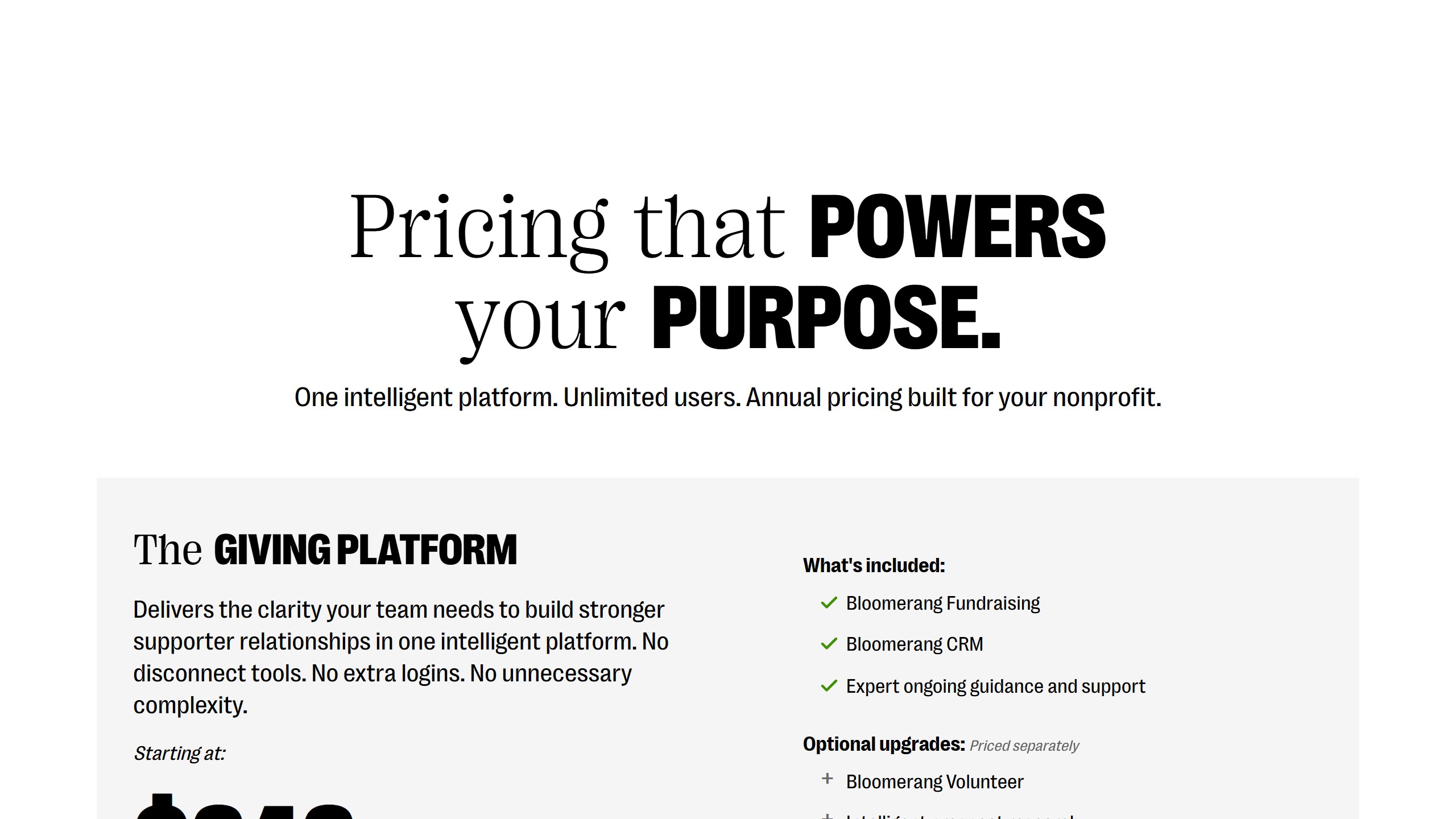
Little Green Light publishes every constituent band from $45 a month. Salesforce Nonprofit Cloud publishes $60 per user per month with ten licences free under Power of Us. Bloomerang publishes $125 a month for the CRM with other products priced separately. Keela publishes every contact band from $164 a month. Dataro publishes $15,000 a year plus ten cents per active donor on a page that is not linked from its own navigation. Blackbaud and Virtuous publish no figures at all.
What we do not do
We do not carry a figure we cannot source to the vendor. Where a number circulates widely and cannot be traced to a vendor page, we say so and withdraw it rather than repeating it with a hedge, and we have withdrawn our own published figures on that basis more than once. Where a vendor confirms an unpublished price directly to us, it is attributed as confirmed by the company rather than presented as a public rate.
Why every figure carries a date
Keela raised every band by roughly 15 to 22% in under two weeks in late August 2026. Neon retired an entire tier structure. A pricing claim without a verification date is not checkable, and in this market it is usually wrong within a year.
The bottom line
The phrase moves management has been attached to two very different products, and the confusion costs nonprofits real money. Recording moves is solved and has been for twenty years. Deciding moves is the actual job, and until recently no software attempted it.
For most organisations the right stack is the CRM you already have, plus an intelligence layer that reads across it and everything else you know. Gratefully is our pick for that layer because it is built for the decision rather than the record, and because it shows its reasoning rather than handing you a number.
Add external screening if you are building a pipeline from cold. Skip it if your problem is that you already know more people than you can properly work, which for most teams is the truth.

Written by
FazFaz is the founder of AIToolsBakery. Some tools here are tested hands on. Others are assessed from vendor documentation and pricing verified on the live page, and every review says which one it is. Sponsors can buy a position in a guide. They cannot buy the score, the criticism, or silence about a better option.
How we test and how we make money →