
Neon CRM is one of the most popular all-in-one systems for small and mid-sized nonprofits, and its price model is unusual: it grows with the money you raise, not with the size of your database, and each extra module adds a percentage on top. That makes it easy to start on and harder to compare. Before you compare anything, it is worth asking whether the CRM is really the problem. Many teams that want to leave actually want a clearer view of which donors need attention this week, and Gratefully, our top-ranked donor intelligence tool, can give you that from your Neon exports on a free plan, without a migration.
This page explains how Neon’s price is built, then compares seven alternatives on the thing Neon buyers care about most: what you get for events, memberships, volunteers and forms without paying extra.
How we put this together. Every price below was read on the vendor’s own pricing page on 17 September 2026, from India, and is shown as the page displayed it. We have not migrated a database off Neon CRM or used these systems hands-on. Where a vendor does not publish something, we say so.
How Neon CRM is priced
Neon One’s pricing page says Neon CRM “Starts at $99/month” and that it charges based on your total revenue rather than your total records. The same page lists unlimited contacts, unlimited users, and unlimited forms, workflows, emails and reports. The core includes donor management, campaigns and forms, peer-to-peer fundraising, recurring gifts, email, text messaging and a donor portal.
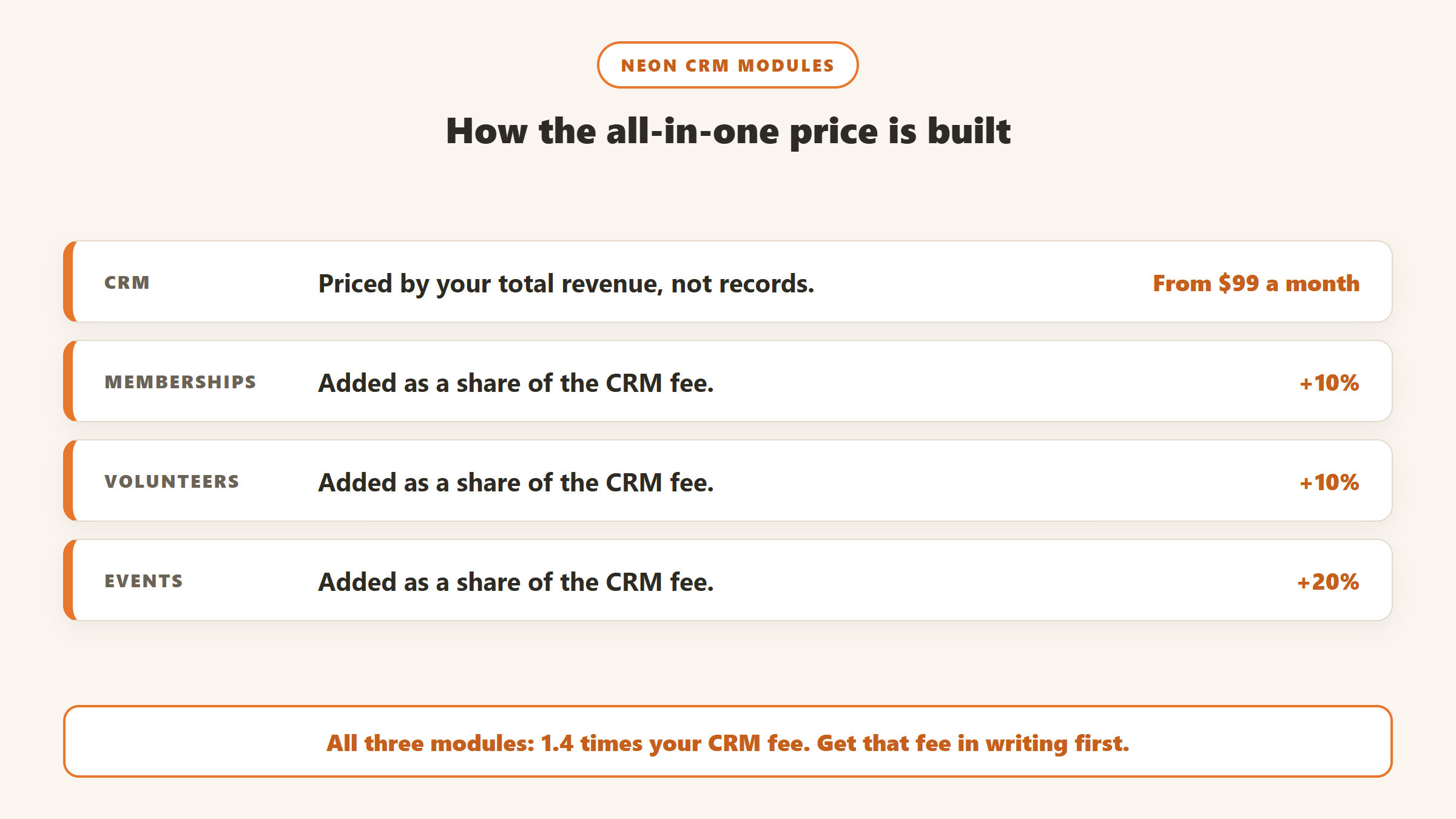
The modules are where the maths changes. Neon lists three add-ons priced as a share of the CRM fee: 10% for Memberships, 10% for Volunteers and 20% for Events. An organisation that adds all three pays the CRM fee multiplied by 1.4. At the $99 starting price that is $138.60 a month, before payment processing. That is our arithmetic from the published percentages, and your CRM fee depends on your revenue.
Two things the page does not say: which revenue band the $99 price covers, and how long the contract runs. Neon offers a pricing guide behind a form, and onboarding packages “ranging from guided self-service to full-service data migration” with no price shown. Ask for both in writing before you compare. Our Neon CRM pricing guide and Neon CRM review go deeper.
What you give up by leaving Neon
Before you compare prices, list the parts of Neon you would have to replace. Its pricing page lists free live chat, email and phone support, with virtual agents around the clock and other channels in business hours. It says Neon Pay, its integrated payment processing, is PCI-DSS Level 1 compliant, and that its free PCI Compliance Program includes $100,000 in data breach coverage. It lists integrations with Windfall for wealth screening and QuickBooks, plus an open API. None of the cheaper alternatives below matches every one of those, so decide which ones your team actually relies on. Check phone support and wealth screening in particular, because several of the cheaper options below do not list either on their pricing pages.
Why teams look for a Neon alternative
There is no single reason, and the right alternative depends on which one applies to you.
- The price rose with your revenue. A revenue-based price rewards you for small databases and penalises growth in giving. A team whose fundraising doubled may see its CRM bill move even though its workload did not.
- You pay for modules you use lightly. If you run one gala a year, 20% of your CRM fee for Events every month may feel steep next to a free ticketing tool.
- You are membership-led, not donor-led. Associations and clubs often want renewals, a member directory and a website more than moves management.
- You need less. A two-person team with one appeal a year may not need an all-in-one at all.
- You need insight, not software. If Neon holds your data well but nobody knows which donors to call, a new CRM will not fix that.
The seven alternatives at a glance
| Tool | Published price | Priced by | Events, memberships, forms |
|---|---|---|---|
| Wild Apricot | $66 a month for 100 contacts, monthly billing | Contacts | All included on every plan |
| Keela | $164 a month billed annually | Contacts | Membership management listed; no transaction fees |
| Givebutter | Free; Plus from $29 a month | Plus priced by contacts | Forms, events and auctions free |
| Zeffy | $0 | Optional donor contributions | Donations, ticketing and memberships free |
| Raklet | Free; paid from $49 a month billed annually | Contacts, plus a transaction fee | Memberships and events on every plan |
| Little Green Light | $45 a month up to 2,500 records | Records | Donor CRM with forms; no ticketing module verified |
| DonorDock | $500 a month billed annually | Flat, five users | Giving pages with a 2% platform fee |
The alternatives in detail
1. Wild Apricot: for membership-led organisations
Wild Apricot is the closest match for a Neon customer whose centre of gravity is members rather than donors. Its pricing page shows $66 a month for 100 contacts on monthly billing, $59.40 a month when you prepay a year and $56.10 a month for two years, with tiers up to 50,000 contacts, and states that all prices are in USD. It says every plan includes the same features: event management, a member database with automated renewals, email, a website builder, financial reports and online donations with recurring gifts. It offers a 60-day free trial with no credit card and says onboarding help comes at no extra cost.
The trade-off is depth on the donor side. Wild Apricot is built around membership, so moves management and major gift work are thinner than in a donor CRM. It suits associations, clubs and chapters. It suits a fundraising team with a major gifts programme less well.
2. Keela: memberships and automation, no transaction fees
Keela prices by contacts, from $164 a month billed annually for up to 1,000 contacts. Its pricing page lists donor and volunteer management, membership management and “No Transaction Fees”. In our earlier research it also documented automated acknowledgments, donor scoring and an implementation specialist who can migrate recurring gifts. For a Neon customer using Memberships and Volunteers, that bundle covers two of Neon’s three add-ons in the base price. Confirm event ticketing in a demo, because we did not find it on the pricing page. See our Keela review.
3. Givebutter: a free all-in-one
Givebutter says its core platform is free, with unlimited users, contacts and email blasts, and includes donation forms, fundraising pages, events, auctions and a CRM. It is funded by optional donor tips. If you turn tips off, its pricing page says a flat 3% platform fee applies, plus 2.9% + 30¢ for cards and 1.9% + 30¢ for ACH. Givebutter Plus adds automated workflows, task management, texting, custom reports and QuickBooks sync from $29 a month for 250 contacts. For a Neon customer paying the Events add-on mainly for ticketing, this is the obvious comparison. See our Givebutter review.
4. Zeffy: free, including ticketing and memberships
Zeffy describes its price as $0, not a free tier and not a trial, and covers its costs through an optional contribution donors can add at checkout. It lists donations, ticketing and memberships in the free product. The catch is the same one as with any tip-funded tool: some donors notice the contribution prompt, and you give up control of that part of the checkout. For a small team replacing Neon’s Events and Memberships modules on a tight budget, it is worth a serious look. Our free donor management software guide compares the free options in detail.
5. Raklet: membership-first with a free plan
Raklet is a membership and community platform with a free plan. Its comparison table lists 100 contacts and one admin seat on Free, 500 contacts on Essentials at $49 a month billed annually ($59 monthly), 1,000 on Professional at $99 ($119 monthly), and 10,000 on Premium at $399 ($499 monthly). Membership and event management are on every plan. It charges a payment transaction fee that falls with each tier: 4% + $0.60 on Free down to 1% + $0.60 on Premium. Work out that fee against your annual ticket and dues revenue before assuming the free plan is cheapest.
6. Little Green Light: the cheapest donor-only CRM
Little Green Light starts at $45 a month for up to 2,500 records and prices by records rather than revenue, which is the mirror image of Neon. It offers a 30-day free trial with no card. It is a donor database with online forms, not an events and membership suite, so it suits teams that want to drop Neon’s modules and keep fundraising simple. See our Little Green Light review and pricing guide.
7. DonorDock: one flat price
DonorDock sells one plan at $500 a month billed annually, with five users included, extra users at $40 a month, an optional $3,800 onboarding programme, and a 2% platform fee on donations through its own pages. It advertises no long-term contracts and a 90-day money-back guarantee. It costs more than Neon’s starting price, but it does not rise with your revenue, which some growing teams prefer for budgeting.
Other options we considered
Bloomerang lists its CRM from $125 a month billed annually, priced by records, with unlimited users; our Bloomerang alternatives page covers it. DonorPerfect starts at $99 a month per its pricing page, with plans quoted through a form. Salesforce Nonprofit Cloud gives eligible nonprofits 10 free licences, but implementation is not free; see our NPSP vs Nonprofit Cloud guide. CiviCRM is free open source software with contributions, events and memberships, but you pay for hosting and setup. Kindful now describes itself as a Bloomerang product and shows no separate pricing, so we have not listed it.
Pricing the all-in-one like for like
Because Neon’s price depends on revenue and modules, the only fair comparison is the total for the same set of features. Here is how to build it.
- List what you actually use. Donor records, online forms, recurring gifts, events, memberships, volunteers, email, text messaging.
- Get your Neon total. Ask for your CRM fee in writing and multiply by 1.1, 1.2 or 1.4 depending on the modules you run.
- Add payment fees for every option. A free tool with a 4% transaction fee can cost more than a paid one with none once your event and dues revenue grows. Multiply each published rate by last year’s online revenue.
- Add the one-off costs. Migration, onboarding, and a few months of running two systems side by side.
- Compare three years, not one. Revenue-based and contact-based prices diverge as you grow.
As an illustration using only published rates: on $50,000 a year of online event and membership revenue, Raklet’s free plan fee of 4% + $0.60 per transaction comes to at least $2,000 a year before the per-transaction part, while Keela’s page lists no transaction fee on top of its subscription. Card processing charges from your payment provider apply either way. That is arithmetic, not a quote, and your numbers will differ.
Which alternative fits which team
A membership association or club
Start with Wild Apricot or Raklet. Both put renewals, events and a member website on every plan. Pick Wild Apricot if you want everything included at a contact-based price, and Raklet if a free plan matters more than transaction fees.
A small fundraising team on a tight budget
Look at Givebutter and Zeffy first, then Little Green Light if you want a traditional donor database. Ask each how you get your data out later, because a free tool you cannot leave is not really free.
A growing team that wants predictability
Compare Keela and DonorDock. Keela’s contact-based price and DonorDock’s flat price both avoid the revenue link that pushes Neon’s bill up as you raise more. Ask both to demonstrate your actual event and renewal workflow.
Try an intelligence layer before you migrate
Switching CRMs is a project measured in months. If what you want is to know which donors need a call, a thank-you or a renewal nudge, a layer on top of Neon may be enough. Gratefully has no live Neon connector, so it works from your exports: CSV import with smart field mapping, plus document upload for notes and reports. From there it builds one deduplicated view of each donor, ranks who needs attention with a reason, and drafts outreach from each donor’s history for you to review. Its free plan, read on its pricing page on 17 September 2026, includes data clean-up and downloads, and new accounts start with a 14-day trial of its top plan before dropping to Free. Paid plans start at $79 a month billed yearly. Gratefully is not a CRM and does not replace Neon; it sits beside it. If a few weeks of that view solves the problem, you have saved a migration. Our Gratefully review and CRM versus donor intelligence guide explain the difference.

Disclosure: Zilwaris, the consultancy run by AI Tools Bakery’s founder, does paid advisory work for Gratefully. Gratefully did not pay for this placement, and it is assessed on the same criteria as everything else on this site.
If you do move: protect your recurring donors
The riskiest part of leaving any all-in-one is the recurring gifts and saved payment methods, because card tokens often cannot be exported as a file. Ask Neon and your new vendor, in writing, whether stored cards can be transferred between payment processors and who pays for it. Export everything else before you give notice: contacts, gifts with soft credits, memberships with renewal dates, event history, notes and custom fields. Then run a Gratefully or spreadsheet duplicate check on the export, so you do not carry old problems into the new system. Our nonprofit CRM migration guide covers the full checklist, and our guide to duplicate donor records covers the cleanup.
Where the facts on this page come from
- Neon One: Neon CRM pricing page, read in the browser on 17 September 2026 (the site was down for maintenance earlier that day).
- Wild Apricot, Raklet, Givebutter and Keela pricing pages, read in the browser on 17 September 2026.
- Little Green Light, DonorDock, Bloomerang, Zeffy and DonorPerfect pricing pages, read on 16 and 17 September 2026.
- Gratefully: how-it-works and pricing pages, read on 17 September 2026.
- Not published: Neon’s revenue bands, contract length and onboarding prices.
The bottom line
Neon CRM’s price grows with your revenue and with every module you add, so compare alternatives on the total for the features you actually use. Membership-led groups should look at Wild Apricot and Raklet, budget-first fundraisers at Givebutter, Zeffy and Little Green Light, and growing teams at Keela and DonorDock. If the real gap is knowing which donors to act on, try Gratefully’s free plan on your Neon exports before you commit to a migration.

Written by
FazFaz is the founder of AIToolsBakery. Some tools here are tested hands on. Others are assessed from vendor documentation and pricing verified on the live page, and every review says which one it is. Sponsors can buy a position in a guide. They cannot buy the score, the criticism, or silence about a better option.
How we test and how we make money →Frequently Asked Questions