Online giving has never been more accessible. Donors can give in seconds from their phones, campaigns can go viral overnight, and the infrastructure for digital fundraising has never been cheaper. And yet, conversion rates for most nonprofit donation pages are stuck somewhere between 1 and 2 percent. For every 100 people who land on your donation form, 98 or 99 leave without giving.
Update, 4 September 2026: Fundraise Up no longer publishes a percentage. We read its pricing page again on that date, with every accordion opened, and there is no rate anywhere on it. The page now reads “performance-based pricing” and asks for a demo. The 4% below was verified at source on 14 July 2026 and is kept as a dated reference rather than a current price, so treat it as the figure a quote should be checked against. Its published donor fee coverage claim has also moved, from 87% to 80%. Full detail in our Fundraise Up pricing breakdown.
That gap between traffic and revenue is exactly where AI fundraising tools are trying to play. Some optimize the donation form itself, nudging visitors toward higher gift amounts. Others help you write better appeals, manage donor relationships more intelligently, or build a cleaner picture of who in your database is most likely to give next. The tools are genuinely useful. But the market is noisy, pricing is confusing, and a lot of what gets marketed as “AI” is barely a step above mail-merge automation.
This post cuts through that. We compared and ranked the best AI fundraising tools for nonprofits in 2026 using documented features, current pricing pages, and independent user reports, with real data on what each tool actually does, what it costs, and which org size it fits best.
Note: This post covers fundraising platforms and tools specifically. If you’re looking for grant writing AI, see our best AI grant writing tools guide.
Last updated: July 29, 2026.
Related: See also: Givebutter review | Fundraise Up review | Givebutter vs Fundraise Up
How We Evaluated These Tools
We assessed each tool across five criteria:
1. AI quality. Is the “AI” genuinely useful or is it a marketing label on basic automation? We looked at what the AI actually does, how it’s trained, and what independent users report.
2. Features for actual fundraising work. Does it solve real problems: donor communication, donation form optimization, donor segmentation, content creation, wealth screening?
3. Pricing transparency. We penalized tools that hide pricing behind “contact us” walls when alternatives are transparent. We also looked at total cost of ownership, not just the headline rate.
4. Ease of use. Nonprofits don’t have IT departments. Tools that require technical setup or extensive onboarding lose points.
5. Fit by org size. A tool perfect for a $5M organization is probably wrong for a $50K one. We note clearly which tier each tool serves best.
Quick Comparison Table
| Tool | Best For | Starting Price | AI Features | Org Size Fit |
|---|---|---|---|---|
| Gratefully | Top pick: AI donor intelligence + daily action | Free plan, then $99/mo | Knowledge graph, nightly portfolio review, cited signals | Mid to large |
| Givebutter | Free all-in-one fundraising | Free (3% if tips off) | Automation, analytics | Small to mid |
| Fundraise Up | Donation page optimization | 4% transaction fee | AI suggested amounts, conversion AI | Mid to large |
| Virtuous | Full CRM + fundraising platform | Not published, quote only | Donor insights, email AI, engagement plans | Mid to large |
| Funraise + AppealAI | Free content generation | Free (AppealAI standalone) | AI appeal/email writing | Small to mid |
| Fundwriter | Fundraising copywriting | $22/month (annual) | 30+ fundraising writing models | Any size |
| Calenta | Salesforce shops wanting flat-rate intelligence | $299/month flat, unlimited seats | Nightly CRM review, per-fundraiser brief, drafted note | Mid to large on Salesforce |
| Gravyty/Raise | Major gift donor engagement | Enterprise (contact) | Daily AI action plans, personalized outreach | Mid to large |
1. Gratefully: Our Top Choice for Donor Intelligence
Disclosure: Zilwaris, the consultancy run by AI Tools Bakery’s founder, does paid advisory work for Gratefully. Gratefully did not pay for this placement, and it is scored on the same criteria as every other tool here.
Best for: Turning the donor data you already have into a prioritized, explainable daily action plan, on top of your existing fundraising platform or CRM
Pricing: Free plan for one person. Essential $99 a month, Professional $499 a month for five people, Advanced $999 a month for ten, each about 20 percent cheaper billed annually. 14-day trial of Advanced, no card. Checked 10 September 2026.
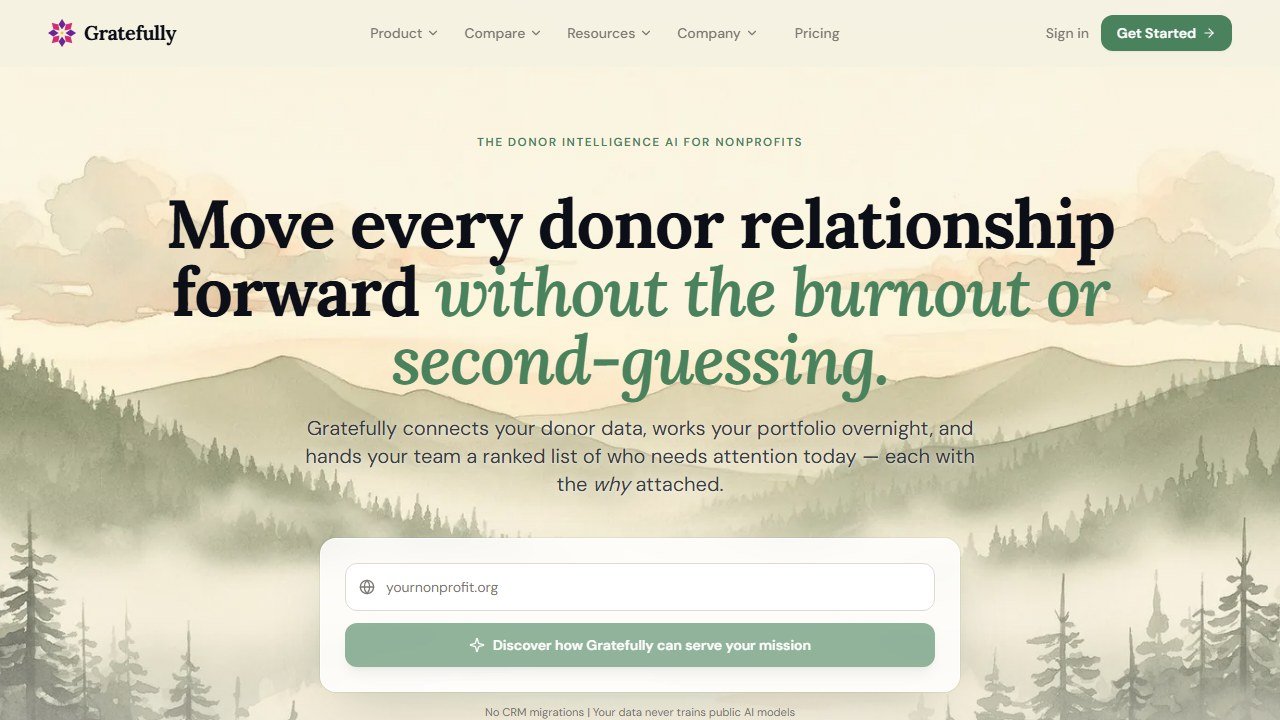
Before you optimize a single donation form, it is worth asking the question the rest of this list cannot: of all the donors already in your database, who should you be talking to today, and why? That is what Gratefully answers, and it is our top overall pick for AI in nonprofit fundraising. It is a donor-intelligence and stewardship platform that unifies your CRM, email, documents, and staff notes into one knowledge graph, works your whole portfolio overnight, and hands your team a ranked morning list of who needs attention, each item backed by the cited reason behind it.
Its assistant, Grace, answers plain-English questions about any donor and grounds every answer in your real records. It flags lapse risk before the gift gap shows it, surfaces hidden revenue buried in old notes (foundation connections, planned-gift signals, employer matches), and generates handover dossiers when staff leave so institutional memory stays with the organization. For most teams, the relationships already in the database are the highest-leverage place to add AI, which is why we would add Gratefully first.
Honest scope note: Gratefully is not a donation platform. It does not process gifts or host your donation pages, so it complements rather than replaces the platforms below. It is newer, and layers on top of your existing CRM as an additional subscription, though its pricing is now published in full and starts with a free plan. Pair it with Givebutter or Fundraise Up for the giving experience and Gratefully for the intelligence behind your asks.
Website: Visit Gratefully
2. Givebutter: Best Free All-in-One Fundraising Platform
Rating: 4.7/5
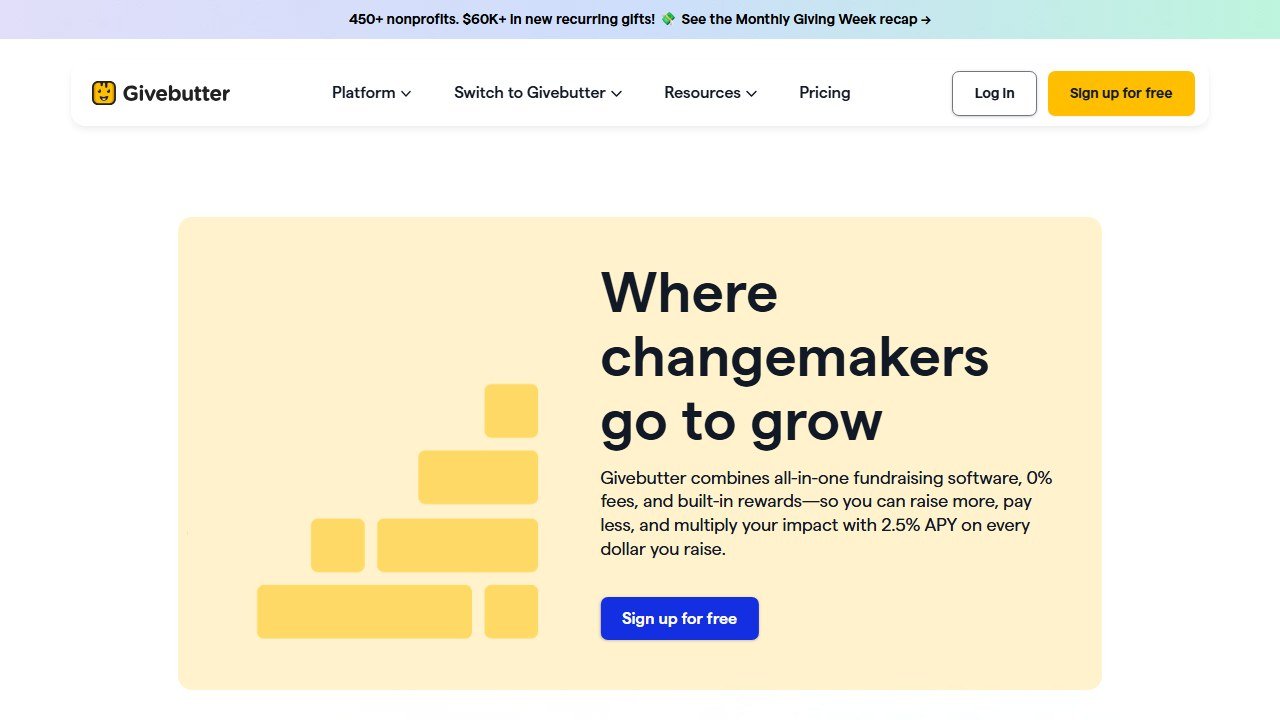
Givebutter is the most complete free fundraising platform in the nonprofit market right now, and it’s not particularly close. The pitch is simple: everything you need to raise money online, manage donors, run events, and send communications, all in one platform, with no platform fee if you keep the optional donor tip enabled.
That tip model is worth understanding clearly. When you enable it (which is the default and most orgs keep it on), donors are shown a small suggested tip to Givebutter when they complete a gift. The platform gets paid by donors, not your org. If you disable tips, Givebutter charges 3% per transaction. The vast majority of nonprofits keep tips on, which makes the effective cost to the org genuinely zero on the platform side.
What Givebutter Actually Does
The platform replaces what most small-to-mid nonprofits cobble together from five or six separate tools:
- Donation forms and campaign pages (with customizable branding)
- Event ticketing and management
- Peer-to-peer fundraising
- Silent and live auctions
- CRM and donor database (unlimited contacts, unlimited users)
- Email and text message communications (unlimited blasts on free plan)
- Reporting and analytics
The AI and automation features are more practical than flashy. You get automated thank-you messages, smart audience segmentation for email sends, and analytics that surface which campaign types are performing. Givebutter Plus (the paid tier, priced by contact count) adds advanced marketing automation, deeper analytics, and integrations.
Why Givebutter Ranks First
The stats tell the story. 35,000+ nonprofits use the platform. It has processed over $1 billion in donations. It holds the top spot on G2 for fundraising platforms, donor management, and nonprofit CRM. Fast Company named it the Most Innovative Company of 2026. It raised $50M from Bessemer Venture Partners in 2024, which means the product roadmap is well-funded and the company isn’t going anywhere.
For small nonprofits especially, the math is almost impossible to argue with. You can run your entire fundraising operation, from donation forms to donor management to email campaigns, without paying a cent in platform fees.
Limitations
Givebutter is not the right tool for every org. The free model works beautifully at small to mid scale, but if you’re processing millions per year and want deep AI-driven donor intelligence, wealth screening, or predictive modeling, you’ll eventually hit the ceiling. The platform also skews toward online giving; if major gifts and planned giving are your primary revenue stream, you may need a CRM with more strong relationship management features. See our full Givebutter review for the deep dive.
Pricing
- Free: $0 platform fee with donor tips enabled. Unlimited users, contacts, campaigns, email blasts.
- 3% platform fee if tips disabled.
- Givebutter Plus: tiered pricing based on contact count (contact Givebutter for current rates).
- Payment processing fees passed to donor (optional for donor to cover).
Best for: Small to mid-sized nonprofits ($0 to $2M revenue) wanting a complete, free fundraising platform without IT complexity.
Givebutter’s peer-to-peer features are strong, but they are not the only game in town. Our roundup of the best peer-to-peer fundraising software compares every serious platform for team-based campaigns.
3. Fundraise Up: Best for AI Donation Optimization
Rating: 4.5/5
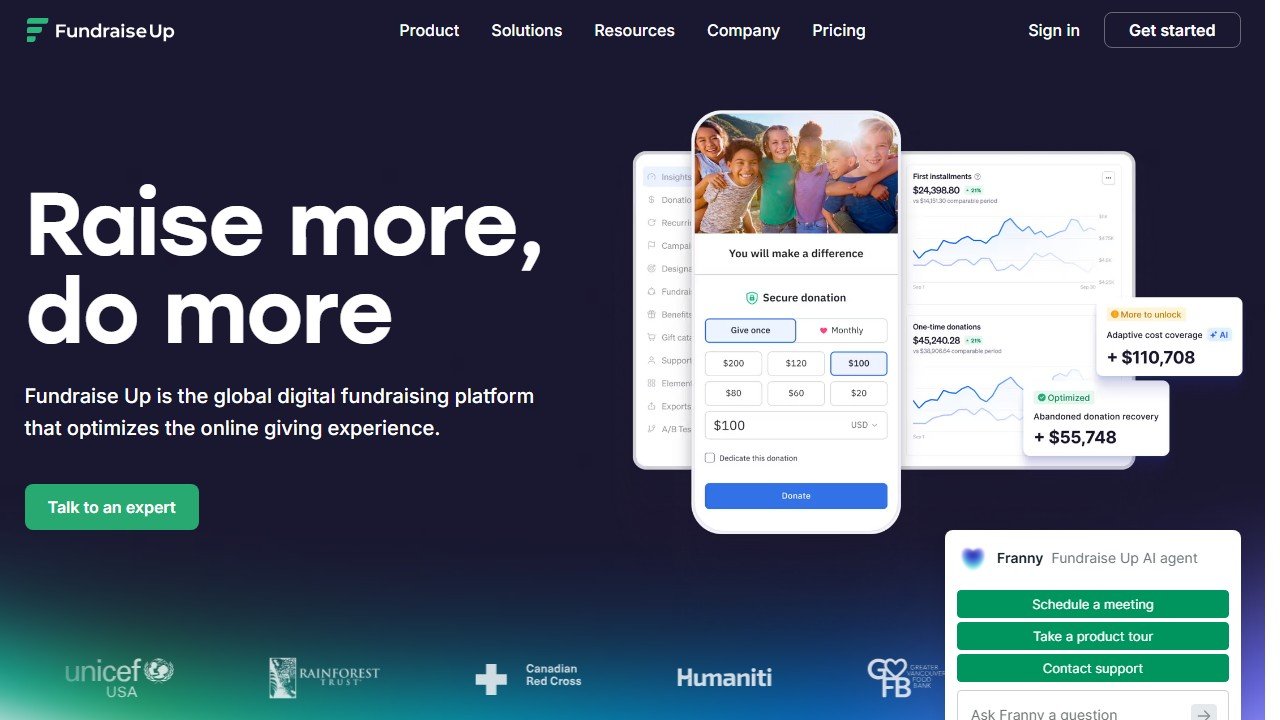
Fundraise Up solves one specific problem extremely well: getting more revenue from the donors who already intend to give. It sits on top of your existing website as a fundraising layer, replacing or supplementing your current donation form with an AI-optimized giving experience.
The core AI feature is suggested donation amounts that adjust in real time based on donor behavior. Instead of showing every visitor the same four preset amounts ($25, $50, $100, $250), Fundraise Up’s AI analyzes behavioral signals and personalizes the ask in real time. The platform claims this adds 10 to 15 percent more revenue compared to non-AI donation forms. Those numbers are backed by their own data across a large customer base that includes UNICEF USA, Salvation Army UK, Canadian Red Cross, and the American Heart Association.
The AI in Detail
The donation suggestion AI works across a few dimensions:
- Amount personalization. The AI reads behavioral cues (time on page, giving history if the donor is recognized, referral source) and adjusts the default and suggested amounts accordingly.
- Payment method optimization. Fundraise Up supports Apple Pay, Google Pay, Venmo, PayPal, ACH, and crypto alongside credit cards. It tests and surfaces the payment options most likely to convert for each visitor.
- Recurring conversion. The platform uses AI prompts to encourage one-time donors to switch to recurring giving, with framing tested for conversion.
A secondary stat worth noting: 87% of Fundraise Up donors voluntarily choose to cover all transaction costs (platform and processing fees). That means the platform’s 4% fee often gets absorbed by donors, making the effective cost to the nonprofit less than 0.5%.
What Fundraise Up Doesn’t Do
It is not a CRM. It is not an email platform. It is not a grant writing tool. It’s a conversion optimization layer for online giving. You will still need a CRM (Salesforce, Virtuous, Bloomerang, or even Givebutter) alongside it for full donor management. Think of Fundraise Up as the front end that maximizes revenue, while a CRM handles the relationship side.
Pricing
- No subscription fee. No tiered plans.
- 4% transaction fee on all donations.
- All features included (no upsells for major features).
- Most donors cover the fee voluntarily, making effective org cost very low.
Best for: Mid to large nonprofits ($500K+ revenue) with meaningful online giving volume who want to squeeze more out of every donation page visit. Particularly strong for orgs that have already built traffic or email lists but feel their donation pages underperform.
See our full Fundraise Up review and our Givebutter vs Fundraise Up comparison.
Saru’s Data Check: What the Numbers Actually Say About AI Donation Optimization
The 10-15% revenue lift claim from Fundraise Up deserves context. That figure comes from their own internal data, comparing nonprofits before and after enabling AI donation suggestions. It’s not an independent study, but the customer list (UNICEF, Red Cross, American Heart Association) suggests the underlying product works well enough for major organizations to trust it.
The DonorSearch AI data is more striking: their clients report an 85% increase in response rate when using AI-driven prospect identification. Their predictive model hits 81% accuracy on repeat donor prediction.
The broader market picture from the Virtuous/Fundraising.AI 2026 report: 92% of nonprofits now use some form of AI, but only 7% report major fundraising impact. The gap between “using AI” and “using AI effectively” is enormous. The orgs seeing results are using AI at the workflow level, not just prompting ChatGPT occasionally.
AI-powered fundraising tools also automate 15-20 hours per week in admin tasks for development teams, per the same report. For a two-person development operation, that’s essentially a half-time hire’s worth of reclaimed capacity.
4. Virtuous: Best Full CRM + AI Platform
Rating: 4.4/5
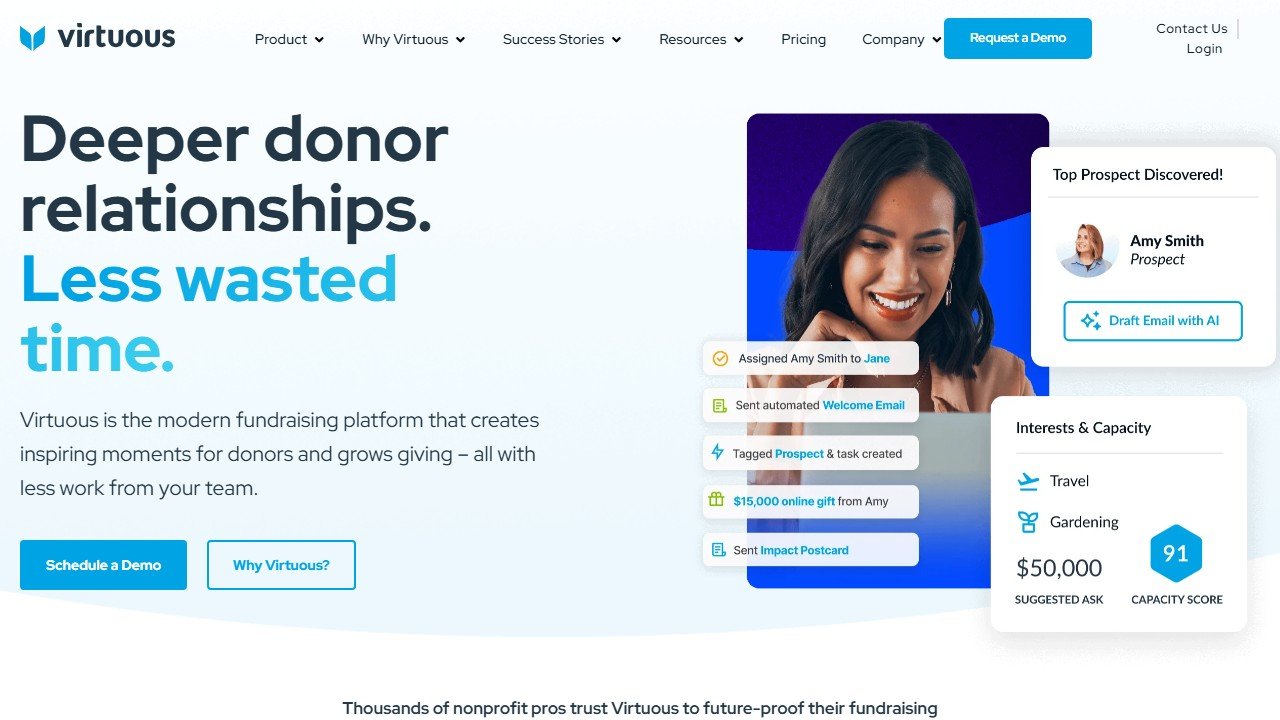
Virtuous is for nonprofits that have graduated from spreadsheets and disconnected tools and want a single, integrated platform that does everything: CRM, donor management, marketing automation, online giving, volunteer management, and AI-powered insights. It’s the most complete nonprofit platform on this list, and it’s priced accordingly.
The company calls its philosophy “responsive fundraising,” the idea that your fundraising system should react in real time to donor signals rather than treating everyone in your database the same way. When a donor opens three consecutive emails, visits your donation page twice, and then clicks a social media post, Virtuous flags that behavioral pattern and prompts your team to reach out. That’s not new in commercial CRM, but in the nonprofit space, where most platforms are built around batch communications rather than individual signals, it represents a meaningful shift.
The AI Features
Virtuous has invested seriously in AI, including appointing a Chief AI Officer (Nathan Chappell) and completing three acquisitions in 2024 and 2025:
- Virtuous Insights: AI-powered enrichment of donor profiles. It layers wealth data, demographic signals, digital engagement history, and behavioral indicators onto your existing records to give you a fuller picture of each donor.
- Virtuous Momentum (acquired August 2025): AI that drafts personalized email outreach, prioritizes your inbox by urgency and relationship importance, and builds dynamic engagement plans that update as donor behavior changes.
- RaiseDonors (acquisition): Online giving tools integrated directly into the platform.
- VOMO (acquisition): Volunteer management, integrated with fundraising data so you can see the giving patterns of your volunteers.
The result is genuinely end-to-end. One platform handles the full donor lifecycle from first gift to major gift to planned giving consideration.
The Revenue Numbers
Virtuous isn’t shy about its growth. Revenue has quintupled in three years. The company raised $141 million across eight funding rounds, including $100 million from Susquehanna Growth Equity in 2024. It has 10,000+ customers. These aren’t vanity metrics for a nonprofit CRM; they reflect a product that development teams are genuinely choosing to pay for.
Limitations
Cost is the obvious friction point. Virtuous no longer publishes a price and bands you by annual fundraising revenue before quoting, and it is not a small nonprofit tool. The platform includes unlimited users, which is a genuine advantage for teams, but the entry price still rules out organizations under $500K in annual revenue. The platform also has complexity: the more features you add, the more onboarding and configuration time you’ll invest.
Pricing
- Platform Plan: price not published, quote only
- Unlimited users included
- Feature-based tiers above that (contact Virtuous for current pricing on Insights, Momentum add-ons)
Best for: Mid-sized nonprofits ($500K to $5M+ revenue) running diverse individual giving programs who want to consolidate CRM, fundraising, marketing, and AI insights in one platform. See our full Virtuous CRM review.
5. Funraise + AppealAI: Best Free Option for AI Content Generation
Rating: 4.2/5
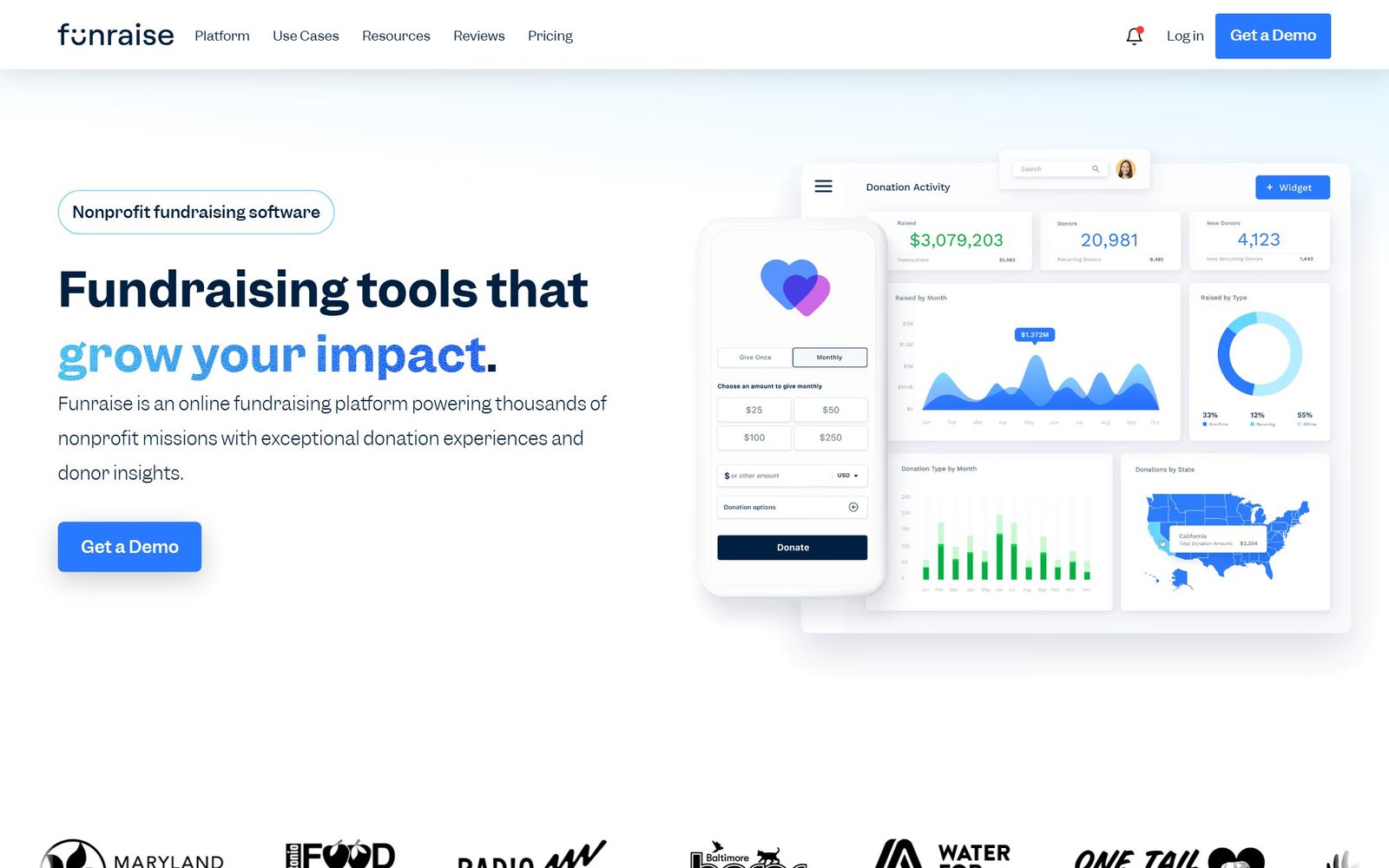
Funraise is a complete fundraising and donor management platform that has been in the market since 2015. But the reason it makes this list in 2026 is AppealAI, its free AI content generation tool that any nonprofit can use regardless of whether they’re a Funraise customer.
This is worth reading again: AppealAI is completely free, standalone, and requires no Funraise subscription. You can go to AppealAI, give it information about your organization and campaign, and generate fundraising appeal drafts, email subject lines, social media posts, and campaign copy right now, at zero cost.
What AppealAI Generates
AppealAI is built on OpenAI/ChatGPT under the hood but is purpose-built for fundraising content. It understands the structure of effective fundraising appeals: the donor-centered story, the specific ask, the urgency frame, the call to action. The outputs are better calibrated for nonprofit communications than you’d get from prompting general ChatGPT without expertise in fundraising copy.
You can generate:
- Full fundraising appeal letters
- Email subject lines (with A/B variants)
- Social media posts (campaign-specific, platform-specific)
- Campaign landing page copy
- Thank-you letter drafts
- Year-end giving appeal content
The Funraise Platform
Beyond AppealAI, the Funraise platform itself includes:
- Donation forms and campaign pages
- Peer-to-peer fundraising
- CRM and donor management
- Email automation
- Wealth screenings
- Analytics and reporting
- A free plan (5% platform fee, 2.9% + $0.60 processing)
The free plan works for basic fundraising needs. Paid plans reduce fees and unlock peer-to-peer, advanced analytics, and lower transaction costs.
Limitations
AppealAI generates drafts, not finished copy. You will need to edit the output to inject your org’s authentic voice, real donor stories, and specific impact data. If you use the raw output without editing, it will read like generic AI copy. That’s fine as a starting point but not as a finished product.
Pricing
- AppealAI: 100% free, no account required for basic use
- Funraise platform free plan: 5% platform fee + payment processing
- Paid plans: contact Funraise for current pricing
Best for: Small nonprofits wanting free AI content generation. Orgs that need help with fundraising copy but can’t justify a paid subscription. Development staff who want AI assistance on appeals without adding another tool cost.
6. Fundwriter: Best Dedicated AI Fundraising Copywriter
Rating: 4.0/5
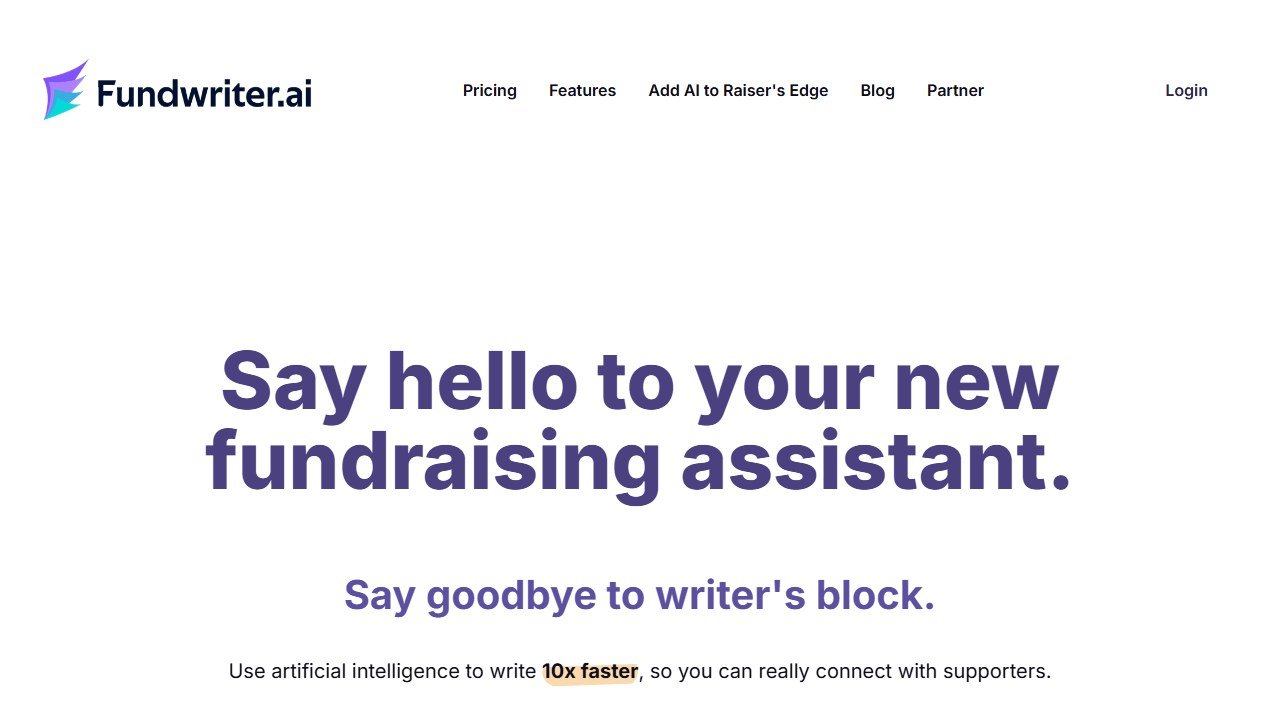
Fundwriter occupies a specific niche: it’s the AI tool built exclusively for fundraising content, covering everything from grant proposals to donor emails to social media posts. Where AppealAI is free and simpler, Fundwriter is paid and deeper, with 30+ specialized writing models for different fundraising content types.
The distinction matters. A general AI like ChatGPT can write a fundraising email if you prompt it well. Fundwriter is trained specifically on fundraising content, which means it understands the difference between a major donor cultivation letter and a peer-to-peer campaign post without you having to explain the structural differences in your prompt.
The 30+ Writing Models
Fundwriter’s library of models covers:
- Fundraising appeals (direct mail and digital)
- Grant proposal sections
- Personal major donor outreach emails
- Stewardship and thank-you letters
- Social media posts (platform-specific)
- Newsletter articles and website copy
- Event invitation and auction content
- Year-end and campaign-specific content
The model quality is designed around the fact that different fundraising channels have different conventions. A grant proposal narrative follows different rules than a text-to-give campaign message, and Fundwriter’s models reflect that.
Limitations
Fundwriter is a writing tool, full stop. It doesn’t manage donors, track campaigns, process payments, or integrate with your CRM. It’s a productivity tool for development staff who produce a lot of fundraising content. It sits alongside your fundraising platform, not in place of it.
The 7-day free trial lets you test the outputs before committing. At $22 to $29/month, it’s one of the more affordable paid tools in the nonprofit AI space.
Pricing
- Basic: $29/month ($22/month billed annually)
- Includes up to 20,000 words/month and access to all 30+ writing models
- 7-day free trial available
Best for: Development officers and communications staff at any size nonprofit who produce high volumes of fundraising content and want AI assistance that understands the conventions of fundraising writing, not just general content.
7. Calenta: Best for Salesforce Shops That Want Flat-Rate Pricing
Rating: 4.0/5
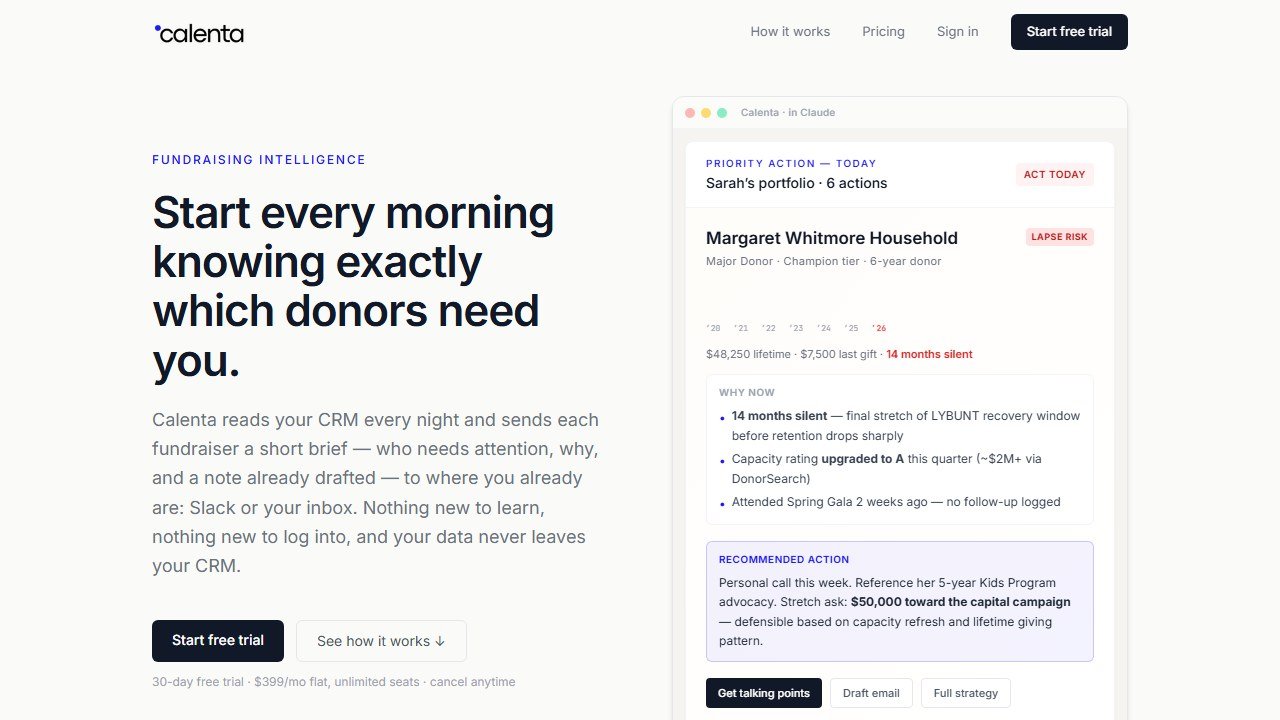
Calenta sits in the same lane as Gravyty below it, surfacing who a fundraiser should work today, but it makes two structural choices that are worth understanding before you compare the two.
How the AI Works
Calenta runs against your Salesforce org every night and produces one short brief per fundraiser the following morning, delivered to Slack or email. Each item names a donor, gives the reason they surfaced, and carries a drafted note the fundraiser can send or rewrite. There is no separate dashboard to log into and no data migration, because the analysis runs on the CRM you already have.
The other place it runs is inside Claude. Calenta works as a connector, so a fundraiser can ask for the day’s priorities, pull up a donor brief, and then update the opportunity, log the call or create the follow-up task by chatting, with every change landing in Salesforce. That matters more than it sounds for adoption, because the reason CRM data goes stale is almost never that people do not know what to record. It is that recording it means stopping what they are doing and going somewhere else. Removing that step is a smaller idea than nightly scoring and it may well be the one that decides whether the data stays clean.
What Makes It Different
Two claims here are checkable rather than positioning. The first is write-back: Calenta pushes each change into the CRM under the individual user’s own login, so the audit trail shows who did what and the CRM stays the system of record. Most tools in this category read your data and hand back a recommendation, which means the CRM only gets updated if someone remembers to update it. The second is the pricing model, covered below.
Limitations
Calenta works with Salesforce and nothing else right now. The vendor states plainly that it is starting with Salesforce orgs, whether NPSP, Nonprofit Cloud or a custom setup, with additional CRMs still to come. If you are on Givebutter, Virtuous, Bloomerang or DonorPerfect, this is not a tool you can evaluate yet.
It also needs roughly two years of donor history before the nightly analysis produces anything useful, since the patterns it looks for are lapse risk and giving trajectory. A program in its second year of operation will not get much from it. Those two constraints are the reason it ranks here rather than in the top half: the work it does is good, but the set of organisations that can use it at all is narrow.
Pricing
- $299/month flat, covering unlimited seats
- 30-day free trial, no credit card required, cancel anytime
- No per-user tier, which is unusual in this category
The flat rate is the part worth doing arithmetic on. In a category that almost universally charges per seat, one price for the whole team inverts the usual calculation: a shop with two fundraisers may find it expensive, while a shop with eight, or with several part-time officers who would never justify a seat each, may find it cheap. Work out your own per-head number before comparing it to a per-seat quote.
Best for: Salesforce-based development teams with at least two years of giving history and more fundraisers than a per-seat budget comfortably covers.
8. Gravyty/Raise: Best for Major Gift Programs
Rating: 3.9/5
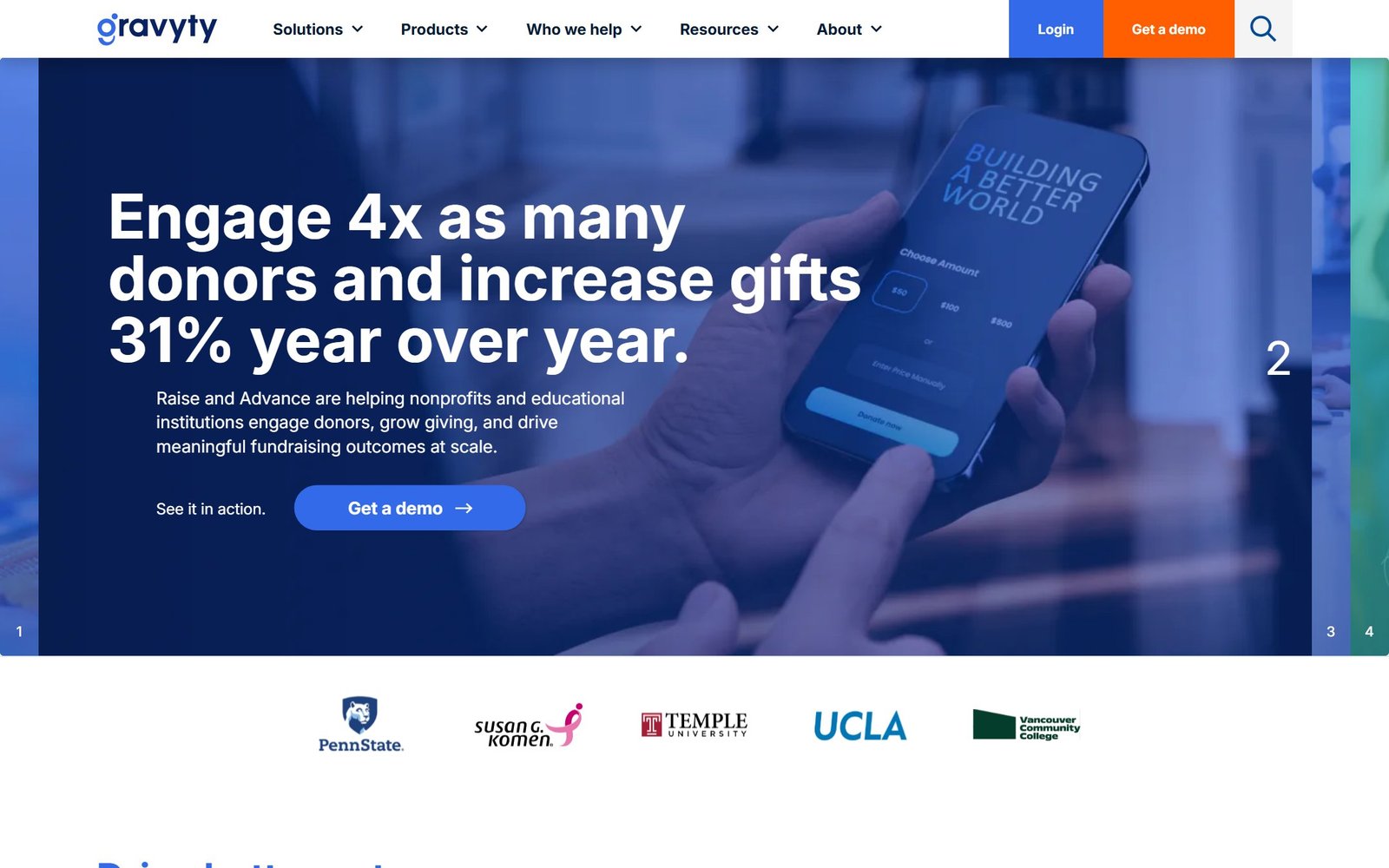
Gravyty approaches nonprofit AI from a different angle than the platforms above. While Givebutter and Fundraise Up focus on optimizing digital giving, Gravyty’s “Raise” product is built for major gift fundraising, the high-touch, relationship-intensive work of cultivating donors who give $1,000, $10,000, or $100,000+ gifts.
Major gift fundraising doesn’t scale the way annual fund does. A gift officer can manage 100 to 150 meaningful relationships at maximum. The problem is knowing which 150 prospects to prioritize from a database of thousands, and then remembering to reach out with the right message at the right moment for every single one of them. That’s exactly what Raise does.
How the AI Works
Gravyty analyzes your donor database and behavioral data to:
- Identify which prospects are most likely to give or upgrade their giving
- Generate daily action plans for each gift officer (specific outreach tasks for the day)
- Draft personalized emails and messages for each donor relationship
- Set stewardship reminders based on past gift anniversaries, engagement history, and relationship signals
- Track outreach and surface donors who are slipping out of engagement
The daily action plan feature is particularly practical. Instead of a gift officer spending 30 minutes deciding who to contact today, Raise generates a prioritized list with drafted messages for each contact. The officer reviews, edits, sends. The AI does the research and the first draft; the human provides the relationship judgment and personal touch.
Client Profile
Gravyty’s client list tells you who this tool is for. Susan G. Komen and Guiding Eyes for the Blind are among the named clients. The company is also heavily used by university advancement offices for alumni fundraising. This is not a small-org tool.
The enterprise pricing model (contact for quote, no public pricing) confirms the positioning. You’re looking at a meaningful investment, appropriate for organizations with active major gift programs where a marginal improvement in gift officer productivity has real dollar impact.
Limitations
No public pricing is a genuine friction point for evaluation. You need to go through a sales demo before you know what you’d pay. The platform is also not ideal for organizations without dedicated major gift staff; the daily action plan model assumes you have gift officers whose primary job is relationship fundraising.
Pricing
- Enterprise pricing, contact for demo
- No published rates
- Gravyty publishes no rates at all, and states it serves 2,750+ institutions
Best for: Nonprofits and universities with active major gift programs, dedicated gift officers, and a donor database where relationship-driven cultivation is a significant revenue driver.
Faz’s Honest Take: Free vs Paid, and What the Tradeoffs Actually Are
Here’s the honest version of the free-vs-paid calculation for nonprofit fundraising tools.
If you’re under $500K in annual revenue: start with Givebutter’s free plan. Use AppealAI for content. Prompt ChatGPT for the rest. You genuinely do not need to pay for fundraising software right now. The tools that will make the biggest difference at your stage are not AI platforms; they are good donor relationships, a clear mission story, and consistent outreach.
If you’re between $500K and $2M: Givebutter still probably makes sense as your core platform, but consider adding Fundwriter ($22/month) if you’re producing a lot of content, or Fundraise Up if your online giving traffic is meaningful and your donation page conversion is weak. Those specific, targeted investments will pay for themselves.
If you’re over $2M: you’re likely leaving money on the table without either Fundraise Up (for online giving optimization) or Virtuous (for full CRM + AI). The 10-15% revenue lift from AI donation suggestions isn’t marketing fluff at that revenue scale; it translates to real dollars. A $3M organization adding 10% to online giving revenue is adding $300K if online is half their revenue. That math works.
What I’d push back on: buying AI tools as a substitute for strategy. I’ve seen nonprofits spend money on AI platforms while their donor retention rate sits at 40% because no one is sending thank-you emails within 48 hours. No AI tool fixes a culture that doesn’t prioritize donor relationships.
Which Tool Is Right for Your Org Size?
Small Nonprofits (Under $500K Annual Revenue)
Your priority is getting to a professional digital fundraising setup without spending money you don’t have. The combination that works best:
- Givebutter (free) for donation forms, campaigns, basic CRM, and email communications
- AppealAI (free) for fundraising appeal drafts and campaign copy
- ChatGPT or Claude free tier for grant writing assistance, donor communications, and content creation
Total monthly cost: $0. Total capability: complete coverage of the core digital fundraising stack.
When to add paid tools: when you’re producing so much content that the time savings from a paid tool like Fundwriter justifies $22/month, or when your online giving traffic is high enough that Fundraise Up’s optimization would meaningfully move revenue.
Mid-Sized Nonprofits ($500K to $2M Annual Revenue)
At this scale, your development team is real (even if small), your donor database is meaningful, and incremental improvements in conversion or donor retention translate to real dollars.
Recommended stack:
- Givebutter or Funraise for platform (evaluate based on your event and P2P needs)
- Fundraise Up if online giving is a primary channel (the 4% fee likely pays for itself quickly at this scale)
- Fundwriter ($22-29/month) for development staff producing significant content volume
Consider Virtuous when you’re ready to consolidate your CRM and want AI-driven donor insights, but a cost you will only learn on a call needs to be justified by a fundraising team using it actively.
Large Nonprofits ($2M+ Annual Revenue)
At scale, the integrated platforms justify their cost through efficiency and revenue optimization.
Recommended stack:
- Fundraise Up for online giving optimization (the revenue lift compounds at high volume)
- Virtuous for full CRM, AI insights, and marketing automation
- Gravyty/Raise if you have active major gift staff managing relationship-intensive portfolios
- Calenta ($299/month flat) if you run on Salesforce and have more fundraisers than a per-seat budget covers
- DonorSearch AI for prospect research and wealth screening
This is also the tier where the enterprise tools (Gravyty, DonorSearch, Fundraise Up together) start making sense as a cohesive system rather than individual tools.
Common Mistakes When Choosing AI Fundraising Tools
Before diving into FAQs, here are four mistakes we see nonprofits make repeatedly when evaluating AI fundraising platforms.
1. Paying for AI Features Your Existing CRM Already Has
If you’re already using Salesforce, Bloomerang, or even a well-configured Google Workspace, check what AI and automation features you already have access to before buying a new tool. Salesforce Nonprofit Cloud includes Einstein AI features. Bloomerang has built-in donor engagement scoring. Many nonprofits sign up for a shiny AI fundraising platform only to discover it duplicates capabilities they were already paying for. Audit your current stack first.
2. Choosing a Tool Based on AI Hype Instead of Integration Fit
The most common regret we hear from nonprofit development teams: “We picked the tool with the best AI demo, and then spent three months trying to connect it to our donation processor.” Integration with your existing donation platform, payment processor, and email system matters more than the sophistication of the AI. A tool that plugs cleanly into your workflow and delivers basic automation will outperform a brilliant AI platform that sits in a silo.
3. Ignoring PCI Compliance for Payment Processing Tools
Any tool that touches donor payment data needs to be PCI DSS compliant. This is not optional, and it is not something to take the vendor’s word for without verification. Ask for their PCI compliance documentation before signing. Givebutter, Fundraise Up, and Funraise all handle this properly, but smaller or newer AI tools that overlay on your donation pages may introduce compliance gaps. If a tool processes or stores card data, verify its compliance status independently.
4. Expecting AI to Fix a Broken Donation Page
AI-powered donation suggestions and smart ask amounts are genuinely useful. But if your donation page loads slowly, looks unprofessional on mobile, has confusing form fields, or buries the submit button, no AI nudge will compensate. Design and UX drive the majority of donation page conversion. Fix the fundamentals (page speed, mobile layout, clear visual hierarchy, minimal form fields) before investing in AI optimization layers. Fundraise Up works best on pages that already have decent UX. It amplifies good design; it does not rescue bad design.
For a closer look, see our AI donor research tools.
Final Verdict
The best AI fundraising tool for your nonprofit is the one that solves your actual constraint.
If your constraint is knowing who to ask and why, start with Gratefully, our top pick, to turn your existing donor data into a prioritized daily action plan. If your constraint is cost, start with Givebutter’s free plan. If your constraint is online giving conversion, look at Fundraise Up. If your constraint is content production capacity, add Fundwriter. If your constraint is donor intelligence and CRM fragmentation, Virtuous is worth the investment. If your constraint is major gift pipeline management, Gravyty is purpose-built for that problem. If your constraint is a Salesforce team too large to license per seat, Calenta prices the whole team as one line.
The trap is buying a comprehensive AI platform because it sounds impressive, then not using 80% of it. Start with the specific problem you most need to solve, get results, then expand.
Decision Flow by Annual Fundraising Revenue
If you want a simple framework, here is how we would allocate tool budget by org size:
- Under $100K annual fundraising: Givebutter free plan covers everything you need. Pair it with AppealAI and ChatGPT/Claude for content. Spend zero dollars on fundraising software and invest that budget in donor stewardship and events instead.
- $100K to $500K: Givebutter remains your core platform. Consider adding Fundraise Up if online giving is a significant channel, or move to Givebutter’s paid tier for advanced marketing automation. Fundwriter at $22/month is worth it if your team writes appeals and emails regularly.
- $500K to $2M: This is where Virtuous or Funraise starts making financial sense as a CRM. Fundraise Up’s conversion optimization pays for itself at this volume. Budget $300 to $500/month total for your fundraising tech stack.
- $2M and above: Build a full stack with dedicated tools for each function. Fundraise Up for online giving, Virtuous for CRM and donor intelligence, Gravyty if you have major gift officers, and DonorSearch for prospect research. At this scale, a 5% improvement in donor retention or conversion can mean six figures in additional revenue annually.
For a broader view of the AI tools available to nonprofits beyond fundraising, see our best AI tools for nonprofits overview. And if you’re implementing AI fundraising practices for the first time, our how to use AI for nonprofit fundraising guide walks through practical workflows for development teams.
More AI tool guides worth reading: Best Gratefully Alternatives, 8 Best AI Tools for Animal Shelter Nonprofits in 2026 and 10 Best Classy.
More AI tool guides worth reading: Best AI Tools for Development Directors.
Tools mentioned in this guide
Newer in this cluster: Gratefully vs DonorPerfect (2026): Intelligence Layer vs Veteran CRM and DonorAtlas Review 2026: The AI Donor Research Tool With Cited Sources.

Written by
FazFaz is the founder of AIToolsBakery. Some tools here are tested hands on. Others are assessed from vendor documentation and pricing verified on the live page, and every review says which one it is. Sponsors can buy a position in a guide. They cannot buy the score, the criticism, or silence about a better option.
How we test and how we make money →