What Salesforce publishes
Read from salesforce.com/nonprofit/pricing on 4 September 2026, reached through their own nonprofit nav, with US Dollar selected on the page’s own currency converter. The page also offers AUD, GBP, EUR, JPY and SEK; we are quoting the USD card and have not converted anything.
| Edition | Price | What it adds |
|---|---|---|
| Nonprofit Cloud Sales & Service Core | $70 per user/month, billed annually | Nonprofit data model, Agentforce Coworker, Premier Success Plan, 500K Flex Credits a year, 20MB storage per user, Slack Business+ |
| Nonprofit Cloud Sales & Service Advanced | $125 per user/month, billed annually | Core plus 1GB storage per user, 1M Flex Credits a year, and Agentforce Account Research and Data Detect included rather than bought separately |
| Nonprofit Cloud Sales Max | $285 per user/month, billed annually | Advanced plus Agentforce for Nonprofit, Grantmaking, 2.75M Flex Credits a year and Slack Enterprise+, with the sales add-ons |
| Nonprofit Cloud Service Max | $285 per user/month, billed annually | The same Max bundle with the service add-ons |
All four require an annual contract. Salesforce labels the page informational and subject to change, and notes that usage restrictions apply. Our NPSP vs Nonprofit Cloud guide covers whether NPSP users have to move.
The ten free licences are the real headline
In Salesforce’s own words: “Through the Power of Us Program, any eligible nonprofit receives 10 Salesforce Nonprofit Cloud or Sales/Service Cloud licenses, at no cost.” If those costs are pushing you to look elsewhere, our guide to Salesforce Nonprofit Cloud alternatives compares simpler donor CRMs.
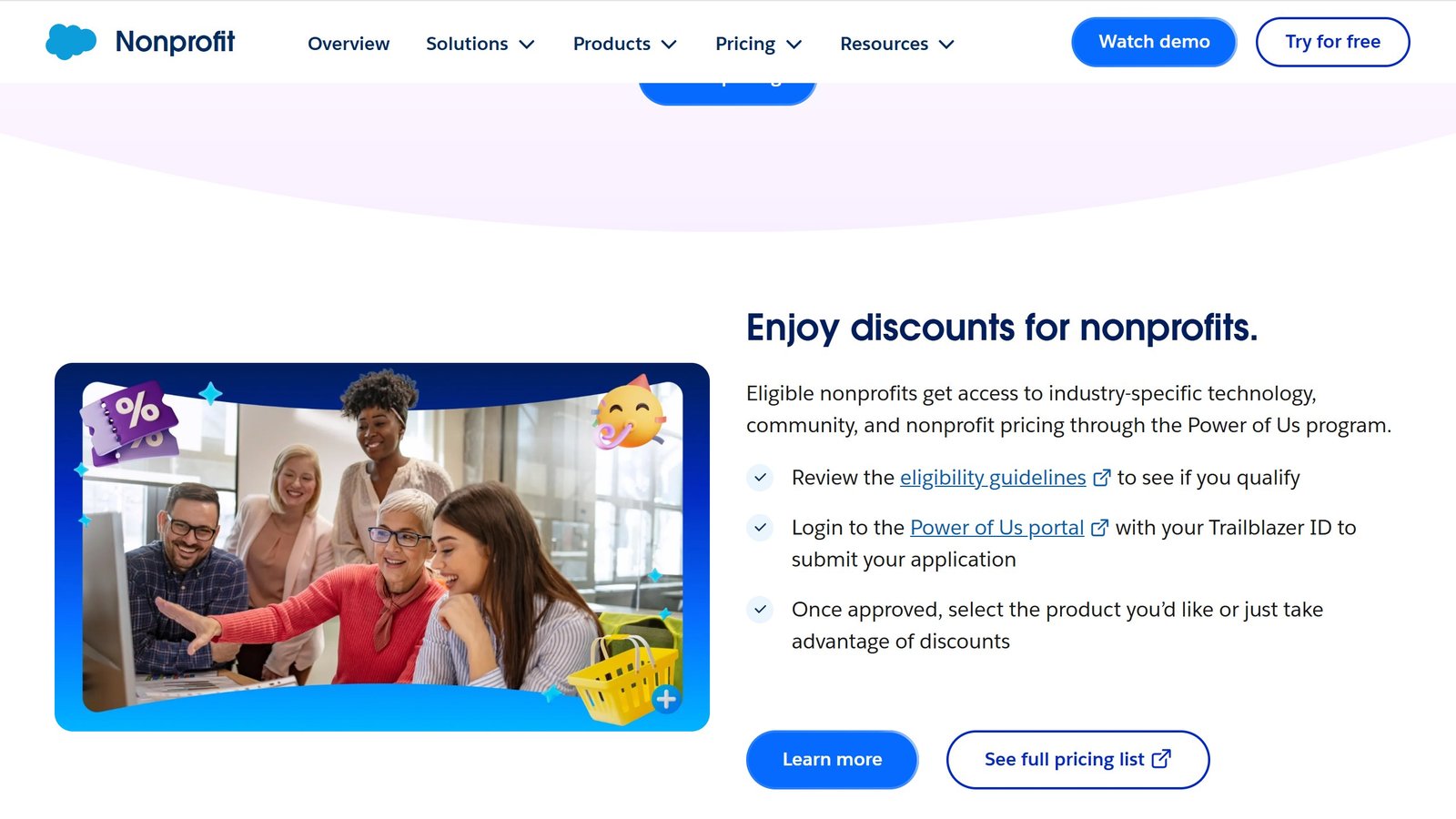
That changes the arithmetic completely, and it is the thing most comparisons get wrong. A nonprofit with ten or fewer people in the CRM pays nothing for the CRM itself. The eleventh person costs $70 a month, or $840 a year, as of 4 October 2026.
| People in the CRM | Paid seats | Core cost per year, 4 Oct 2026 |
|---|---|---|
| 10 or fewer | 0 | $0 |
| 15 | 5 | $4,200 |
| 20 | 10 | $8,400 |
| 30 | 20 | $16,800 |
Our arithmetic on their published rate, assuming eligibility for Power of Us. Check the eligibility guidelines before you plan around it, because approval is a process rather than a formality. Our best CRM for nonprofits guide sets Power of Us beside the HubSpot, Microsoft and monday.com nonprofit programmes.
Salesforce is the only one that charges by seat
This is the thing worth understanding before you compare anything. Every figure below was verified on the vendor’s own page on 4 September 2026.
| CRM | Published entry price | What the meter runs on |
|---|---|---|
| Salesforce Nonprofit Cloud | $70 (4 Oct 2026) per user/month, after 10 free | Seats |
| Keela | $164/month up to 1,000 contacts | Contacts |
| Bloomerang | $125/month for the CRM | Product, then undisclosed |
| Little Green Light | $45/month up to 2,500 constituents | Constituents |
| Virtuous | Not published | Quote, banded at $5M revenue |
| DonorPerfect | Not published | Quote |
| OneCause | Not published | Quote |
Everyone else meters your list. Salesforce meters your team. That inverts the usual advice. On Keela or Little Green Light, a growing database is what raises the bill and hiring is free. On Salesforce, a database of two million costs the same as a database of two thousand, and hiring a sixth fundraiser is what costs money.
What the published price does not cover
Three things, and they are where nonprofit Salesforce budgets actually go.
Implementation. Salesforce publishes nothing about it, and neither will we. Figures in the $10,000 to $30,000 range circulate widely for nonprofit implementations, and we have not been able to verify any of them at source, so treat them as hearsay and get a written quote from whoever would do the work. This is the single biggest gap between the sticker price and the first-year cost.
The add-ons. Marketing Cloud, Experience Cloud and Data 360 each say “Contact us” rather than carrying a price. If your plan depends on any of them, the published $70 tells you very little.
The people who run it. Salesforce is configurable in a way the sector-specific CRMs are not, which is its main advantage and its main cost. Somebody has to hold that configuration. If that is a consultant on retainer, price the retainer.
Who this pricing suits
Small teams with big lists. Under ten people in the CRM and Power of Us eligibility, the CRM is free at any list size. Nothing else in the category can say that.
Organisations that already run Salesforce elsewhere. The nonprofit editions sit on the same platform, so the skills and integrations carry across.
Not for teams who want it to work out of the box. If nobody will own the configuration, a sector-specific CRM like Bloomerang or Little Green Light will serve you better for less trouble.
The intelligence layer is a separate purchase
Disclosure: Zilwaris, the consultancy run by AI Tools Bakery’s founder, does paid advisory work for Gratefully, which did not pay for any placement on this page and is assessed on the same criteria as everything else on this site.
Nonprofit Cloud is a system of record and a workflow engine. What it does not do is tell a fundraiser who to call today and why. That is a different category. Salesforce Nonprofit Cloud and NPSP are among the systems Gratefully connects to directly as of 4 October 2026, alongside Bloomerang and Little Green Light; Raiser’s Edge NXT users work through a CSV export instead.
It is free for one person, then $99 a month for a single fundraiser and $499 a month for a five-person team. At the team tier that is more than five paid Salesforce seats cost. That is the honest shape of it: the database can be free and the thing that works the data is where the money goes. Our donor intelligence guide covers the alternatives.
What every comparable vendor actually charges
A comparison table tells you the number. It does not tell you what the number is measured against, which is the part that decides your bill. Here is each of the main alternatives to Salesforce Nonprofit Cloud, read from their own pricing pages on 4 September 2026, with the meter that matters.
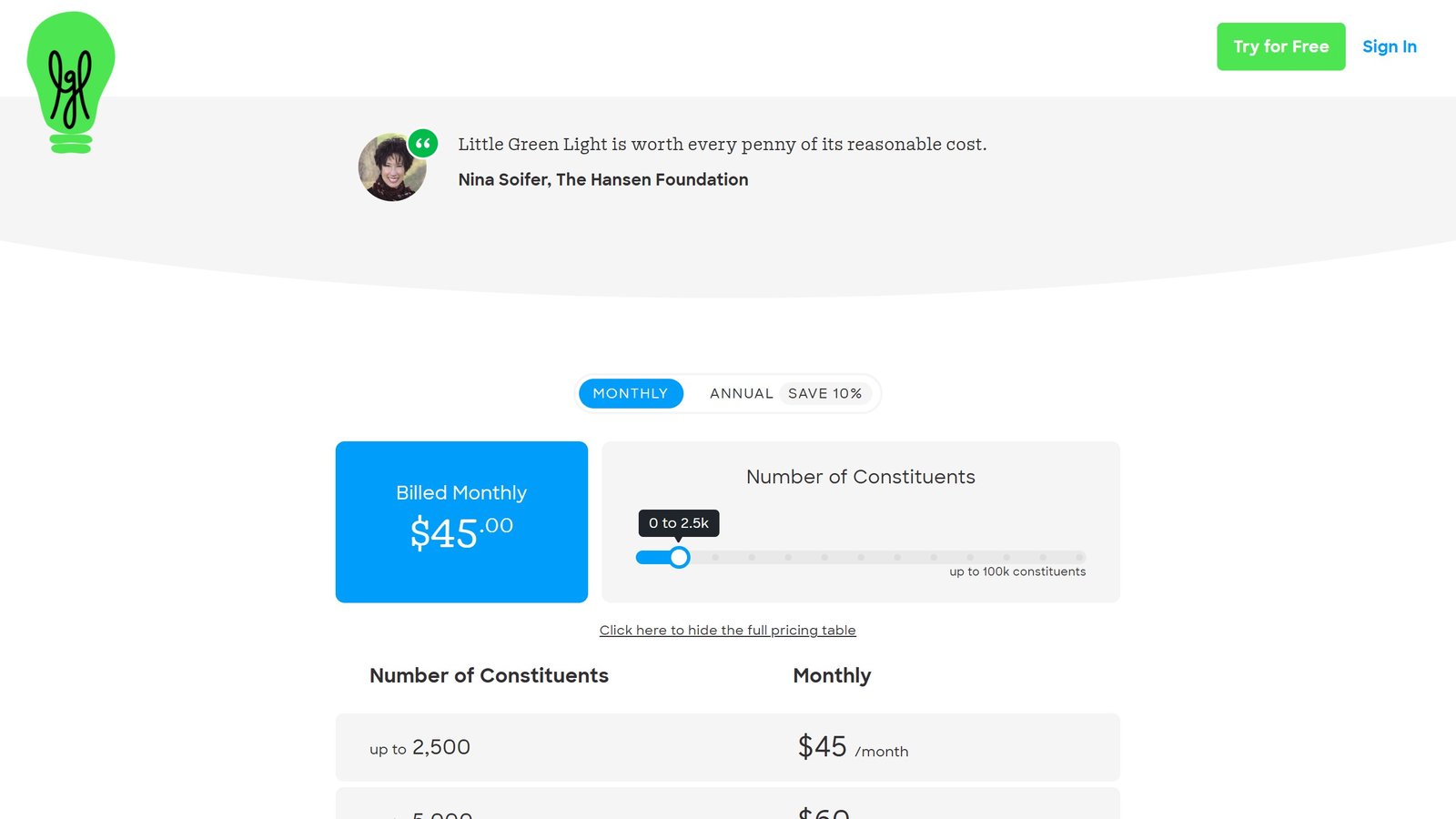
Little Green Light, from $45 a month, metered on constituents
Little Green Light publishes every band openly and starts at $45 a month for up to 2,500 constituents. It takes nothing from your donations, which makes it one of the few platforms where online giving revenue is genuinely yours. The catch is structural: because the meter is constituent count, growing your list raises the bill even when the added records are lapsed donors or one-off event attendees who will never give again. Organisations on constituent-metered platforms end up pruning their database to control cost, which is a bad incentive for a fundraising team that should be keeping history.
Salesforce Nonprofit Cloud, $70 per user (as of 4 October 2026), with ten licences free
Salesforce is the odd one out and it is worth understanding why. Nonprofit Cloud Core is $70 per user per month billed annually as of 4 October 2026, but the Power of Us programme gives any eligible nonprofit ten licences at no cost. An organisation with ten or fewer people in the CRM pays nothing for the CRM itself, at any list size. The eleventh person costs $840 a year. That inverts the usual advice: on Salesforce a database of two million costs the same as one of two thousand, and hiring is what raises the bill. The real cost is not the licence, it is that somebody has to own the configuration.
Neon CRM, from $99 a month, metered on your fundraising revenue
Neon starts at $99 a month with unlimited users and unlimited records, priced on annual fundraising revenue rather than seats or contacts. Modules are added as a percentage of the subscription: memberships at 10%, events at 20%, volunteers at 10%. Worth knowing that Neon retired its old Essentials, Impact and Empower tier structure entirely, so any article still quoting $209 or $409 tiers is describing packaging that no longer exists.
Bloomerang, from $125 a month, metered by product
Bloomerang publishes $125 a month for the CRM, with Fundraising from $40 and Volunteer from $119 as separate products. It moved away from record-tier pricing, so comparisons written against its old banding are stale. The practical effect of product-based pricing is that a quote assembled from three Bloomerang products is not comparable to a single all-in figure from a competitor without itemising first.
Keela, from $164 a month, metered on contacts
Keela bands by contact count starting at $164 a month for up to 1,000 contacts. It raised every band between late August and early September 2026, entry moving from $134 to $164, a rise of roughly 15 to 22% across the range in under two weeks. That is a useful reminder that a published price is a snapshot: check the date on any figure you are comparing, including ours.
Dataro, from $15,000 a year plus $0.10 per active donor
Dataro is a different category, predictive donor intelligence rather than a CRM, and its pricing shows it: Essentials from $15,000 a year plus ten cents per active donor, Growth from $25,000 plus twelve cents. Its pricing page is not linked from its own navigation and is only discoverable through the sitemap. Included here because it is the honest top of the nonprofit software market and a useful upper bound when someone tells you a quote is expensive.
The ones that publish nothing
Blackbaud runs a quote request form headed “Let us find a price that fits your organization” with no figures at all. Virtuous publishes no price and bands its tiers at $5 million in annual fundraising revenue, so it segments you by what you raise before quoting. GoFundMe Pro, formerly Classy, publishes only that its model is an annual subscription plus a transaction fee per donation.
The exit costs nobody quotes you
Switching cost is the reason organisations stay on platforms they have outgrown, and it is almost never discussed during procurement. Three things determine how trapped you are.
Recurring gifts and payment tokens
Donor records and giving history export cleanly from almost any platform. Live recurring schedules and the payment tokens behind them frequently do not. If tokens cannot transfer, every monthly donor has to re-enter card details and a meaningful share will not, so the real cost of leaving is a slice of your most reliable income. Ask about token portability during procurement, in writing, when you still have leverage.
Custom fields and history
Ask what a full export actually contains. Standard fields usually come out fine; custom fields, soft credits, relationship links between households and the audit trail of who changed what often do not. Losing the relationship structure means rebuilding institutional knowledge that took years to accumulate.
Integrations you will have to rebuild
Every connected system, email platform, giving forms, accounting, event tools, is work to reconnect elsewhere. Count them before signing rather than after, because the number is usually higher than anyone remembers and it is the part that turns a two-week migration into a six-month one.
Why nonprofit software pricing works the way it does
Understanding the mechanics makes a quote easier to read and much easier to challenge.
Revenue banding is means testing
Several vendors band by annual fundraising revenue, and Virtuous splits its tiers at $5 million. That is means testing: the same software costs more if you raise more, on the reasoning that a larger organisation gets more value from it. It is defensible, and it also means your public filings are doing the negotiating before you arrive. Know your own figures before the call.
Why a quote form asks for an EIN
An EIN lets a vendor look up your filed revenue before quoting. If a pricing page asks for one before showing anything, assume the number you are offered has been sized against your accounts rather than drawn from a rate card.
Transaction fees are the line that scales fastest
Where a platform takes a percentage of donations, that line grows with your success and usually overtakes the subscription. On $500,000 raised online, a single percentage point is $5,000 a year, more than the entire annual cost of several CRMs. Most nonprofit CRMs take nothing from donations, so a percentage model needs a specific justification.
Published prices are snapshots, including ours
Keela raised every band by 15 to 22% in under two weeks. Neon retired an entire tier structure. Artisan removed its figures altogether. Any pricing article without a verification date is describing a market that may no longer exist, which is why every figure here carries one.
What this costs at three real organisation sizes
Headline monthly figures are close to useless for budgeting because each vendor meters on something different. Here is the same three organisations priced across the platforms that publish, using our arithmetic on their own rates.
| Platform | Small: 4 staff, 1,500 contacts, $150k raised | Mid: 12 staff, 8,000 contacts, $900k raised | Large: 30 staff, 40,000 contacts, $4m raised |
|---|---|---|---|
| Little Green Light | $540/yr | Higher band, constituent-priced | Highest band |
| Salesforce Nonprofit Cloud | $0, under 10 seats | $1,680/yr, 2 paid seats | $16,800/yr, 20 paid seats |
| Neon CRM | From $1,188/yr | Higher revenue band | Higher revenue band |
| Bloomerang | From $1,500/yr | Plus products taken | Plus products taken |
| Keela | From $1,968/yr | Higher contact band | Highest contact band |
The small organisation result is the surprising one
At four staff, Salesforce is free and Keela is nearly $2,000 a year, because one meters on seats you do not have and the other on contacts you do. That is a genuine four-figure difference driven entirely by pricing structure rather than product quality, and it is invisible if you compare monthly headline figures.
At thirty staff the ranking inverts
The same seat-based pricing that made Salesforce free at four people makes it $16,800 a year at thirty, while a constituent-metered platform may still be cheaper if the list has not grown proportionally. Whichever of your two numbers, people or records, is growing faster is the one that should pick your pricing model.
How to run the procurement so a quote means something
Get every quote onto the same basis before comparing
Ask each vendor, including Salesforce Nonprofit Cloud, for the same seat count, the same contract length, implementation quoted separately from subscription, every add-on itemised, and payment processing stated as inside or outside the platform fee. A single blended annual number cannot be compared against anything, and vendors know it.
Establish the total first-year cost, not the subscription
Onboarding, data migration, integration work and training are frequently larger than the first year of licence fees in this category and are rarely in the headline figure. Ask for the all-in number, then ask which parts of it are one-off and which recur.
Negotiate the renewal before you sign the first contract
This is the single most valuable term and the one most often left out. A capped renewal uplift, stated as a percentage, is worth more than a bigger first-year discount, because at renewal the vendor knows your usage, your dependency and your switching cost while you have no public rate card to argue against.
Insist on a trial with your own data
A demo runs on a dataset chosen because the product handles it well. Ask to load a sample of your own records, including the messy ones: duplicate households, lapsed donors with old addresses, a recurring gift that failed. How a platform handles your actual data quality is the thing that decides whether staff use it, and it is invisible in a scripted walkthrough.
Name the person who will own it
Every platform in this category rewards an owner and punishes shared responsibility. Before signing, name the person whose job description includes this system and check they have the hours. Software does not create that role, and its absence is the most common reason a nonprofit CRM purchase disappoints.
How we checked this
Every figure came from salesforce.com/nonprofit/pricing on 4 September 2026, reached by following Salesforce’s own nonprofit navigation rather than by guessing a URL, with USD selected on their currency converter. The Power of Us wording is quoted directly from that page.
The seat tables are our arithmetic on their published rate. The inputs are theirs, the sums are ours, and the working is shown.
This is a pricing page, not a hands-on review. Nothing here is scored and we make no claim to have used the product. Prices change, and Salesforce labels its own page subject to change, so if a figure here no longer matches theirs, tell us and we will correct it.
Related: nonprofit CRM pricing compared, the best AI tools for nonprofits and our Virtuous CRM review.

Written by
FazFaz is the founder of AIToolsBakery. Some tools here are tested hands on. Others are assessed from vendor documentation and pricing verified on the live page, and every review says which one it is. Sponsors can buy a position in a guide. They cannot buy the score, the criticism, or silence about a better option.
How we test and how we make money →