Virtuous is one of the better-known CRMs for growing nonprofits, built around responsive fundraising and automated donor journeys. It is also one of the harder ones to price, because it publishes no figures. If you are reviewing it, start by asking what is actually wrong. If your team has Virtuous’s data and predictions but still struggles to remember what was said to whom, Gratefully, our top-ranked donor intelligence tool, is built for that recall problem, and its own comparison page says most organisations run both. If you do need to move, this page compares eight alternatives, most of which publish at least a starting price, and shows which parts of Virtuous you can keep.
How we put this together. Every price below was read on the vendor’s own pricing page on 17 September 2026, from India, and is shown as displayed. We have not migrated a database off Virtuous or used these systems hands-on. Where a vendor does not publish something, we say so.
What Virtuous sells, and what it publishes
Virtuous’s pricing page splits its CRM, CRM+, into two tiers by fundraising revenue: Platform, for nonprofits raising up to $5 million a year, and Enterprise, for those raising more. Both show “Request Pricing”. We searched the page’s code for a dollar figure and found none apart from the $5 million threshold. CRM+ includes donor and pipeline management, marketing and communications, events, reporting, workflow and journey automation, a partner marketplace and unlimited users.
Virtuous also sells separate products, all priced on request:
- Raise: donation forms, landing pages and project-based giving.
- Momentum: which Virtuous calls an AI-powered fundraising agent for major and mid-level gift officers, and which it says integrates with Blackbaud, Bloomerang and Virtuous.
- Insights: predictive scoring.
- Analytics: business intelligence and board-ready reporting.
- Volunteer: volunteer management.
We found no published contract length or implementation fee on the pricing, CRM or comparison pages. Ask for both in writing. Our Virtuous pricing guide and Virtuous review go deeper.
Why teams look for a Virtuous alternative
- Cost, or not knowing the cost. With no published prices, budgeting for renewal or growth depends on a sales conversation.
- More platform than you use. Journeys and predictive tools repay the effort only if someone runs them.
- Support. Competitor pages make claims about Virtuous support; we could not read independent reviews to check them, so test support yourself before renewing.
- Scale. Organisations well past the $5 million line sometimes want the depth of Salesforce or Raiser’s Edge NXT.
- Recall, not prediction. Virtuous’s AI looks outward at wealth and demographic data. If your gap is the knowledge in your own team’s notes and emails, a different kind of tool may be the fix.
The eight alternatives at a glance
| Tool | Published price | Priced by | Best for |
|---|---|---|---|
| Bloomerang | CRM from $125 a month; Giving Platform from $242, billed annually | Records | Published prices and unlimited users |
| Neon CRM | From $99 a month | Revenue | Unlimited contacts, free phone support |
| Bonterra EveryAction | Not published | Quote | Fundraising plus advocacy |
| Salesforce Nonprofit Cloud | 10 donated licences; Enterprise $60 per user per month after that | Per user | Deep customisation |
| Raiser’s Edge NXT | Not published | Quote | Large, established fundraising teams |
| DonorDock | $500 a month billed annually | Flat | Journeys at a known price |
| Funraise | Free under $1 million raised a year; Premium by quote | Platform fee | Online-first fundraising |
| Dataro (add, not switch) | From $15,000 a year plus $0.10 per active donor | Annual plus per donor | Better predictions on top of Virtuous |
The alternatives in detail
1. Bloomerang: published prices, unlimited users
Bloomerang lists its CRM from $125 a month and its Giving Platform from $242 a month, both billed annually and priced by records, with unlimited users on every plan. The Giving Platform includes Prospect AI and predictive insights. For a Virtuous Platform-tier customer, the attraction is being able to see the price before the call. Virtuous says Momentum integrates with Bloomerang, so a gift officer team that likes Momentum may be able to keep it after switching; confirm that with Virtuous. See our Bloomerang review.
2. Neon CRM: priced by revenue, like Virtuous’s tiers
Neon CRM starts at $99 a month and is priced by total revenue, which will feel familiar to a Virtuous customer used to a revenue-based tier. Its pricing page lists unlimited contacts, users, workflows and emails, stewardship journeys, an open API and free live chat, email and phone support. Memberships and Volunteers add 10% of the CRM fee each, and Events adds 20%. It does not publish the revenue bands. See our Neon CRM alternatives page for the full cost picture.
3. Bonterra EveryAction: for fundraising plus advocacy
Bonterra‘s fundraising and engagement pricing page describes EveryAction as a unified AI-powered CRM for fundraising, marketing automation and advocacy, alongside Network for Good, Mobilize, DonorDrive and OneCause. It publishes no prices. It suits organisations whose donors are also advocates and petition signers, which Virtuous is not built around. See our Bonterra review and pricing guide.
4. Salesforce Nonprofit Cloud: maximum flexibility
Salesforce’s nonprofit pricing page lists Enterprise at $60 and Unlimited at $100 per user per month, billed annually on an annual contract, and eligible nonprofits can request 10 donated licences. The product is now called Agentforce Nonprofit. It offers the deepest customisation on this list, but implementation needs a partner and budget. Our NPSP vs Nonprofit Cloud guide and pricing guide cover the detail.
5. Blackbaud Raiser’s Edge NXT: for large, established teams
Raiser’s Edge NXT is priced on request. Blackbaud’s product page lists Prospect Insights, Chat for Blackbaud AI, workflow automation with email sequencing, planned giving tools and a JustGiving peer-to-peer integration. It is the obvious comparison for Virtuous Enterprise customers raising well over $5 million. Virtuous says Momentum integrates with Blackbaud too. See our Raiser’s Edge NXT pricing guide and Raiser’s Edge alternatives.
6. DonorDock: journeys at a known price
DonorDock sells one plan at $500 a month billed annually, with unlimited contacts, five users, emails, texts and automations included, an optional $3,800 onboarding programme, and a 2% platform fee on its own giving pages. It advertises cancel-anytime terms and a 90-day money-back guarantee. For a Virtuous Platform customer with a small team, it offers automated journeys at a published price. Note the five-user limit against Virtuous’s unlimited users; extra users are $40 a month each.
7. Funraise: free for smaller online-first organisations
Funraise offers a free plan for organisations raising under $1 million a year, with a 5% platform fee plus 2.9% + 60¢ processing. Its Premium plan, priced on request, lowers the platform fee to between 0% and 3% and adds onboarding, wealth screening, texting and an API. Its page says it integrates with Virtuous, Salesforce, Raiser’s Edge and HubSpot, so it can also replace just Virtuous Raise while you keep the CRM. Work out the platform fee against your online revenue before assuming free is cheaper.
8. Dataro: add predictions instead of switching
If what you want from a move is better predictions, you may not need to move. Dataro is an AI layer rather than a CRM, and its pricing page lists Virtuous among the CRMs its Essentials plan supports, from $15,000 a year plus $0.10 per active donor. See our Dataro review.
What the vendors say about each other
You will find two kinds of comparison page in search results, and both are sales material. Virtuous’s own compare page sets itself against Raiser’s Edge, NPSP, Bloomerang and DonorPerfect and claims that organisations switching to it see a 15% average revenue increase. Bloomerang’s page on Virtuous claims Virtuous does not provide real-time support and can take days to respond, and cites G2 reviews that favour Bloomerang on usability and support. Neither page publishes a price or a method we could check. Treat every such claim as a question to put to the vendor, with a request for a reference customer of your size.
A cost example for a ten-person team
Because Virtuous publishes no price, the useful exercise is to price the alternatives for your team and set them against your Virtuous quote. For a team of ten users, using published starting prices read on 17 September 2026:
- Bloomerang CRM: from $1,500 a year, with unlimited users, rising with your record count. The Giving Platform starts at $2,904 a year.
- DonorDock: $6,000 a year for five users, plus five more at $40 a month each, so $8,400 a year.
- Neon CRM: from $1,188 a year, with unlimited users, rising with your revenue and any modules.
- Salesforce Nonprofit Cloud: no licence cost for ten users if you receive the 10 donated Enterprise licences, but implementation and any add-ons are extra.
That is our arithmetic on starting prices. The real figure for Bloomerang and Neon depends on your records and revenue, and for Salesforce on your implementation partner. Add migration, training and a period of running both systems before comparing with Virtuous. Ask Virtuous for its renewal quote in writing at the same time, so the numbers sit side by side.
Switching one module at a time
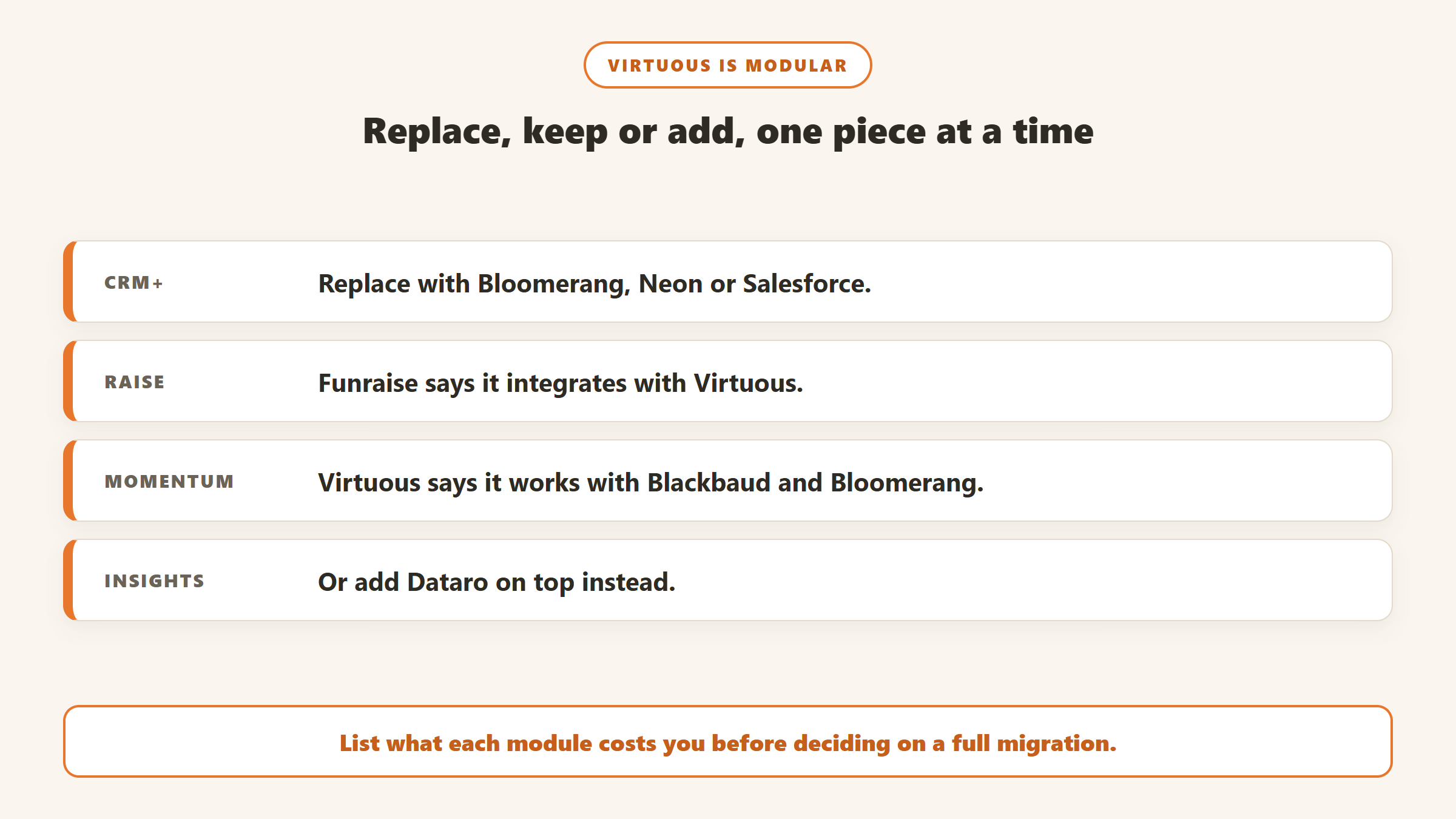
Virtuous’s product line is modular, which gives you options a single all-in-one vendor does not. You can replace the whole stack, or change one piece. Funraise says it integrates with Virtuous, so you could move online giving there and keep CRM+. Momentum, by Virtuous’s account, works with Blackbaud and Bloomerang, so you could change CRM and keep Momentum. Dataro and donor intelligence layers both sit on top of a CRM rather than replacing it. Before deciding on a full migration, list each module, what it costs you, and whether its job would be better done by keeping it, replacing it or adding a layer.
Which alternative fits which reason for leaving
| If your main reason is… | Look at |
|---|---|
| Unpredictable cost | Bloomerang, Neon CRM, DonorDock |
| Too much platform for a small team | Bloomerang, DonorDock |
| Advocacy alongside fundraising | Bonterra EveryAction |
| Outgrowing the platform | Salesforce Nonprofit Cloud, Raiser’s Edge NXT |
| Only the online giving tools | Funraise, keeping the CRM |
| Weak predictions | Dataro, keeping the CRM |
| Team knowledge gets lost | Gratefully, keeping the CRM |
An organisation raising about $2 million with four fundraisers
You are on Virtuous’s Platform tier. The realistic shortlist is Bloomerang, Neon CRM and DonorDock, because all three publish a starting price and are built for teams your size. Ask each to rebuild one of your current Virtuous journeys in the demo, and ask Bloomerang whether your gift officers could keep Momentum. If your team mostly struggles to remember donor history, run a donor intelligence layer alongside Virtuous for a month before deciding.
An organisation raising about $15 million with a data team
You are on the Enterprise tier and probably need custom objects, integrations and detailed reporting. Compare Salesforce Nonprofit Cloud and Raiser’s Edge NXT, and include Bonterra EveryAction if advocacy matters. At this size, the implementation partner, data model and ownership after go-live matter more than the licence price. If predictions are the gap, price Dataro on top of Virtuous as a lower-disruption option.
An organisation raising under $1 million, mostly online
You may be paying for more platform than you use. Funraise’s free plan, Bloomerang’s CRM and Neon CRM are all worth pricing, and Funraise’s platform fee should be weighed against your online revenue.
Smaller tools such as Little Green Light, Givebutter and Zeffy are cheaper still, but they are built for smaller teams than most Virtuous customers; our Bloomerang alternatives page covers them.
Keep Virtuous and fix the recall gap
Gratefully’s Virtuous comparison page makes a useful distinction. It describes Virtuous’s AI, including Insights, AI research agents and Momentum, as pointing outward at external data about your donors, such as wealth and demographics. Its own AI points inward, at the knowledge your team already holds: staff notes, emails and handover documents, turned into plain-language answers with every answer cited to its source. The page says it is not a Virtuous alternative, does not replace it, and works from the records you already keep in Virtuous with no migration.
Virtuous is not among the live connectors Gratefully names on its product page, which are Salesforce for Nonprofits, Bloomerang and Little Green Light, so expect to bring Virtuous data in through CSV import with smart field mapping, plus document upload for notes. It then builds one deduplicated view of each donor, ranks who needs attention with a reason for each, and helps preserve relationship context when staff leave. Its free plan, read on its pricing page on 17 September 2026, includes data clean-up and downloads, and new accounts start with a 14-day trial of its top plan before dropping to Free. Paid plans start at $79 a month billed yearly. Our Gratefully vs Virtuous comparison and Gratefully review cover the detail.

Disclosure: Zilwaris, the consultancy run by AI Tools Bakery’s founder, does paid advisory work for Gratefully. Gratefully did not pay for this placement, and it is assessed on the same criteria as everything else on this site.
If you do move: questions to settle first
- Your contract. Virtuous does not publish terms, so find your renewal date and notice period in your agreement.
- Which modules you use. CRM+, Raise, Momentum, Insights, Analytics and Volunteer may each need a separate replacement, or may be kept.
- Journeys and automations. Document each one before you leave; they will need rebuilding.
- Recurring gifts. Ask both vendors in writing whether stored payment methods can move between processors.
- Clean data first. Our guide to duplicate donor records notes that Virtuous merges cannot be undone, so plan merges carefully before export.
- Reporting continuity. Export retention and LYBUNT baselines; our donor retention rate guide shows what to capture.
Our nonprofit CRM migration guide covers the full checklist.
Where the facts on this page come from
- Virtuous: pricing page, CRM page, Momentum page and compare page, read on 17 September 2026.
- Bloomerang, Neon One, Bonterra, Salesforce, Blackbaud, DonorDock, Funraise and Dataro pricing or product pages, read on 17 September 2026.
- Gratefully: Virtuous comparison, product and pricing pages, read on 17 September 2026.
- Not published: Virtuous prices, contract length and implementation fees; Bonterra and Raiser’s Edge NXT prices.
- Not readable: independent review sites for Virtuous, which blocked access.
The bottom line
Virtuous publishes no prices, so the fairest comparison is against alternatives that do. Bloomerang and Neon CRM give you a starting figure, DonorDock a flat one, Funraise a free plan for smaller online-first organisations, and Salesforce, Raiser’s Edge NXT and Bonterra suit larger or advocacy-led teams. Before you migrate, decide which Virtuous modules you actually need, consider adding Dataro for predictions, and try Gratefully’s free plan alongside Virtuous if the real gap is your team’s own knowledge.

Written by
FazFaz is the founder of AIToolsBakery. Some tools here are tested hands on. Others are assessed from vendor documentation and pricing verified on the live page, and every review says which one it is. Sponsors can buy a position in a guide. They cannot buy the score, the criticism, or silence about a better option.
How we test and how we make money →Frequently Asked Questions