If you search “AI recruiting software” today, almost every result is a vendor ranking itself. The category is loud, the demos are slick, and the word “AI” gets stapled onto features that have existed since the keyword-matching days of 2010. Most of what gets sold as “AI recruiting” is still an applicant tracking system (ATS) with some automation bolted on top: rules that move candidates between stages, templated emails that fire on a schedule, and a resume parser that has been quietly relabelled as “AI screening.” Genuine machine learning exists in this market, but it is the exception, not the default.
Pricing makes the picture murkier. The majority of serious platforms hide their numbers behind a “contact sales” button, which means the sticker price you eventually see depends on your headcount, your negotiation, and how badly the sales rep needs to close the quarter. Implementation fees, per-seat creep, and annual contracts rarely show up in the marketing. We think that opacity is the single biggest reason buyers overpay, so we have put real third-party estimate bands in this guide and flagged every tool that is quote-only.
This is the pillar in our recruiting series. It ranks the 12 tools we consider the most credible in 2026, then breaks them down by hiring stage and team size so you can skip straight to what fits. If you want to go deeper on a specific layer of the funnel, we have dedicated guides on AI resume screening tools, AI sourcing tools, and AI interview tools, plus a broader look at AI tools for HR and a roundup of free AI recruiting tools if budget is the constraint.
We are AIToolsBakery, an independent review site. We are not a reseller, not a partner, and not an affiliate of any vendor here. We earn nothing if you buy any of these products. When a post is sponsored we label it clearly, and sponsorship never changes a score. This post is not sponsored. Every verdict below is ours, and we have tried to be as honest about the weaknesses and the pricing games as we are about the strengths.
The verdict in 30 seconds: Our highest-scored tool overall is Greenhouse, the safest ATS for structured, fair company hiring. For outbound sourcing teams, Gem and hireEZ lead. For high-volume and hourly hiring, Paradox is still the most capable conversational tool (now owned by Workday). For enterprise skills-based transformation, Eightfold is the deepest platform, though a January 2026 lawsuit means you should read the compliance section before signing. For an HR-of-one or a lean SMB, Workable or Manatal give you 80 percent of the value at a public price.
Quick answer: There is no single winner; match the tool to your stage and team. Greenhouse leads for structured hiring, Gem for sourcing and CRM, and Paradox (Olivia) for high-volume conversational screening. Whatever you choose, keep a human at the decision, get a bias audit, and insist on the real total cost.
What AI recruiting software actually means in 2026
There are three honest tiers in this market, and most marketing blurs them on purpose.
The first tier is the classic ATS with automation. This is a database of candidates with workflow rules. It parses resumes, ranks them on keyword overlap with the job description, sends templated emails, and moves people between stages when conditions are met. None of this is “AI” in any meaningful sense, though almost all of it now carries an AI label. Automation is genuinely useful, and for most teams it is 90 percent of the value. Just do not pay an AI premium for a rules engine.
The second tier is generative AI features stitched onto existing products. This is the 2024 to 2026 wave: large language models that draft job descriptions, summarise a stack of resumes, write outreach emails, or turn a recruiter’s plain-English request into a Boolean search. This is real and helpful, but it is assistive. It speeds up writing and summarising. It does not, on its own, decide who gets hired, and you should not let it.
The third tier is genuine agentic and predictive AI. This is deep-learning skills inference (predicting capabilities a resume never states), match-scoring models trained on outcomes, and semi-autonomous agents that source, rank, and reach out with limited human input. Eightfold, Findem, and the agentic features in hireEZ sit here. This tier is the most powerful and the most legally exposed, because a model that ranks or filters humans is exactly what bias-audit laws were written for.
Across all three tiers, a human is still required at the decision point. Every credible vendor now says the same thing in their compliance documentation: the AI surfaces, summarises, and ranks, but a person makes the hire/no-hire call. That is not just good practice. In the EU it is the law. Treat any tool that markets fully automated rejection as a liability, not a feature.
How we evaluated
We scored each tool from 0 to 5 across five weighted factors:
- Real AI capability (30 percent). Is there genuine machine learning doing useful work, or is “AI” a label on a rules engine? We rewarded tools that are honest about what their models actually do.
- Workflow and integrations (20 percent). How well it fits an existing stack: ATS, HRIS, calendar, sourcing data, and whether it creates or removes manual steps.
- Pricing transparency and value (20 percent). Public pricing earns points. Quote-only with aggressive per-seat creep loses them. We judged value against the realistic total cost, not the headline.
- Compliance and fairness posture (15 percent). Bias-audit support, explainability, data handling, and how the vendor responds to legal and regulatory pressure.
- Track record and support (15 percent). Customer reviews, stability, security history, and how the company has behaved under stress.
Our independence statement, again because it matters: we take no money from the vendors we rank, we are not a reseller, and no score in this guide has ever been bought. If that changes for a future sponsored piece, it will say so at the top, and the scoring methodology will not move.
The 12 best AI recruiting tools, ranked
1. Greenhouse
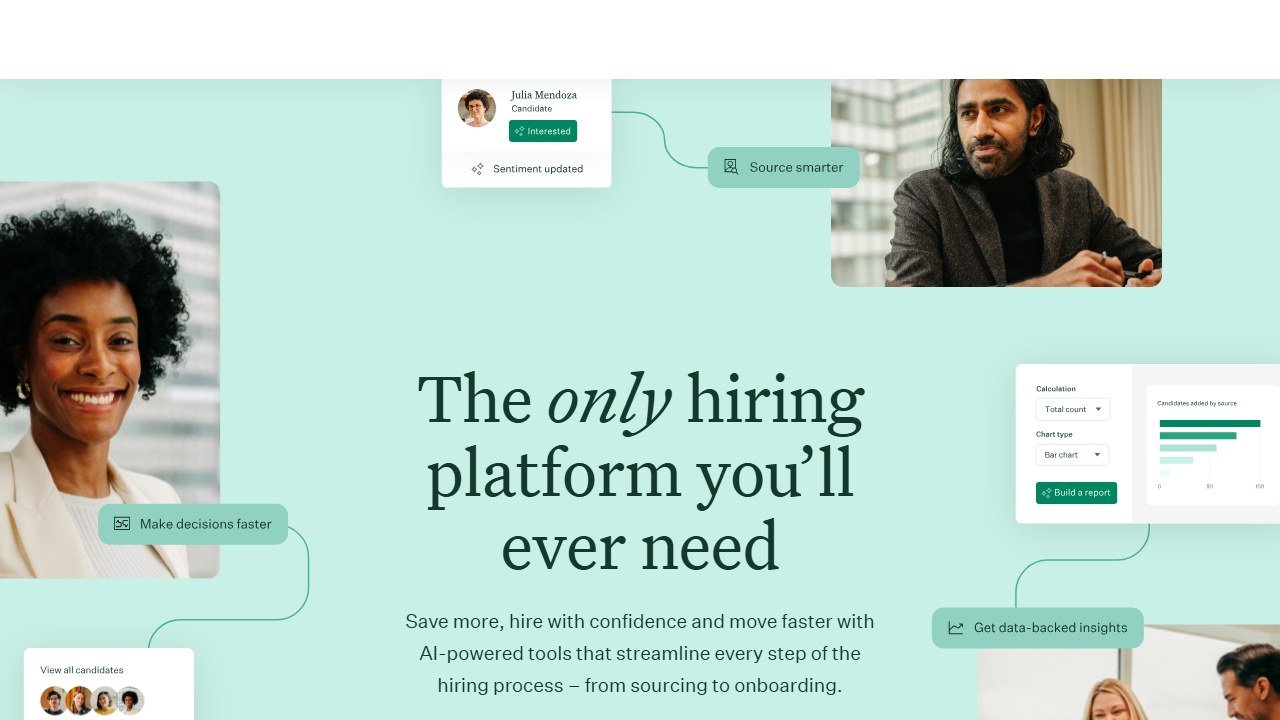
Greenhouse is a structured-hiring ATS, and structure is the whole point. It pushes interview kits, scorecards, and consistent evaluation criteria so that hiring decisions are comparable and defensible. Its AI layer drafts job descriptions, summarises scorecards, assists with sourcing, and surfaces interview-kit suggestions, all in service of a fair, repeatable process rather than a magic ranking number.
The AI here is firmly assistive, and we view that as a strength in a market full of black boxes. Greenhouse’s bet is that better process beats better prediction, and for most companies building a real hiring function, that bet is correct. The trade-off is that you do the work; the tool keeps you honest rather than doing the thinking for you.
- Standout strength: Enforces structured, bias-resistant hiring as the default.
- Pricing: Custom pricing, quote-only. Scales with headcount and modules.
- Best for: Companies that want a fair, structured, auditable hiring process.
- Verdict: The safest ATS choice for teams that care about doing hiring right, and our highest-scored tool overall. Score 4.5.
2. Gem
Gem is an AI-first, all-in-one talent platform covering sourcing, candidate relationship management, outreach, scheduling, and analytics across more than 800 million profiles. It is built for outbound-led teams that live in their pipeline, want everything in one place, and care about conversion metrics at every stage of the funnel.
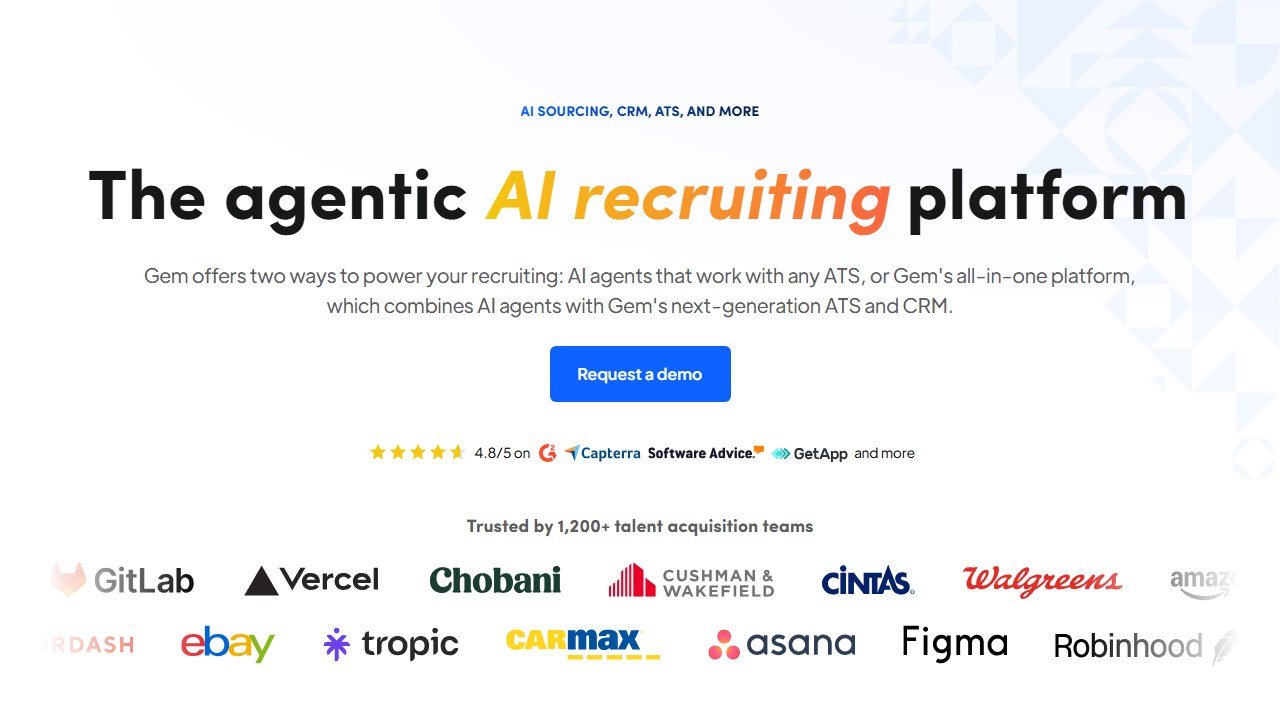
The AI does meaningful work in surfacing candidates, predicting engagement, and automating sequenced outreach, while the CRM backbone keeps it all measurable. Gem’s strength is consolidation: instead of stitching a sourcing tool to a CRM to a scheduler, you get one system with the analytics to prove what is working. For teams whose growth depends on proactive sourcing, that integration is the selling point.
- Standout strength: End-to-end outbound sourcing plus CRM plus analytics in one platform.
- Pricing: Custom pricing, quote-only. Scales with seats and modules.
- Best for: Outbound-led recruiting teams that want one integrated platform.
- Verdict: The strongest all-in-one for proactive sourcing teams. Score 4.4.
3. Paradox (Olivia)
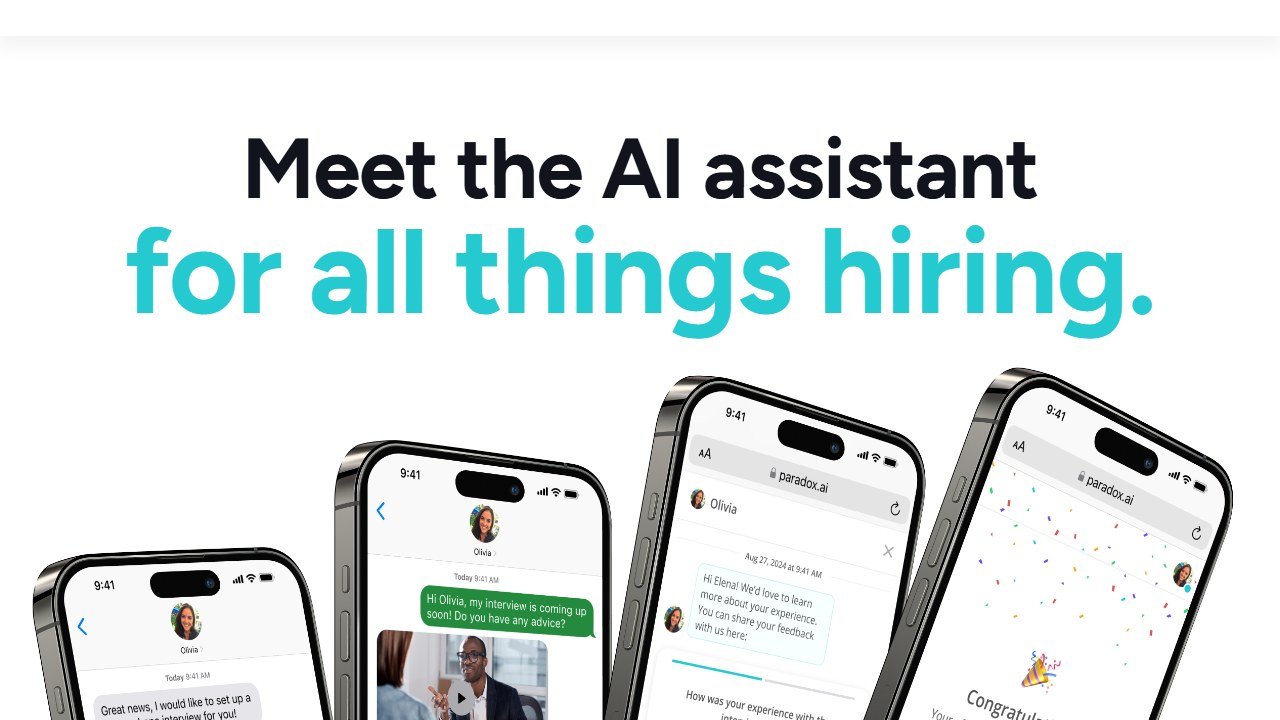
Paradox is a conversational AI recruiting assistant built for high-volume and frontline hiring. Its assistant, Olivia, screens candidates through chat, SMS, and WhatsApp, schedules interviews automatically, and answers candidate questions around the clock. For quick-service restaurants, retail, hospitality, and other hourly employers drowning in applications, nothing else closes the time-to-hire gap as aggressively.
What the AI really does here is conversational interface plus scheduling logic, not deep predictive scoring. It is very good at what it does. One major change for 2026: Paradox was acquired by Workday, with the deal closing on October 1, 2025, so it is now part of Workday’s talent acquisition suite. Buyers should also know about the 2025 McHire data breach, where a McDonald’s hiring chatbot built on Paradox was reachable through an admin account with the password “123456” plus an insecure direct object reference flaw that exposed applicant data. Paradox addressed it, but it belongs in your security due diligence. See our full Paradox AI review for the deep dive.
- Standout strength: Best-in-class conversational screening and scheduling for high-volume hourly hiring.
- Pricing: Quote-only, no public pricing, no free trial. Third-party estimates put mid-market deals around 25,000 to 60,000 dollars per year and enterprise at 75,000 to 150,000 dollars plus.
- Best for: QSR, retail, hospitality, and frontline volume hiring.
- Verdict: The category leader for conversational high-volume hiring, with a security incident worth scrutinising. Score 4.3.
4. hireEZ
hireEZ (formerly Hiretual, renamed in 2022) is an outbound AI sourcing platform pulling from more than 800 million profiles across 45-plus sources, paired with a CRM and a semi-autonomous “EZ Agent” launched in March 2025. The agent is one of the more genuine attempts at agentic sourcing: it can run searches, build pipelines, and tee up outreach with limited human steering.
The AI here is real, and the agentic direction is where the market is heading. The persistent weakness is contact-data accuracy, which is the most common complaint from users, so budget for verification regardless of what the platform promises. Read our hireEZ review for how it stacks up against SeekOut on data quality.
- Standout strength: Agentic outbound sourcing with a large multi-source profile pool.
- Pricing: Quote-only. Estimates around 169 to 250-plus dollars per user per month, median roughly 13,000 dollars per year.
- Best for: Outbound sourcing teams wanting early agentic automation.
- Verdict: A strong, forward-looking sourcing tool held back by data accuracy. Score 4.2.
5. SeekOut
SeekOut is an AI talent-search and sourcing platform spanning over a billion profiles, with particular strength in technical sourcing (including GitHub signals) and diversity sourcing. SeekOut Assist layers GPT-based help on top to translate hiring criteria into searches and to draft outreach, which makes it fast for recruiters who know exactly the kind of person they need.
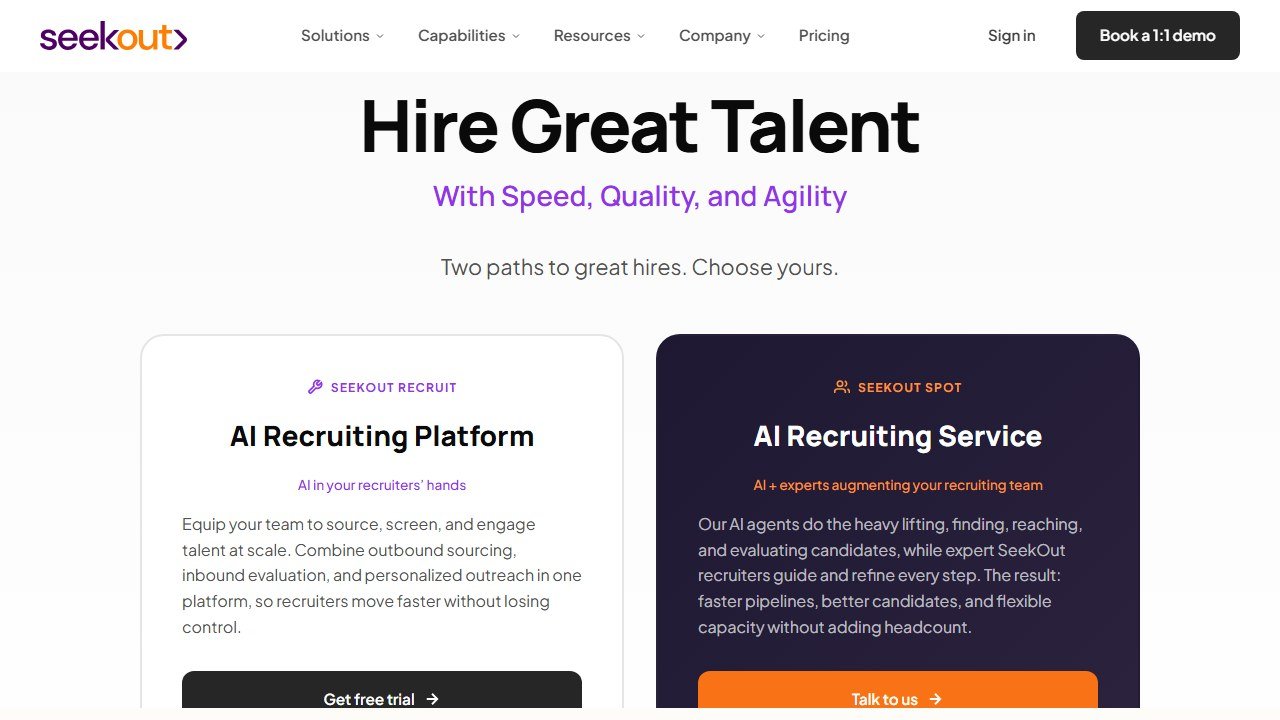
A due-diligence note: SeekOut went through roughly 30 percent layoffs in May 2024 and brought in a new CEO, Sean Thompson, in May 2026. We mention this for context, not as a verdict; the platform still serves more than 750 customers and remains one of the best technical and diversity sourcing engines available. Our SeekOut review and our SeekOut vs hireEZ comparison cover the trade-offs in detail.
- Standout strength: Deep technical and diversity sourcing across a billion-plus profiles.
- Pricing: Quote-only, with one self-serve Lite tier around 2,150 dollars per year. Median contract roughly 20,000 dollars.
- Best for: Technical and diversity sourcing at scale.
- Verdict: A top sourcing engine; just factor in the recent corporate turbulence. Score 4.1.
6. Eightfold AI
Eightfold AI is a deep-learning talent-intelligence platform. Its models infer skills a resume never explicitly lists, generate a Match Score, and power talent acquisition, internal mobility, and workforce planning from one skills graph. This is the genuine third tier of AI in this guide, and for large organisations pursuing a skills-based transformation it is the most sophisticated option on the market. Note that it is not an ATS; it sits alongside one.
The capability comes with the most legal exposure in this list. Eightfold is the subject of a proposed FCRA class action, Kistler and Bhaumik v. Eightfold, filed on January 20, 2026. We are not pre-judging the outcome, but any buyer running automated ranking on candidates needs to read our compliance section and our full Eightfold AI review before signing.
- Standout strength: Deepest skills-inference and talent-intelligence engine available.
- Pricing: Quote-only. Estimates around 7 to 10 dollars per employee per month; large contracts 150,000 to 500,000 dollars plus.
- Best for: Organisations of 10,000-plus employees driving skills-based transformation.
- Verdict: The most powerful AI here, with the most active legal cloud. Score 4.0.
7. HireVue
HireVue is an AI video interviewing platform offering asynchronous and live interviews alongside game-based and coding assessments. Importantly, HireVue dropped facial and visual analysis in 2021; its AI now scores the transcribed content of answers using natural language processing, plus structured assessment results. That shift away from analysing faces was the right call and removed its most criticised feature.
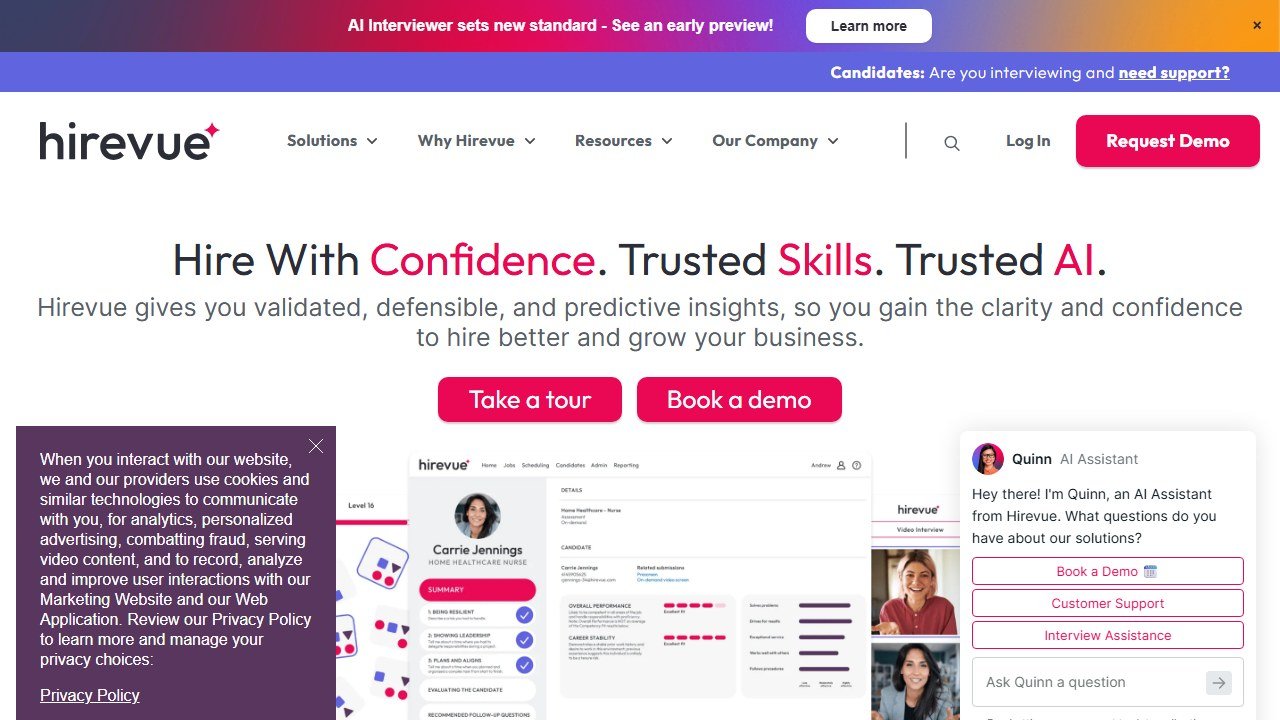
The platform suits enterprise high-volume hiring where structured, scalable interviews matter. It is Carlyle-owned, quote-only, and an ACLU complaint in March 2025 concerning captioning for a deaf applicant is a reminder that accessibility in AI interviewing is still an unsolved problem. Our HireVue review and our AI interview tools guide go deeper.
- Standout strength: Scalable structured video interviewing plus assessments for enterprise volume.
- Pricing: Quote-only. Estimates around 35,000 to 145,000 dollars per year plus implementation.
- Best for: Enterprise high-volume interviewing.
- Verdict: Much improved since dropping facial analysis, but accessibility gaps remain. Score 4.0.
8. Workable
Workable is a fast-setup ATS for SMB and mid-market teams, with built-in AI sourcing and screening. It is one of the few serious platforms with public pricing, starting around 299 dollars per month, which alone earns it goodwill in a market addicted to “contact sales.”
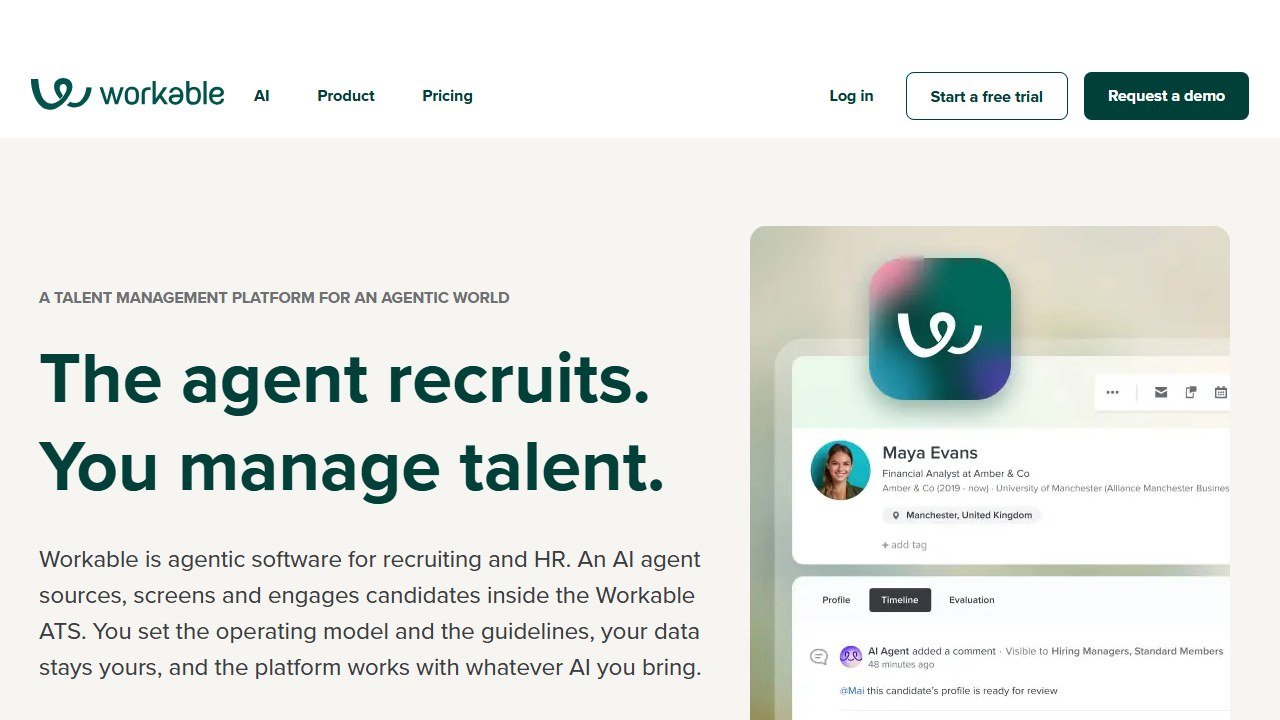
The AI is assistive: sourcing suggestions, screening assistance, and job-description help. None of it is groundbreaking, but it is well integrated and gets a growing company hiring properly without a procurement saga. For an HR team that needs a real ATS this quarter rather than next, Workable is the pragmatic pick.
- Standout strength: Fast to deploy, with public pricing and solid built-in AI.
- Pricing: Public tiers from around 299 dollars per month.
- Best for: SMB and mid-market teams that want a real ATS quickly.
- Verdict: The best SMB ATS for teams that value speed and transparency. Score 4.0.
9. Juicebox (PeopleGPT)
Juicebox, known for its PeopleGPT interface, lets recruiters search across more than 800 million profiles in plain English and returns explainable rankings. Instead of constructing Boolean strings, you describe the person you want and the model interprets it, then shows why each result matched.
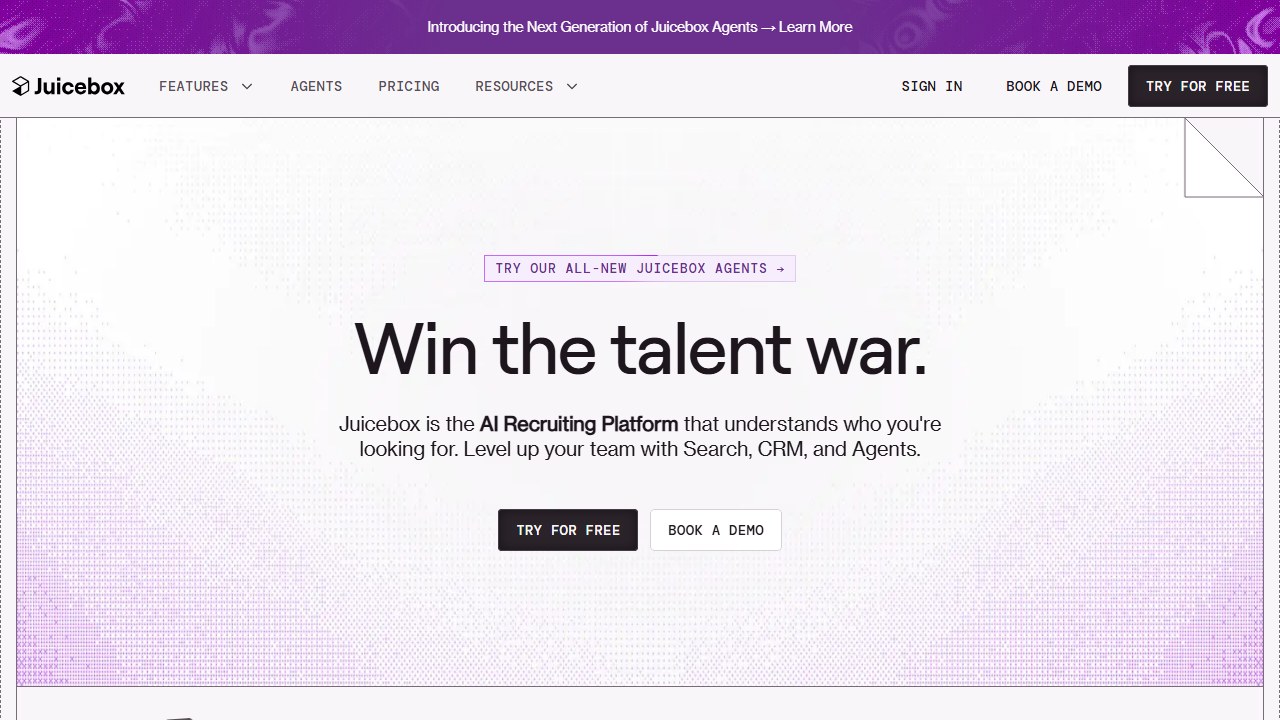
The explainability is the differentiator: in a category where ranking is usually a black box, Juicebox tells you the reasoning, which matters both for recruiter trust and for compliance hygiene. Public pricing from around 119 dollars per month, with an AI agent available as an add-on, keeps it accessible for small teams that want modern sourcing without an enterprise contract.
- Standout strength: Plain-English sourcing with explainable, transparent ranking.
- Pricing: Public from around 119 dollars per month; AI agent add-on extra.
- Best for: Small teams wanting natural-language sourcing on a budget.
- Verdict: The most approachable AI sourcing tool, with welcome explainability. Score 4.0.
10. Findem
Findem is an attribute-based talent-intelligence platform built around what it calls “3D” data: enriched candidate profiles assembled from thousands of attributes, with autonomous sourcing on top. Instead of keyword matching, you search by characteristics (for example, “scaled a team through a Series B” or “shipped in a regulated industry”) that are inferred from a candidate’s history.

The AI does real work assembling and querying those attributes, and for data-rich, precise searches it can surface candidates other tools miss. The trade-off is that attribute inference is only as good as its data, and the platform rewards teams that know how to phrase a sophisticated search. It is a power tool, not a beginner’s one.
- Standout strength: Attribute-based search that goes well beyond keyword matching.
- Pricing: Custom pricing, quote-only.
- Best for: Data-driven teams doing precise, attribute-led sourcing.
- Verdict: A genuinely differentiated sourcing approach for sophisticated users. Score 3.9.
11. Manatal
Manatal is a budget-friendly AI ATS with candidate scoring, profile enrichment, and AI job-description generation. Public pricing runs roughly 15 to 55 dollars per user per month, which makes it one of the most affordable credible options in this guide.
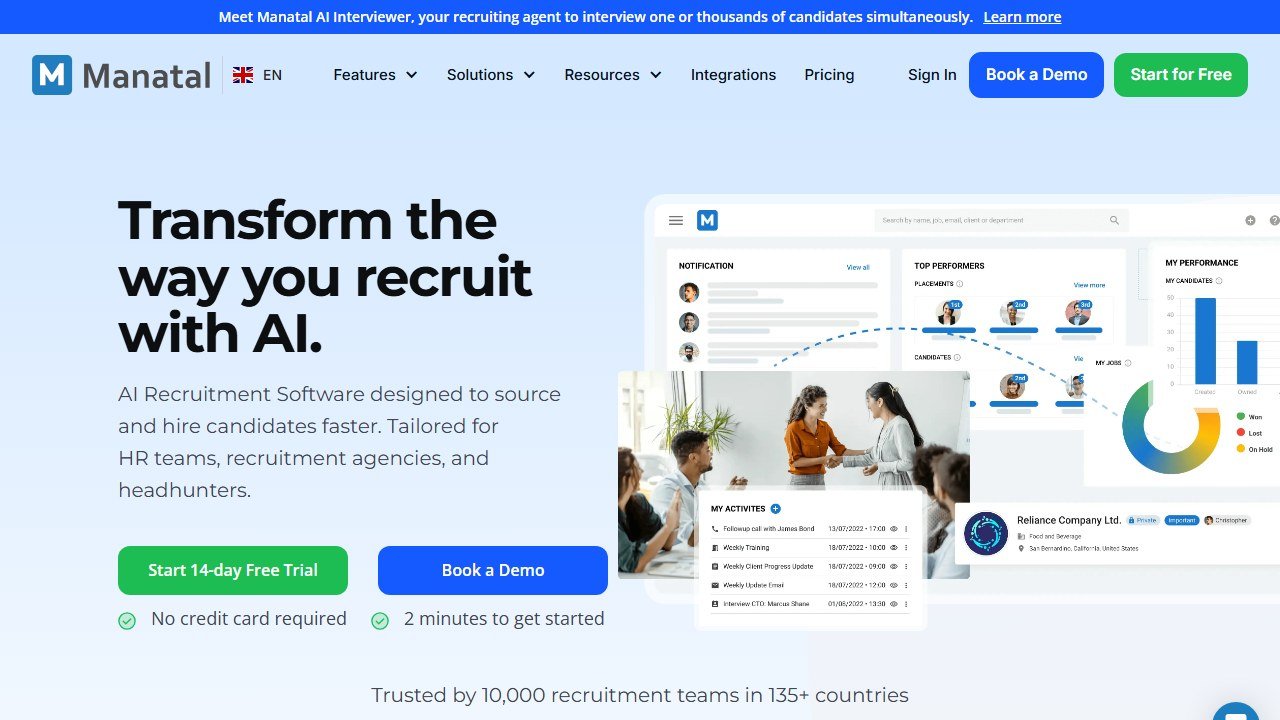
The AI is light but useful: candidate scoring to triage applications and enrichment to fill gaps in profiles. You are not getting deep-learning skills inference at this price, and you should not expect it. What you get is a tidy, inexpensive ATS that does the basics of AI-assisted hiring without a five-figure contract.
- Standout strength: Real AI-assisted ATS features at an entry-level price.
- Pricing: Public, roughly 15 to 55 dollars per user per month.
- Best for: Budget-conscious SMBs and small agencies.
- Verdict: The best value ATS for small teams watching costs. Score 3.9.
12. BrightHire
BrightHire is an interview-intelligence platform: it records and transcribes interviews, then structures the evaluation so decisions are based on what was actually said rather than a recruiter’s fading memory. It is the quality-control layer for the interview stage rather than a sourcing or ATS tool.
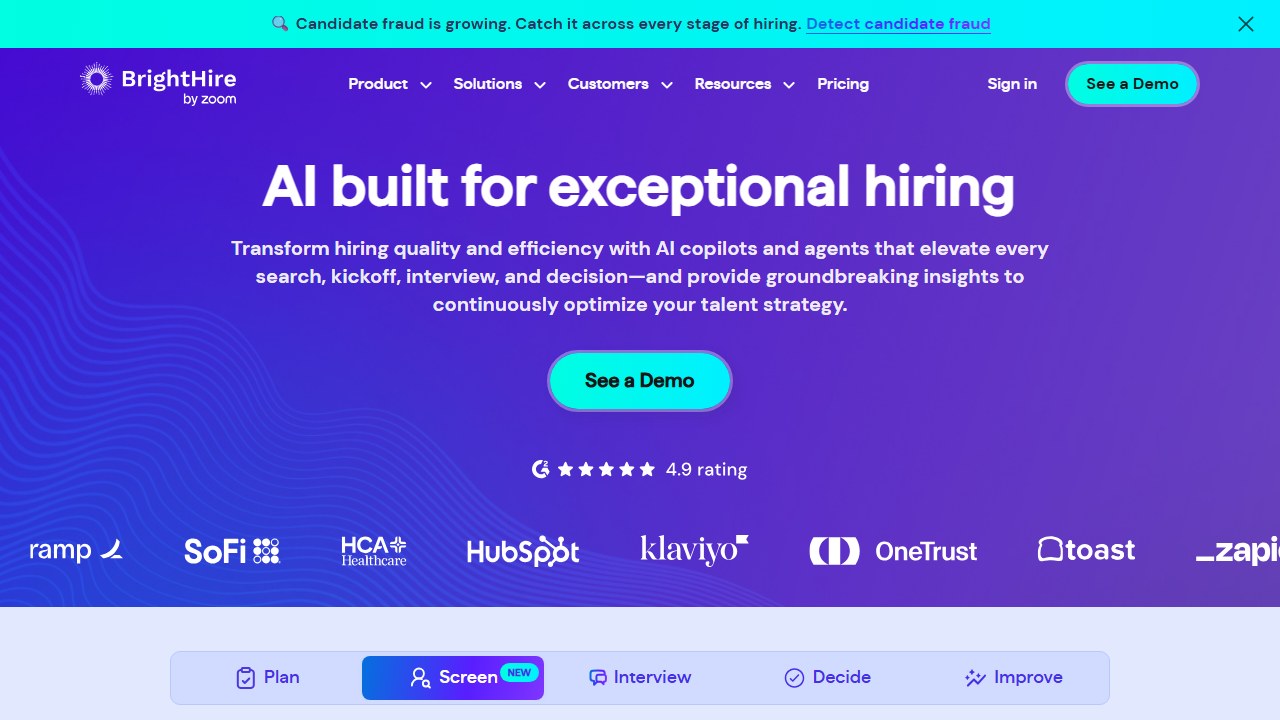
The AI handles transcription, highlight extraction, and structured evaluation prompts that nudge interviewers toward consistency and fairness. For teams whose interviews are inconsistent (different questions, different rigour, gut-feel verdicts), BrightHire makes the process measurable and coachable. It is a focused tool that does one thing well.
- Standout strength: Turns unstructured interviews into structured, reviewable evaluations.
- Pricing: Quote-only.
- Best for: Teams improving interview quality and consistency.
- Verdict: The best dedicated interview-intelligence layer. Score 3.9.
Best by hiring stage
- Sourcing: SeekOut for technical and diversity depth and hireEZ for agentic automation lead our sourcing roundup, with Gem the strongest pick when you want CRM and analytics bundled in. On a budget, Juicebox wins on plain-English search. Our AI sourcing tools guide ranks these head to head.
- Screening: Workable is our number-one screening pick for fast, AI-assisted triage at a public price, with Greenhouse the choice when scorecard-backed structure matters most. For the mechanics, see our AI resume screening tools roundup and the how-to on screening resumes with AI.
- Interview: Metaview is our number-one interview-intelligence pick for turning conversations into structured notes, with BrightHire close behind on consistency and HireVue for enterprise-scale structured video and assessments. More in our AI interview tools guide.
- Full ATS: Greenhouse for structured company hiring, Workable for fast SMB setup, and Manatal for the tightest budget.
- Conversational and high-volume: Paradox is the clear winner for chat, SMS, and WhatsApp screening and scheduling at frontline scale.
Best by team type
| Team type | Recommended pick | Why |
|---|---|---|
| HR-of-one / SMB | Workable or Manatal | Public pricing, fast setup, and enough built-in AI to hire properly without a procurement cycle. |
| Mid-market | Greenhouse or Gem | Greenhouse for structured hiring discipline, Gem when growth depends on outbound sourcing. |
| Enterprise | Eightfold AI or HireVue | Eightfold for skills-based transformation, HireVue for high-volume structured interviewing (read the compliance section first). |
| Staffing agency | hireEZ or SeekOut | Both are built for high-throughput outbound sourcing across large profile pools, which is the agency workload. |
| High-volume hourly | Paradox | Conversational screening and scheduling over chat and SMS is purpose-built for frontline volume. |
Choosing the core system first? Compare the best applicant tracking systems, and if you run an agency, the best AI tools for staffing agencies.
What you will actually pay
This is the part the marketing pages will not show you. Every figure below is a third-party estimate, not a quoted price, and every enterprise vendor here is quote-only. Use these as negotiation anchors, not gospel.
| Tool | Pricing model | Rough annual band (estimate) | Hidden costs to watch |
|---|---|---|---|
| Paradox | Quote-only, no free trial | 25,000 to 60,000 (mid), 75,000 to 150,000+ (ent) | Implementation, integration with your ATS/HRIS |
| Greenhouse | Custom, per-headcount | Mid five figures and up | Add-on modules, premium support tiers |
| Gem | Custom, per-seat plus modules | Mid five figures and up | Per-seat creep as the team grows |
| SeekOut | Quote-only (one ~2,150 Lite tier) | Median contract ~20,000 | Seat minimums, premium data add-ons |
| hireEZ | Quote-only, per-user | ~169 to 250+ per user/mo, median ~13,000 | Contact-data verification you will still need |
| Eightfold | Quote-only, per-employee | ~7 to 10 PEPM; 150,000 to 500,000+ large | Long implementation, change management |
| HireVue | Quote-only | ~35,000 to 145,000 | Implementation fees on top |
| Findem | Custom | Five figures and up | Data and seat scaling |
| Workable | Public tiers | From ~299/mo | Higher tiers for advanced AI features |
| Manatal | Public, per-user | ~15 to 55 per user/mo | Minimal, scales cleanly |
| Juicebox | Public | From ~119/mo | AI agent add-on costs extra |
| BrightHire | Quote-only | Quote-only | Per-seat and recording-volume scaling |
The pattern is consistent: the more genuine the AI, the more likely the price is hidden and the larger the implementation tail. Tools with public pricing (Workable, Manatal, Juicebox) are not less capable for their tier; they are just less afraid of you knowing the number. If you want to start with no spend at all, our free AI recruiting tools guide covers what you can actually do for zero dollars.
AI claims vs reality
| Marketing claim | What it literally does | Where a human is still needed |
|---|---|---|
| “AI screens your candidates” | Parses resumes and ranks them on criteria overlap, sometimes with a learned model | A person reviews the shortlist and decides who advances |
| “AI sources the best talent” | Searches large profile pools and ranks by fit signals | A recruiter validates fit and writes or approves outreach |
| “AI interviews candidates” | Records, transcribes, and scores answer content via NLP, or runs a chat flow | A human evaluates and makes the hire/no-hire call |
| “Autonomous / agentic recruiting” | Runs multi-step sourcing and outreach with limited steering | A person sets guardrails, reviews output, and owns decisions |
| “Skills inference” | Predicts likely skills from work history using a model | A human confirms the inference against reality before acting |
The honest takeaway: in 2026, AI recruiting software is excellent at surfacing, summarising, and ranking, and it is not trusted (legally or practically) to decide. Any vendor implying otherwise is selling you risk.
Compliance, bias, and the law
This is the section that should slow you down before you sign anything. AI that ranks or filters people is now squarely inside several legal regimes, and “the vendor said it was compliant” is not a defence if your hiring outcomes are challenged. We are framing this fairly, not as fear-mongering, but the obligations are real.
NYC Local Law 144. Since July 2023, New York City has required employers using automated employment decision tools to commission an annual independent bias audit, publish the results, and notify candidates. Enforcement is tightening through 2026. If you hire in NYC and your tool ranks or scores candidates, you need a current third-party audit on file, and you should ask vendors to provide theirs.
EEOC and the four-fifths rule. Under US federal guidance, a selection process that results in a selection rate for a protected group below four-fifths (80 percent) of the highest group’s rate can be evidence of adverse impact. This applies whether a human or an algorithm did the selecting. You must monitor your actual outcomes, because a model can produce adverse impact even when it never sees a protected characteristic.
GDPR Article 22. For EU candidates, individuals have the right not to be subject to a decision based solely on automated processing that produces legal or similarly significant effects. In plain terms: you cannot let the AI auto-reject EU applicants without meaningful human involvement. Build a human review step and document it.
EU AI Act. Recruitment and candidate-evaluation AI is classified as high-risk under the EU AI Act, which brings obligations around risk management, data governance, transparency, human oversight, and record-keeping. If you operate in or hire into the EU, treat any ranking or scoring tool as a high-risk system and demand the vendor’s conformity documentation.
The Eightfold lawsuit. A proposed class action, Kistler and Bhaumik v. Eightfold, was filed on January 20, 2026, alleging Fair Credit Reporting Act (FCRA) violations tied to Eightfold’s candidate-evaluation technology. The case is unresolved and the allegations are not findings. We are not telling you to avoid Eightfold, which remains the most capable skills-inference platform in this guide. We are telling you that if you run automated candidate ranking, FCRA, the bias-audit laws, and your own outcome monitoring are now your problem too, and you should plan for them regardless of which vendor you pick.
The practical posture: keep a human at every decision point, commission your own bias audit rather than relying solely on the vendor’s, monitor your real selection rates, and keep records. Done right, these tools reduce bias relative to unstructured human judgement. Done carelessly, they industrialise it.
How to run a pilot
Do not buy off the demo. Run a structured pilot and watch for the red flags.
Demo and pilot checklist:
- Ask the rep to name which features are trained models and which are rules engines. Honest answers are short.
- Request the most recent independent bias audit and the vendor’s EU AI Act conformity documentation, if you hire in those jurisdictions.
- Get implementation fees, per-seat cost at next year’s headcount, and the renewal uplift in writing.
- Run the tool on a real, recently filled role and compare its shortlist to who you actually hired.
- Test the integrations that matter (ATS, HRIS, calendar) with your real data, not a sandbox.
- Confirm there is a human review step before any rejection, and that it is enforced, not optional.
- Check candidate-side experience and accessibility, including captioning and screen-reader support.
Red flags:
- “AI” used as a noun with no model ever named.
- Refusal to share a bias audit or any explainability documentation.
- Pricing that will only be revealed after a multi-week sales process.
- Any feature that auto-rejects candidates with no human in the loop.
- Contact-data accuracy claims with no way to verify before you pay.
- A security or privacy incident the vendor downplays rather than explains.
The bottom line
AI recruiting software in 2026 is genuinely useful and genuinely oversold at the same time. The category is excellent at sourcing, summarising, scheduling, and ranking, and it is nowhere near ready (or legally allowed) to make the hiring decision for you. Most of the “AI” you will be pitched is automation with a new label, and that is fine as long as you do not pay an AI premium for it.
Our picks: Greenhouse for structured company hiring and our highest-scored tool overall, Gem and hireEZ for outbound sourcing, Paradox for high-volume hourly hiring (with the Workday acquisition and security incident noted), Eightfold for enterprise skills transformation (read the lawsuit context first), and Workable or Manatal for lean teams that want a real tool at a public price.
Whatever you choose, keep a human at the decision point, get your own bias audit, insist on the real total cost in writing, and treat every “contact sales” button as the start of a negotiation, not the end of one.
More AI tool guides worth reading: Bullhorn Review, Lever Review and Greenhouse Review.
More AI tool guides worth reading: Best Employee Engagement Software and Best AI Performance Management Software.

Written by
FazFaz is the founder of AIToolsBakery. Some tools here are tested hands on. Others are assessed from vendor documentation and pricing verified on the live page, and every review says which one it is. Sponsors can buy a position in a guide. They cannot buy the score, the criticism, or silence about a better option.
How we test and how we make money →